Protecting Children’s Teeth: Sealants Explained

Usually, Parents want simple, proven ways to keep little smiles healthy. Dental sealants deliver exactly that. In addition, they act like tiny raincoats for the grooves of your child’s back teeth, and they block the bacteria & acids that start tooth decay. Therefore In this guide from White Swan Dental Clinic, you’ll learn what sealants are, how they work, when kids should get them, and why they’re one of the smartest preventive choices a family can make. Get details on Dental Clinic in Business Bay

What Are Dental Sealants?

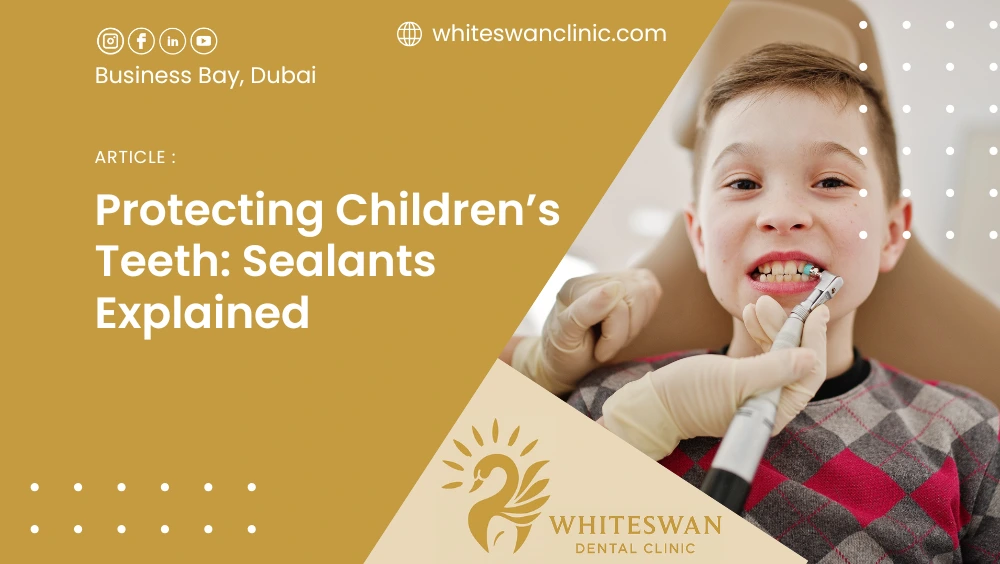
Apparently and in simple words , dental sealants are ultra-thin, protective coatings painted onto the chewing surfaces of molars and premolars. Just so those back teeth contain deep fissures & pits, toothbrush bristles often can’t reach every nook. As a result , cavities form because plaque hides there . Because of which A sealant flows into those grooves and hardens, creating a smooth, easy-to-clean surface.

Why Children Benefit the Most

Kids snack frequently, love sticky treats, and still master brushing. As a result , their back teeth are the first to struggle. Even though fluoride strengthens enamel across the whole tooth, sealants specifically protect the most cavity-prone areas. Together , they provide a strong one-two punch against tooth decay.

On top of that , research shows that sealed teeth experience far fewer cavities than unsealed teeth especially in the first two years after placement when new molars face the highest risk. 

How Sealants Work Step by Step

At White Swan Dental Clinic, the procedure is quick, comfortable, and kid-friendly:

  1. Clean: Apparently, We thoroughly polish the tooth to remove plaque.
  2. Isolate: We keep the tooth dry with a small shield or cotton .
  3. Condition: Moreover, A gentle gel prepares enamel so the sealant bonds tightly.
  4. Dry & Rinse: Besides this we rinse the gel away and also dry the tooth completely.
  5. Cure & Paint : In addition We brush on the sealant material. After that we use a special light to harden it in seconds.
  6. Check the Bite: We make sure everything feels natural.

That’s it no discomfort, no needles, and no drilling,. Usually Kids say the process feels like “painting their tooth.” 

What Are Sealants Made Of?

Apparently Most modern sealants are tooth-colored resins designed to flow into microscopic grooves. Moreover Many are BPA-free once cured, and all undergo strict safety testing. Because of which For children with high cavity risk or where moisture control is tricky, most of the dentists may choose glass ionomer sealants, which can release fluoride over time. As a result, your pediatric dentist will recommend the best option. Get details on Get details on Root Canal Treatment in Dubai.

When Should Children Get Sealants?

Timing matters. Because new molars have the deepest grooves just after they erupt, we suggest:

  • First permanent molars: usually erupt around ages 6–7
  • Second permanent molars: usually erupt around ages 11–13
  • Premolars: considered case-by-case, depending on groove depth and risk

As a result ,If your child has baby molars especially with deep pits, usually we may also recommend sealants earlier to prevent cavities before permanent teeth arrive.

Who Is a Good Candidate?

Usually Sealants help most kids, but they’re particularly helpful if your child:

  • Mainly it your child Has a history of tooth decay or cavities in baby teeth
  • If your child have the habit of Snacking frequently on sticky sweets or carbohydrates
  • Apparently Struggles with brushing or flossing 
  • Has deep pits and fissures visible in the molars
  • If your kid Has orthodontic appliances that complicate hygiene

Additionally Even a cavity-free child benefits since sealants act proactively, not reactively.

Benefits You Can See & Count

  • Powerful prevention: In addition They protect the exact spots where decay strikes first.
  • Pain-free application: no shots, No drilling.
  • Cost-effective: Apparently Preventing one cavity normally costs less than filling one later.
  • Long-lasting: usually  With good care, sealants protect for 4–7 years, sometimes longer than that .
  • Tooth-colored: usually  They’re nearly invisible, so kids feel confident.

Are Sealants Safe?

Yes. Apparently, Dental sealants have been used safely for decades. While you may read about BPA concerns, levels after placement are extremely low and drop quickly as the material fully cures. In fact, a child’s routine exposure to BPA from everyday items often exceeds any brief exposure from a sealant appointment. Therefore If you still worry, ask us about BPA-free formulations.

Fluoride vs Sealants : Better Together

Mostly, parents ask whether fluoride makes sealants unnecessary. Usually The answer is no; because they protect differently. Apparently Fluoride strengthens the whole enamel surface, while sealants shield the grooves where bacteria hide. Because of which , pairing water, varnish, or fluoride toothpaste, with sealants gives your child the broadest protection. Get details on Dental Checkup in Business Bay.  

Caring for Sealed Teeth

Good news: sealed teeth don’t require special routines. Anyhow, a few habits keep protection at its best:

  • Apparently You should Brush twice a day  with a fluoride toothpaste
  • You can Floss daily to clean between teeth
  • You must Limit sticky candies & sugary snacks
  • you can Schedule checkups every six months so that we can inspect the sealants

Additionally, If a sealant wears or chips , we simply touch it up. Therefore The fix is affordable, comfortable, and quick,.

What About Insurance & Cost ?

Since sealants prevent cavities, many dental plans cover them for children on permanent molars. Moreover, Even without coverage, families usually find that sealants cost less than future dental repairs. Therefore At White Swan Dental Clinic, we provide clear estimates, discuss benefits upfront, and help you choose the best timing for your budget & your child .

Common Myths– Busted

  • “sealants aren’t needed because my child brushes well, .” But that’s not the reality, Even excellent brushers miss microscopic grooves; sealants usually  protect those areas anyway.
  • “Sealants feel bulky.” Once cured, they feel natural & smooth .
  • “They don’t last long.” But in contrast to that, With routine care, many sealants can be refreshed easily & last several years .
  • “They’re only for kids with cavities.” In reality , sealants help kids keep that cavity-free record intact.

The White Swan Dental Clinic Difference

Parents tell us they love our calm approach and kid-friendly flow. Moreover We celebrate their bravery with small rewards, show children the “blue light,” & “paintbrush” and explain every step,. Most significantly, we personalize recommendations to your cavity risk, dental history, & child’s diet,. As prevention should feel personal, we never take a one-size-fits-all route. Looking for a Best clinic for Tooth Removal?

Quick Takeaways for Busy Parents

  • Seal early: you should make sure to Protect new molars as soon as they erupt.
  • Pair with fluoride: Use both for maximum defense.
  • Keep up checkups: We’ll monitor and maintain sealants as your child grows.

Act now: The easiest cavity to treat is the one that never forms.

Related Articles:

» Orthodontics for Kids: Best Timing

» First Dental Visit: Dubai Parent’s Guide

» Causes of Toothache and Quick Relief

» How to Remove Dental Stains Safely?

» Early Orthodontic Evaluation for Kids

Ready to Shield Your Child’s Smile?

Prevention should be simple, gentle, and effective. Dental sealants are all three. When you combine them with fluoride, smart snacking, and consistent home care, your child gets strong protection where it matters most. consequently If you’d like personalized guidance, the team at White Swan Dental Clinic is here to help, since healthy habits today build confident smiles for years to come.

FAQs: Protecting Children’s Teeth

1) What  do dental sealants do?

Usually  they seal the deep grooves on molars where bacteria hide, so plaque & food can’t start & settle tooth decay.

2) Do sealants hurt?

No. We simply clean, dry, paint the sealant, and cure it. Kids usually feel nothing besides gentle air and water.

3) How long do sealants last?

They typically protect for 4–7 years. We check them at each visit and reapply if needed.

4) Are sealants safe for my child?

Yes. Modern materials are rigorously tested. We can also use BPA-free choices if you prefer.

5) Will my child still need fluoride?

Absolutely.  Usually Fluoride strengthens the entire tooth. Also Sealants protect the grooves. Moreover Together, they offer broader protection.

6) Which teeth should be sealed first?

You can apparently begin with the first permanent molars around ages 6–7, after that the second molars (around 11–13).consequently  We’ll evaluate premolars as needed.

7) Can baby teeth get sealants?

Sometimes.  Moreover, If a baby molar has very deep fissures & pits or your child has a high cavity risk, sealants can help.

8) What if a sealant chips?

We repair or replace it quickly. The touch-up is simple and comfortable.

9) Do sealants change how teeth look or feel?

They’re tooth-colored and smooth. Most children don’t notice them after placement.

10) Are there foods my child should avoid after sealants?

Your child can eat normally right away. Nevertheless, minimizing very sticky candies protects both sealants and overall oral health.

11) Will insurance cover sealants?

Many plans cover them for kids’ permanent molars. Our team at White Swan Dental Clinic will review your benefits before treatment.

12) How do I know if my child needs them now?

Apparently, If a molar recently erupted or your child gets frequent cavities, now is the ideal time. Therefore Book a checkup so we can assess the grooves and cavity risk.
First Dental Visit: Dubai Parent’s Guide

Apparently,For many families, the first dental visit in Dubai feels like a big milestone equal parts nerve-wracking & exciting . Although , with a friendly clinic & the right preparation, that first appointment becomes a positive memory that sets the tone for a lifetime of healthy smiles. Because of which At White Swan Dental Clinic, our pediatric team welcomes little ones with playful energy,patience, and warmth. More significantly, we guide parents step by step so you always know what’s next. Get details on Dental Clinic in Dubai.  

Why the First Visit Matters

Usually children build habits early. As a result , when they enjoy their first appointment, they’re more likely to keep up with daily brushing & regular dental check-ups . Besides this , early assessments help us spot concerns such as bite problems,early cavities,lip-tie or tongue-tie, and enamel defects,. Hence , your child gets timely, gentle care instead of stressful, last-minute fixes.

When to Book Your Child’s First Dental Visit

Globally, pediatric bodies recommend “first visit by first birthday or within six months of the first tooth.”Usually In Dubai, that timing works beautifully too, especially given the frequent snacks,sticky & sweet, celebrations. Ideally,schedule first appointment when your child is well-rested and fed. On top of that , aim for a time of day when your little one typically feels calm & curious .

What Happens at White Swan Dental Clinic

Needless to say , parents want to know exactly what the first visit includes. Therefore Here’s our friendly, step-by-step flow:

  1. A warm hello
    Initially, our reception team offers a cozy space with books & toys,confirms basic details, and greets your family,. Since comfort matters, we keep wait times short.
  2. Meet the pediatric dentist
    After that , your child meets the dentist in a calm, colorful room designed for kids.consequently We explain everything in cheerful, age-appropriate language.
  3. chair ride or Knee-to-knee exam
    For toddlers & infants , we often use a knee-to-knee exam with you present. At the same time , older kids may take a “chair ride” to explore gadgets. Significantly , we look for plaque,check gums & tongue, and count teeth,.
  4. Gentle cleaning (if appropriate)
    When needed, we do a quick polish to demonstrate brushing techniques & remove plaque . In addition , we may apply topical fluoride to protect enamel.
  5. Bite and growth check
    We Usually evaluate oral habits (pacifier use,thumb sucking,) bite alignment, and,spacing,. Therefore If we see early crossbite or crowding , we normally note it for future monitoring.
  6. Personalized guidance
    In the end , we cover scheduling your next children’s dental check-up,injury prevention,bottle & sippy-cup tips,snack ideas, and brushing routines. Get details on Root Canal Treatment in Dubai

How to Prepare Your Child & Yourself:

Apparently,Preparation reduces anxiety dramatically. Try these parent-tested tips:

  • Talk positively:
    Use upbeat words like “tooth counting” and “shine.” Avoid scary terms. Also , share your own calm confidence children mirror your mood.
  • Practice at home:
    you can do role-play of a mini check-up in front of a toy mirror. Additionally, read a short story about visiting the kids dentist. This playful repetition builds familiarity.
  • Choose comfort items:
    Bring a favorite blanket or plushie . On top of that , pack a snack and water for after the visit.
  • Plan your timing:
    Schedule when your child is fresh—morning often works best. Also, keep the day’s calendar light so nobody feels rushed.

Dubai-Specific Considerations Parents Ask About

billing &Insurance : usually Dubai offers a wide range of insurance plans. Because of which , check your policy for X-rays ,fluoride,& pediatric dentistry coverage, . Consequently,our team helps you understand claim co-pays & codes before treatment begins.

cavities & Diet: usually  Many families enjoy celebratory sweets juices, and dates,. While these are part of local culture, they can feed cavity-causing bacteria. Therefore , keep sweets with meals,limit grazing, and offer water after snacks, whenever possible.

hydration & Climate : since Dubai is warm, children typically sip all day. Nonetheless, try to reduce sugary drinks in sippy cups or bottles . Moreover, Prefer water especially between meals.

Languages & comfort: Dubai is wonderfully multicultural. At White Swan Dental Clinic, our staff communicates clearly and kindly. In addition, we use visual aids so kids grasp each step regardless of language. Get details on Teeth Whitening near Business Bay.  

Common Treatments for Young Children

  • Fluoride varnish: usually,Strengthens enamel quickly & safely.
  • Fissure sealants (((when age-appropriate))): They are ,Thin protective layers on chewing surfaces to block bacteria.
  • Silver diamine fluoride (SDF):Apparently, In special cases, this liquid can arrest early decay painlessly.
  • Space maintainers:usually these devices keep space for the adult tooth, If a baby tooth is lost early,.
  • Behavior guidance: rewards,distraction, and Tell show do, build cooperation without pressure.

Since prevention always beats repair, our team prioritizes minimally invasive care,coaching, and guidance, 

X-Rays: When & Why

Parents often ask about X-rays . We only take digital X-rays when clinically necessary—usually to check between teeth, confirm tooth development, or assess trauma. Thanks to modern sensors and shielding, exposure remains very low. Moreover, we follow strict, evidence-based intervals tailored to your child’s risk level.

Anxiety-Friendly Dentistry

Apparently,even resilient kids can feel nervous. Because of which , we use kid-centric strategies:

  • Tell-Show-Do: We demonstrate, explain, and after that proceed.
  • Positive reinforcement: praise,certificates, & Stickers,.
  • Parental presence: For young children, your calm presence helps.
  • Comfort techniques: Slow breathing, music, and “count-with-me” games.
  • Sedation (only if needed): For extensive treatment or special health needs, we discuss safe options in detail and obtain informed consent. Looking for a Teeth Cleaning and Polishing?

Building Daily Habits at Home

Consistency turns tiny actions into powerful protection:

  • Apparently brush twice a day with a pea-sized amount or smear of fluoride toothpaste based on your age.
  • Floss nightly once teeth touch.
  • Offer tooth-friendly snacks: veggies,nuts,fruits,yogurt,, & cheese,.
  • Prefer water over juice between meals.
  • You should replace toothbrushes after illness or every 3 months.
  • you can Schedule regular check-ups every 6 months, or as advised.

Why Choose White Swan Dental Clinic

Usually Parents tell us they love our pediatric dentist in Dubai team for three reasons: practical guidance,clear communication, and gentle care,. Besides this, , we value a child-friendly environment, transparent fees, and punctuality,. Most significantly, we partner with you since your child’s smile deserves a thoughtful, customized plan.

Related Articles:

» Causes of Toothache and Quick Relief

» How to Remove Dental Stains Safely?

» Orthodontics for Kids: Best Timing

» Post-Whitening Care and Maintenance

» How Often Should You See a Dentist?

Quick Checklist for Parents

  • Apparently Book the first dental visit by age one.
  • You can Choose a kids dentist in Dubai with child-friendly rooms.
  • Bring comfort item & insurance details.
  • Use role-play at home & positive language .
  • Prioritize water, flossing, & fluoride toothpaste,.
  • Keep regular children’s dental check-ups on your calendar.

Your Next Step

Apparently, If you’re ready to make that first appointment, White Swan Dental Clinic would love to welcome your family. Since the first visit shapes future habits, let’s start strong with a care plan built just for your child, clarity, and kindness,.

FAQs: First Dental Visit in Dubai

1) When to  book my child’s first dental visit?

By the first birthday or within six months of the first tooth. Earlier is better for prevention and habit-building.

2) How long does the first appointment take?

Typically 30–40 minutes. However, we move at your child’s pace so the experience stays positive.

3) Is it necessary to take my child’s  X-rays on the first visit?

Not usually. Mostly we take digital X-rays if there’s a clear reason, such as suspected cavities between teeth,tooth development concerns, or trauma.

4) What if my child is scared?

That’s common. We use gentle behavior guidance, Tell-Show-Do, and parental presence. Additionally, we always pause if your child needs a moment.

5) Do you accept insurance?

Yes, we work with many Dubai insurers. Moreover Bring your policy details & card; consequently we’ll help you understand coverage before any treatment.

6) Is fluoride treatment  safe for young children?

Yes. Usually Topical fluoride is safe, quick, and highly effective,, at avoiding  cavities when used as directed during application.

7) What are the remedies for preventing  cavities at home?

Offer water between meals, limit sugary snacks, floss once teeth touch, and Brush twice daily with fluoride toothpaste,. Also Regular children’s dental check-ups matter, too.

8) My child loves juice. Any tips?

You can usually switch to water between meals, keep portions small, and Offer juice with meals only,. On top of that , avoid sending children to bed with anything but water.

9) Define dental sealants?

Usually Fissure sealants are protective coatings placed on chewing surfaces to block bacteria & food. Therefore They are highly preventive & painless when indicated.

10) What to do if my child gets a chipped tooth after a fall?

you can Call us immediately. Also visit the clinic,apply a cold compress, and Save any fragments in milk,. Consequently Prompt evaluation reduces complications.

11) Does thumb sucking have an adverse effect on teeth?

Apparently, Prolonged habits can influence jaw growth &  bite. Because of which We monitor alignment over time & guide gentle habit-breaking strategies.

12) How often  shall we come back after the first visit?

Usually   every six months. Nevertheless  , if your child has higher cavity risk, we might suggest more frequent reviews.

Deep Cleaning vs Routine Scale & Polish—What You Need and When

Apparently, At White Swan Dental Clinic, patients often ask whether they need routine scale and polish orca deep cleaning . Both treatments remove tartar & plaque , yet they serve different purposes, suit different stages of gum health & target different areas, . Therefore This guide breaks down what each service involves, when each is recommended, and how to keep your smile bright and gums healthy for the long haul. Get details on Dental Clinic in Dubai

Quick Definitions (So You Know the Difference)

  • Routine Polish & Scale : A preventive hygiene visit that removes soft plaque and hard tartar above the gumline, after that polishes teeth to reduce future buildup & smooth surfaces . Consequently It’s part of regular dental hygiene maintenance,comfortable, and fast,.
  • Deep Cleaning (Root Planing & Scaling ): A therapeutic procedure for gum disease. Moreover,Your hygienist or dentist cleans below the gumline to remove infected deposits and then smooths the roots (root planing) therefore gums can reattach. Consequently,It’s completed by quadrant or area & may involve numbing for comfort.

How Plaque Becomes a Problem

Initially comes sticky plaque,a film of bacteria that forms all day, every day. Moreover,If it isn’t brushed and flossed away, it hardens into tartar (calculus). And ,Tartar irritates the gums and can trigger gingivitis (bleeding gums,swollen,red,). Left unchecked, gingivitis can progress to periodontitis, where the bone supporting the teeth is affected. Therefore at that point, a simple polish won’t be enough this is when a deep cleaning is indicated.

When a Routine Scale & Polish Is Exactly Right

Choose a routine scale and polish when:

  • Apparently when you attend regular check-ups your gums don’t bleed routinely.
  • Your hygienist notes shallow pockets (3 mm or less) &,minimal tartar
  • When You want to smooth light surface stains & freshen bad breath .
  • Usually when You’re maintaining results after previous periodontal therapy.

Since this treatment focuses on above-the-gum deposits, it’s comfortable and quick. On top of that , the polishing step helps resist new plaque accumulation, so your teeth feel cleaner for longer. Get details on Dental Checkup in Business Bay.  

Signs You May Need a Deep Cleaning

Apparently Consider a deep cleaning also called scaling and root planing when you notice:

  • Bleeding gums during flossing or brushing .
  • Persistent bad breath that mouthwash won’t fix.
  • Shifting teeth,tooth looseness, or Gum recession,.
  • Pus near the gumline,swelling, or Tender gums,.
  • Your dentist measures periodontal pockets greater than 4 mm.

In these cases, bacteria have moved below the gumline. Because of which , simply polishing the tooth surface won’t remove the cause of inflammation. A deep cleaning treats the infection source directly.

What Actually Happens During Each Treatment

Routine Scale & Polish: Step by Step

  1. Assessment: We discuss any concerns & review your oral health .
  2. Scaling: hand instruments & Ultrasonic remove tartar & plaque from visible surfaces.
  3. Polish: A gentle polish smooths enamel, lifting light stains from wine,coffee, or tea,.
  4. Advice/Fluoride: You may receive personalized oral hygiene coaching & fluoride .

Deep Cleaning: Step by Step

  1. Diagnosis & Charting: We evaluate bleeding points & measure pocket depths .
  2. Local Anaesthetic: Selected areas are numbed for comfort.
  3. Scaling: usually Instruments remove deep deposits below the gumline.
  4. Root Planing: We smooth the root so inflamed tissue can reattach & heal.
  5. Re-evaluation: After healing, we adjust your periodontal maintenance plan & re-measure pockets .

Healing,Sensitivity & Comfort, 

Apparently A scale and polish rarely needs numbing and typically causes minimal sensitivity. Anyhow , deep cleaning may involve anaesthetic procedure since we’re working under the gums. Therefore You might feel mild tenderness for a day or two; careful brushing,soft foods, and saltwater rinses, help. Significantly , sensitivity typically eases as roots are cleaner & inflammation settles. Get details on Teeth Whitening near Business Bay

Results You Can Expect

  • Routine scale & polish: easier brushing,less stain,fresher breath, and smoother teeth,. As a result , your daily routine becomes more effective.
  • Deep cleaning: improved breath,firmer gums,shrinking pocket depths, & Reduced bleeding,. In the course of time , you can protect the bone that supports your teeth & stabilise periodontal disease. 

How Often Should You Have Each?

  • Routine scale & polish: Most people do well every 6 months. If you build up tartar quickly or have previous issues, every 3–4 months may be wiser.
  • Deep cleaning: Usually completed over 1–2 visits per side of the mouth.Next , periodontal maintenance (every 3–4 months) which helps to keep gum disease under control.

Value & Cost:- Thinking Long-Term

Usually a routine scale & polish is a low-cost investment in prevention. At the same time , a deep cleaning costs more since it’s more detailed,numbed, & longer,. Yet the value is significant: treating periodontitis early reduces the risk of tooth loss, extensive restorative work, and ongoing discomfort. Consequently , timely therapy & prevention saves you stress,money, and time,.

Home Care That Supercharges Your Results

Since professional care works best alongside daily habits, here’s what to focus on:

  • Two-minute brushing, twice a day , with an electric toothbrush or a soft brush .
  • Gentle technique along the gumline & Fluoride toothpaste .
  • Daily interdental cleaning with interdental brushes or floss sized for your spaces.
  • Mouthwash as advised but never as a substitute for flossing or brushing .
  • No smoking,water after sugary snacks, or acidic drinks and Balanced diet,.

Usually Better home care means calmer gums & fewer deposits; because of which , both scale & polish and deep cleaning deliver longer-lasting benefits. Looking for a Teeth Cleaning and Polishing

Which One Do You Need Today?

  • If your last check-up was clear & your gums don’t bleed , a routine polish & scale is likely enough.
  • If you’ve noticed gum tenderness,bad breath, or, bleeding, especially if it’s still persistent ask about an examination for deep cleaning.
  • If you’ve already had periodontal therapy, it is apparently best to stick with periodontal maintenance for keeping the results stable.

Not sure? Additionally you can Book a gum assessment at White Swan Dental Clinic. Consequently We’ll recommend explain, & measure the right treatment not more, not less.

Related Articles:

» Post-Whitening Care and Maintenance: Keep Your Bright Smile Longer

» How to Remove Dental Stains Safely?

» Post-Whitening Care and Maintenance

» Laser Teeth Whitening Pros and Cons

» How Often Should You See a Dentist?

Final Takeaway

To conclude,Think of routine polish & scale as your six-month deep cleaning & tune-up as targeted therapy when gums need more help. Therefore,Together with regular check-ups,interdental cleaning, and daily brushing, these treatments protect your confidence,breath, and teeth,.

Are you Ready to find out what you need now? Then you should Book a gum health assessment at White Swan Dental Clinic . Consequently,We’ll recommend the right care,explain pocket measurements, and examine your gums, so your smile stays future-proof,fresh, and stable,.

FAQs: Deep Cleaning vs Routine Scale & Polish

1) Is a deep cleaning the same as a scale and polish?

No. A scale and polish cleans above the gumline and polishes enamel. A deep cleaning removes deposits below the gumline and smooths roots to treat gum disease.

2) Does a deep cleaning hurt?

We numb the area, so you should feel pressure but not pain. Mild tenderness is common after, yet it settles quickly.

3) How do I know if I need a deep cleaning?

Signs include bleeding gums, persistent bad breath, gum tenderness, loose teeth, and measured pockets over 4 mm.

4) Can a scale and polish cure gum disease?

It prevents issues and treats early inflammation, but established periodontitis needs a deep cleaning.

5) How long does each treatment take?

A scale and polish often takes 20–40 minutes. A deep cleaning is longer and may be split into quadrants for comfort and precision.

6) Will my teeth feel sensitive after?

Possibly, especially after deep cleaning, because roots are newly exposed to a healthy environment. Sensitivity usually improves with time and fluoride care

7) How often should I get a scale and polish?

Typically every 6 months; high-risk patients may benefit from every 3–4 months.

8) Do I still need floss if I get regular cleanings?

Yes. Professional care lowers the bacterial load, but daily interdental cleaning stops quick re-accumulation between visits.

9) Is deep cleaning a one-time fix?

It treats active infection, yet periodontal maintenance is crucial. Because bacteria return, ongoing care prevents relapse.

10) Will deep cleaning make my gums recede?

The procedure doesn’t cause recession; it may reveal recession that was hidden by swollen tissue. As inflammation reduces, gums appear healthier.

11) What if I’m nervous about dental treatment?

Tell us—communication helps. We can slow down, offer additional numbing options, and use gentle techniques to keep you comfortable.

12) How soon can I eat after a deep cleaning?

Once numbness wears off, choose soft foods and lukewarm drinks for the first day. Avoid smoking and very hot or spicy foods initially.

How Long Does Invisalign Take?

Apparently,If you’re considering Invisalign to straighten your smile, one question usually comes first: how long does Invisalign take? Intelligably so,time matters. Moreover You want a smooth journey, realistic expectations, and a clear plan, from first scan to final retainer. Therefore In this guide, you’ll learn the typical Invisalign treatment time, the key factors that speed it up (or slow it down), and what to expect at White Swan Dental Clinic from day one. Finally, you’ll know exactly how your commitment translates into results.

Typical Invisalign Timelines

Although every smile is unique, most adults finish Invisalign in 6–18 months. Many mild cases wrap up closer to 6–9 months, while more complex tooth movements can stretch toward 12–18 months. Teens often follow a similar window; however, timing varies with growth and cooperation. Significantly, wear time determines everything usually 22 hours per day is the gold standard. Therefore When you wear your clear aligners as directed, your teeth track efficiently and your timeline stays on target. Get details on Dental Clinic in Dubai.

First, How Invisalign Actually Works

Apparently Before we talk speed, let’s clarify the mechanics. Usually Invisalign uses a series of custom, removable aligner trays that apply gentle, targeted forces. Moreover You’ll switch to a new set about every 7–14 days, depending on your plan. Therefore each set nudges teeth a fraction of a millimeter. Since movement is incremental, consistency is everything. Consequently, attend reviews,change them on schedule, and Wear the trays,.In short,Do those three, and the clock stays friendly.

What Affects Your Invisalign Timeline?

Apparently Several variables influence Invisalign duration. Therefore Here’s what makes the difference—and how you can stay on track.

  1. Case Complexity
    • Mild crowding/spacing (≤3 mm): often 6–9 months.
    • Moderate spacing/crowding (3–5 mm): normally 9–15 months.
    • Complex bites (rotations,open bite,crossbite,,deep bite, ): expect 12–18+ months.
      As complexity rises, so does the number of aligner sets and fine-tuning steps.
  2. Daily Wear Time (Compliance)
    You’ll hear it often because it matters most: keep trays in 22 hours daily. Take them out for meals and brushing, then put them back. Missed hours push teeth off their “tracking,” which adds refinements and extra weeks.
  3. Attachment Use
    Small, tooth-colored Invisalign attachments act like handles, guiding precise movements. On top of that They may look subtle, yet they boost control. As a resultWith better control, movements complete in fewer attempts saving time overall.
  4. Age and Biology
    Teeth move in adults and teens alike, but biology varies person to person. Some respond quickly; others need a touch more time. Nonetheless, consistent wear still outruns biology in importance.
  5. Oral Hygiene & Habits
    Usually  Great hygiene keeps gums healthy, which supports efficient tooth movement. Alternatively ,inflammation or irritation can slow things down. Therefore ,clean your aligners regularly, floss, and brush,.
  6. Tech & Check-Ins
    Regular reviews done via in-clinic or virtual let us catch issues early and keep you on schedule. ThereforeAt White Swan Dental Clinic, we pair precise digital planning with attentive follow-ups to minimize detours. Looking for a Teeth Cleaning and Polishing?

Complex vs Moderate vs Mild : Realistic Ranges

Since estimates help you plan, here’s a practical breakdown:

  • Mild crowding or spacing :
    Usually you can expect around 10–20 aligners and 6–9 months of wear. Moreover With consistent 22-hour compliance, you might finish on the early side.
  • Moderate corrections:
    You can Plan for roughly 20–30 aligners and 9–15 months. Therefore You may need a short refinement phase an additional mini-series of trays for the last 5–10% of perfecting.
  • Complex bite issues or rotations:
    Usually  Anticipate 30+ aligners and 12–18 months (sometimes longer). elastics,precision cuts, & Attachments, may be part of your plan to achieve stable, functional results.

Teens vs Adults:- Is There a Difference?

Typically , Invisalign for teens & Invisalign for adults takes a similar length of time. However, teens sometimes enjoy a slight biological advantage due to ongoing growth. On the other hand, adults usually excel in consistency—especially with wear time and hygiene. Either way, cooperation wins. When trays go back in right after meals, treatment stays brisk. Get details on Teeth Whitening near Business Bay.

Can You Speed Up Invisalign?

You can—responsibly. While we never rush biology, smart habits and modern tools help:

  • Perfect Compliance: Keep aligners in 22 hours daily. This remains the fastest, safest accelerator.
  • Switch on Schedule: Move to the next set only when approved.
  • Address Fit Early: In addition If an aligner stops “seating,” or feels loose use chewies as directed and let us know quickly.
  • Lifestyle Tweaks: you can reduce frequent snacking (fewer tray removals) and sip plain water when aligners are in.
  • Tech-Assisted Planning: consequently Digital precision & planning attachments keep your case efficient & reduce trial-and-error .

Your Invisalign Journey at White Swan Dental Clinic

Here’s how we structure care so your timeline stays clear and predictable:

  • Comprehensive Consultation

Usually  We assess your bite,gums, and smile,, after that discuss timelines & goals consequently . consequently You’ll hear a realistic range, not a sales pitch.

  • 3D Digital Scans & Planning

Usually We capture accurate scans and craft a staged Invisalign treatment plan. Finally,You’ll preview projected tooth movements and estimated treatment time before we start.

  • Instructions,Attachments, & Fitting, 

After that, we teach you aligner change schedules,cleaning, & wear,deliver your first sets, and place any needed attachments.

  • Regular Reviews

Usually Quick check-ins verify tracking. Moreover If something drifts, we avoid bigger delays later & correct early.

  • Refinements When Needed

Consequently, minor refin, ements fine-tune results so your bite feels as good as it looks.

  • Smile Protection & Retention

Usually  After active treatment, we provide retainers to lock in your new alignment. Consistent retainer wear protects your time investment. Looking for a General Dentistry in Business Bay?

Life With Aligners: Practical Tips That Save Time

  • You should Wear trays 22 hours daily, even on holidays & weekends.
  • Replace aligners on the exact scheduled day. Therefore Set reminders so nothing slips.
  • keep trays clean to maintain gum health,brush before reinsertion, and Rinse after meals,.
  • Carry your aligner case everywhere; napkins “eat” aligners more often than you think.
  • Tell us early if something feels off—early micro-corrections prevent macro-delays.

What Happens After Invisalign?

Although your active Invisalign phase ends, your smile still needs retention. Moreover teeth have memory, so retainers keep them in position while bone and ligaments stabilize. Normally , you’ll wear retainers full-time for a short period, after that nights only long-term. Therefore This final step protects the months you invested & preserves your results.

So,approximately how long does Invisalign take? Normally For most people, 6–18 months. Your exact number depends on complexity, compliance, and smart follow-ups. With precise planning and consistent wear, you move efficiently and predictably. Consequently with the right partner, White Swan Dental Clinic, the process stays clear from the first scan to the last retainer.

Related Articles:

» Causes of Toothache and Quick Relief

» Post-Whitening Care and Maintenance: Keep Your Bright Smile Longer

» How to Remove Dental Stains Safely?

» Laser Teeth Whitening Pros and Cons

» When Should I Have Root Canal Retreatment

Ready to map your exact timeline?

Apparently you can Book a consultation with White Swan Dental Clinic. Consequently We’ll scan, plan, and give you a clear Invisalign treatment time personalized to your goals so that you can start now and smile sooner.

FAQs on “How Long Does Invisalign Take?”

1) Can Invisalign work faster than braces?

Typically, Invisalign runs on a similar schedule to modern braces for comparable cases. Anyhow, many patients progress more smoothly with Invisalign since they follow instructions closely & wear the trays comfortably.

2) Can I finish Invisalign early?

Possibly. If your teeth track perfectly and your clinician approves slightly quicker changes, you might shorten the plan. Nevertheless, never switch trays earlier without guidance—over-speeding risks soreness, poor tracking, and extra refinements.

3) Why did my friend finish in 7 months and I’m at 12?

Different starting points, movements, and biology. Your case might require more rotation, root movement, or bite correction. That said, 22-hour wear keeps you as close to the minimum as your case allows.

4) Will I need refinements?

Maybe. Refinements are common and normal. They provide a few extra aligners to polish final details. Since they’re targeted, they rarely add significant time especially if you’ve worn trays consistently.

5) How long should  I  wear retainers after Invisalign?

Usually you can plan on full-time wear initially, after that nights only long-term. Moreover, as a rule, retainers are a lifelong habit crucial easy, and light, for maintaining your aligned smile.

Cracked Tooth: Repair Options

Apparently,If you noticed sudden sensitivity to cold water, heard a faint “click” when chewing, or felt a sharp zing while biting a seed, you might be dealing with a cracked tooth. Luckily, modern dentistry offers several precise, durable ways to restore comfort & repair cracks . Consequently Below, we’ll walk you through how to spot a crack, what causes it, and most importantly the best treatment options available at White Swan Dental Clinic. However, we’ll keep things practical, so that you can choose the right fix with confidence.

How to tell if you have a cracked tooth

Usually Cracks don’t always scream for attention; they typically whisper. Anyhow , certain clues stand out:

  • Pain on release after biting (you clamp down, it hurts most when you let go).
  • Usually Temperature sensitivity, especially to hot soup or icy drinks .
  • Intermittent discomfort when chewing crusty bread or nuts .
  • A line on the enamel you can see in bright light.
  • Swollen gum around a specific tooth.

Because symptoms vary, professional evaluation matters. At your exam, we use magnification, transillumination, and bite tests to locate the crack. We may also take X-rays to assess the dentin and pulp for deeper involvement. Get details on Dental Clinic in Dubai.

Why teeth crack in the first place

Despite the fact that every case differs, several usual suspects keep showing up:

  • Bruxism: clenching or teeth grinding )usually during sleep.
  • Also Large, old fillings that weaken remaining enamel.
  • Chewing hard objects such as pens,olive pits, or ice,.
  • Temperature swings—like chasing hot coffee with ice water.
  • Trauma from sports or accidents.
  • Natural aging and repeated chewing stress.

Additionally, addressing the cause protects your repair. Moreover For example, if bruxism caused the damage, a custom night guard becomes part of your long-term plan. Looking for a Preventive Dentistry in Business Bay?

Not all cracks are equal: common types

Understanding the crack type helps you understand the fix:

  • Craze lines superficial lines in enamel only; usually cosmetic, not painful.
  • Fractured cusp a corner breaks from chewing stress or a large filling.
  • Cracked tooth (incomplete) a line extends from the crown toward the root.
  • Split tooth it is a condition where the crack divides the tooth into separate segments.
  • Vertical root fracture usually a deep crack that starts in the root.

Consequently,, let’s match these with proven repair options.

Repair option 1: Tooth bonding composite resin

Usually For shallow cracks & small chips , dental bonding can be an elegant, conservative solution. Moreover We sculpt it to blend with your natural enamel,apply tooth-colored composite resin, and prepare the surface,. After that we cure it with polish & light for a seamless finish.

Best for: hairline cracks,minor chips, and craze lines, that don’t reach the dentin.

Benefits: natural appearance,budget-friendly,minimally invasive and quick,,,.

Limits: it is not as strong as porcelain;therefore may require occasional touch-ups.

Repair option 2: Porcelain veneers for front-tooth cracks

Usually When a front tooth shows a visible discoloration or crack , a porcelain veneer can deliver aesthetics & strength at once. Since veneers cover only the front surface, they preserve more natural tooth than a full crown while restoring shape.

 & masking cracks 

Usually Best for: anterior cracked tooth with cosmetic concerns but intact core strength.

Benefits: conservative prep, stain resistance,lifelike translucency

Limits:involves heavy bite forces, or not ideal if the crack compromises the tooth’s structure. Get details on Dental Checkup in Business Bay.

Repair option 3: Inlay or onlay; when a filling isn’t enough

Normally,If a crack undermines a cusp or weakens a large portion of chewing surface, we typically recommend a ceramic inlay/onlay. Moreover, think of these as precision-milled puzzle pieces that fit into or over the tooth to restore strength without covering it entirely.

Best for: fractured cusp, moderate cracks, or large failing fillings.

Benefits:conservative vs excellent fit,full crown,durable ceramics,.,.

Limits: not indicated for very extensive cracks that threaten the whole tooth.

Repair option 4: Dental crown full-coverage protection

Usually When a crack runs deeper or when the tooth has a big, old restoration a dental crown provides full-coverage reinforcement. Moreover,After we remove weakened enamel & shape the tooth, a zirconia crown or custom porcelain wraps the tooth 360°, protecting it from further fracture & flexing .

Best for: heavy bite forces,large restorations,or deeper or longer cracked tooth lines,.

Benefits: natural look,long service life, high strength, maximum coverage, 

Limits: cost is higher than fillings or bonding ,requires more tooth reduction than onlays; 

Repair option 5: Root canal therapy; when the pulp is involved

Usually If a crack reaches the pulp and causes swelling,heat sensitivity, or lingering pain,, root canal therapy can save the tooth & relieve the discomfort . Moreover We seal them,disinfect the canals, and remove the inflamed tissue,. Since cracks weaken structure, a crown normally follows to prevent splitting.

Best for: abscess risk,pulpitis, or symptomatic deeper cracks,.

Benefits: tooth preservation,infection control,pain relief,,.

Limits: if the crack splits the root or extends below the bone , extraction may be wiser.

Repair option 6: dental implant & Extraction (((when a crack is too deep)))

Apparently,Sometimes the crack extends below the bone & gum, or the tooth has already split. Usually In those situations, extraction protects your comfort & health . Moreover after removal, a dental implant can replace the root; after that we place a lifelike crown on top. At the same time , for front teeth, we can discuss temporary solutions to maintain your smile during healing. Looking for a Broken Tooth Treatment in business bay?

Best for: vertical root fracture or split tooth 

Benefits: long-term value,preserves jawbone,.natural function,durable, 

Limits: crown,cost than a fillingor,higher upfront & longer timeline. 

What about pain right now? (Emergency steps)

If you suspect a crack:

  1. You should refrain from chewing on that side.
  2. Additionally Rinse with warm salt water to soothe tissues.
  3. Use a cold compress externally for swelling.
  4. You can Take OTC pain relief as directed if it is appropriate for your health.
  5. Call our clinic for an emergency dentist visit;usually early care prevents bigger problems.

How we choose the right repair at White Swan Dental Clinic

Since each crack behaves differently, we usually follow a stepwise, evidence-based approach:

  • Diagnosis first: sometimes CBCT if indicated,X-rays,transillumination and ,bite tests, .
  • Crack mapping: we identify length, direction, and depth.
  • Function analysis: we check your bite, parafunction (grinding), and enamel thickness.
  • Conservative first: when strength allows, we prefer bonding, onlays, or veneers.
  • Reinforcement when needed: root canal therapy & crowns protect compromised teeth.
  • Prevention plan: habit coaching to stop repeats,dietary tweaks, and night guard,.

Consequently,This plan keeps treatment efficient while safeguarding long-term tooth health. Get details on Best Clinic for Tooth Removal.

Cost, insurance, and value

Usually Fees vary with lab work,materials, and complexity,. Anyhow , insurance usually helps with root canals,onlays, and crowns, when medically necessary. More significantly , timely treatment normally saves money by preventing fractures that demand implants & extractions later.

Related Articles:

» Tooth Swelling & Infection: When to Seek Immediate Care

» Wisdom Tooth Removal: What to Expect?

» Cavity Symptoms and Early Treatment

» Whitening for Sensitive Teeth Safely

» Can Cavities Heal Without Fillings?

Prevention: protect your repair for the long run

Apparently,Once we fix the crack, you’ll want to keep it that way. Because of which :

  • Remember to Wear a night guard if you have the habit of grinding or clenching.
  • Refrain from chewing hard candies & ice .
  • Switch habits—no pen caps, please.
  • Mind temperature shocks; give hot and cold extremes a buffer.
  • Keep routine checkups so that it makes it easy for diagnosing the micro-cracks early.

Ready to stop the zings and chew comfortably again?

Because cracks rarely fix themselves, early care truly matters. Apparently If you’ve noticed a suspicious line,temperature sensitivity, or bite-release pain, reach out to White Swan Dental Clinic. Consequently We’ll protect your smile,treat conservatively, and diagnose precisely, so that you can get back to enjoying every bite.

FAQs on “Cracked Tooth: Repair Options”

1) Is every cracked tooth painful?

Not always. Craze lines typically don’t hurt, while deeper cracks can cause sharp pain when you release your bite. However, even painless cracks may worsen; prompt evaluation prevents bigger repairs.

2) Do I always need a crown for a crack?

No. Minor cracks respond well to bonding or onlays.  Moreover We recommend a crown when the tooth flexes or when the crack follows a large, old filling,threatens the pulp, or undermines cusps.

3) how long does a rectified  cracked tooth last?

Usually With proper care like regular checkups, good home hygiene and ,a night guard if you grind, onlays & crowns  can last many years. Since lifestyle matters, your habits play a major role.

4) Will a root canal “kill” my tooth?

Usually a root canal removes inflamed pulp, but the tooth remains in your mouth, reinforced & functional  with a crown.Therefore  You’ll chew normally again, without the nerve pain that brought you in.

5) When is extraction and implant the best choice?

If the tooth is split or the crack extends below bone, repairs won’t hold. In that case, extraction followed by a dental implant provides dependable function and protects neighboring teeth.

Orthodontics for Kids: Best Timing

Parents often wonder. When is the right moment to start braces or aligners for my child? At White Swan Dental Clinic, we hear this every week. Fortunately, timing orthodontic care isn’t guesswork. With a little guidance on growth stages, modern treatment options & early warning signs, you can choose a path that protects your child’s smile for life. In this guide, we explain the best timing for children’s orthodontics, why early evaluations matter and how to keep treatment simple,cost effective and comfortable.

Why timing matters more than you think

Children’s jaws & facial bones are growing rapidly. So orthodontists can guide jaw growth and create space for adult teeth more easily during these periods . Start at the right moment and treatment tends to be gentler, shorter & more predictable. Wait too long and problems may harden into bone, which can lead to extractions or longer treatment later. Get details on Dental Clinic in Dubai.

The golden rule: first check by age 7

The American Association of Orthodontists recommends a first orthodontic check up by age seven. In this age , most of the children have a mix of baby and adult teeth that is also called mixed dentition. At this stage, we can spot crossbites, crowding, open bites & skeletal imbalances that may not be obvious to the eye. Importantly, an age seven visit rarely means braces right away; instead, it gives you a clear roadmap.

Two phase care explained (and when it helps)

Not every child needs two phases, understanding them helps you plan.

  • Phase I Interceptive Orthodontics: Typically between ages 7 to 10, Phase I uses limited appliances such as space maintainer, palate expander or short term partial braces to correct jaw width, crossbites, or severe crowding early. This phase guides growth and makes room for incoming teeth
  • Resting period: After phase I, we pause while adult teeth finish erupting. We monitor progress every 4 to 6 months to ensure everything stays on track.
  • Phase II (Comprehensive Braces/Aligners): Usually between ages from 11 to 14, Phase II fine tunes alignment, closes any gaps & perfects the bite using braces or clear aligners. 

Signs your child might need earlier attention

You don’t have to wait until age seven if you notice:

  • Mouth breathing, thumb sucking or tongue thrusting after age 4 to5
  • Crossbite upper teeth bite inside the lowers or a noticeable underbite
  • Overbite where upper teeth significantly cover lowers
  • Crowding, overlapping, or extra spacing as adult teeth erupt
  • Early or late loss of baby teeth
  • Clicking jaws, chewing difficulty, or speech lisp
  • Teeth that meet asymmetrically or don’t meet at all

If any of these show up, book a visit sooner. Early guidance keeps treatment efficient and may prevent tooth wear or gum issues later. Looking for a Pediatric Dentist in Business Bay?

Best ages for common treatments

Every child is unique, here is a helpful schedule

  • Ages 6 to 8: Ideal for expanders to correct crossbites and narrow palates. Growth at the mid-palatal suture responds beautifully at this age.
  • Ages 7to10: Great window for interceptive orthodontics to create space and manage habits.
  • Ages 10 to12: As most adult teeth erupt, we reconsider crowding and bite. Planning for comprehensive treatment often begins now.
  • Ages 11–14: Prime time for full braces or clear aligners. Puberty growth spurts help correct jaw relationships efficiently.
  • Ages 14+: Still very treatable; Some skeletal corrections may require more advanced appliances or longer timelines.

Braces versus clear aligners for kids

Both approaches may deliver excellent results when used at the right time.

  • Braces are fixed, so kids can’t remove them. That is helpful for consistency. Modern low profile brackets improve comfort & hygiene access.
  • Clear aligners are removable & nearly invisible. Because kids may forget to wear them, parental oversight and wear-time tracking are essential. Many families love aligners for fewer food restrictions and easier brushing.

At White Swan Dental Clinic, we assess your child’s bite complexity, readiness, and compliance habits before recommending braces or aligners. Get details on General Dentistry in Business Bay.

But won’t they grow out of it?

Sometimes spacing or mild irregularities improve as the jaw grows. However, bite problems rarely fix themselves. Crossbites, deep overbites, and underbites often worsen with growth. Moreover, severe crowding doesn’t just “wait it out”—it can force teeth to erupt in poor positions, occasionally outside the gum line. Early evaluation separates harmless quirks from issues that benefit from timely action.

Comfort, hygiene, and school routines

Parents often ask whether treatment disrupts school or sports. Usually, it doesn’t.

  • Appointments: We plan short, regular visits. Many adjustments take less than 20 minutes.
  • Comfort: Mild soreness after new wires or aligner changes is common for 1–2 days. Soft foods and over-the-counter options help.
  • Hygiene: With braces, we teach angled brushing and flossing tools. With aligners, kids brush after meals before popping trays back in.
  • Sports: Mouthguards protect smiles with braces or aligners.
  • Music: Wind instrument players adapt quickly with wax and practice.

Cost, insurance and planning

Because the best timing often shortens overall treatment, it may reduce cost. Many dental plans contribute to orthodontic coverage for dependents. We offer flexible payment options, staged treatment (Phase I and II) and transparent fees. During your consultation, we’ll map out a plan that fits your family’s budget and calendar. Looking for a Periodontics in Business Bay?

What a first visit looks like at White Swan Dental Clinic

Here’s our typical process:

  1. Conversation and history: We learn about your child’s habits, comfort, and goals.
  2. Digital scans and photos: These replace old-school impressions in most cases.
  3. X-rays as needed: We evaluate developing teeth and jaw relationships.
  4. Diagnosis and timing plan: We explain whether to treat now or monitor growth.
  5. Customized roadmap: You’ll receive a clear home-care guide and timeline.

This calm, step-by-step approach helps families feel confident—without pressure.

Related Articles:

» Early Orthodontic Evaluation for Kids

» Causes of Toothache and Quick Relief

» What to Expect at a Dental Exam?

» Cavity Symptoms and Early Treatment

» Dental emergencies: what to do first?

The simple takeaway on timing

  • Check by age 7, even if you suspect “it’s too soon.”
  • Use growth to your advantage: Phase I solves big issues early , Phase II perfects alignment during preteen or early teen years.
  • Choose braces or aligners based on your child’s bite & habits, not just looks.
  • Finally, keep it positive. With the right timing, orthodontics can be smooth, efficient and confident

Ready to plan the right time?

We are here to help. Book a complimentary orthodontic screening at White Swan Dental Clinic. We will evaluate growth, explain choices plainly and craft a timeline that fits school, sports and family life so your child’s smile thrives now and in the future.

FAQs on “Orthodontics for Kids: Best Timing”

1) What is the best age to start braces for kids?

Most children begin clear aligners or comprehensive braces between 11 to 14, when adult teeth growth is active. However, schedule an age 7 evaluation so we can identify any early issues & decide whether to monitor or intervene.

2) Does every child need Phase I treatment?

No. Many kids simply need monitoring until the ideal time for one comprehensive phase. Phase I  interceptive  treatment helps when there is a crossbite, narrow palate, significant crowding, or harmful habits that could distort jaw growth.

3) Are clear aligners a good choice for children?

Yes especially for motivated kids who can wear trays 20 to 22 hours daily. Aligners are discreet & removable, which simplifies hygiene. However, if wear-time is inconsistent, braces may work better.

4) How long does treatment usually take?

Every case is unique, but many comprehensive plans finish within 12–24 months. Interceptive treatment may last only a few months to a year. Because good timing leverages growth, it can shorten treatment overall.

5) Will my child need a retainer?

Absolutely. Retainers hold teeth in their new positions while bone stabilizes. We provide comfortable, easy to wear options & a simple schedule to protect your child’s results for the long term.

How Long Do Implants Last Really?

If you are thinking about dental implants you have probably heard phrases like lifetime solution or permanent tooth replacement. At White Swan Dental Clinic, we like honest answers and break it down clearly, practically & with real world timelines. so you know exactly what to expect & how to make your implant last as long as possible.

Implants Can Last Decades With the Right Care

A well placed titanium dental implant that integrates with healthy bone may last 20 years or more. Depends on several factors you can control like oral hygiene & lifestyle & a few you cannot, such as systemic health or bone density. Most patients enjoy long term success.

The implant post often lasts the longest the abutment may need occasional replacement & the crown typically needs refreshing after 10 to 15 years due to normal wear. Get details on Dental Clinic in Dubai.

What exactly is Dental Implant?

A dental implant has three parts;

  1. Implant fixture : a titanium / zirconia screw that goes into the jaw & fuses with bone.
  2. Abutment: the connector between the implant & the crown.
  3. Crown, bridge or denture: the visible tooth or teeth.

Because the implant integrates with your jawbone through osseointegration, . It prevents bone loss & supports confident, smiling, chewing and speaking. 

What Influences Implant Lifespan?

Implants are strong, several variables shape how long they actually last:

1) Surgical Planning and Placement

At White Swan Dental Clinic, we use advanced imaging to gauge bone volume, nerve location and bite forces . Precise placement supports stable integration & thoughtful angulation reduces the stress on the implant over time.

2) Bone Quality and Quantity

If you have tooth loss for a while, you may have lost bone sinus lift or Bone grafting can rebuild the foundation so the implant integrates predictably.

3) Restoration Design and Bite Forces

A well designed implant crown distributes pressure evenly. Teeth grinding (bruxism) issues like or an imbalanced bite increase stress & can shorten the life of the prosthetic parts. A nightguard often protects your investment.

4) Oral Hygiene and Gum Health

Peri implantitis gum inflammation & bone loss around an implant threatens longevity.. Consistent brushing, interdental cleaning and professional maintenance are dramatically lower than risk.

5) Lifestyle and Systemic Health

Smoking, poorly controlled diabetes, and certain medications can interfere with healing & long term success. Risk management and coordinated care many patients still do very well. Looking for a Preventive Dentistry in Business Bay?

Typical Lifespan of Each Component

  • Implant fixture (post): Often 20+ years and frequently lifetime with excellent health and maintenance.
  • Abutment: Usually 10 to 15 years, sometimes longer; replacement is straightforward if wear occurs.
  • Crown/bridge: Commonly 10 to 15 years before replacement due to chipping normal wear or aesthetic updates.
  • Implant supported dentures (For example All-on-4/All-on-X): The implants themselves can last decades, while the prosthesis may need repairs or replacement within 7 to 15 years, depending on material & care.

Lifetime or Real Life: What Patients Should Expect

Yes, you’ll hear that implants are “permanent.” In practice, your implant post can be permanent, but prosthetic parts behave like tires on a car, high-performance and long lasting. Fortunately, replacing a crown is routine & far easier than placing a new implant.

Consider that your mouth is a living system. Your bite shifts, your gum line changes and your chewing forces vary over the years. Regular checkups catch small issues before they threaten the implant. Get details on Dental Checkup in Business Bay.

How to Make Your Dental Implants Last Longer

Brush and Clean Daily

Brush twice a day with a soft brush & low abrasive toothpaste. Then clean between the teeth & around the implant with floss, interdental brushes or water flossers. This removes the biofilm that triggers inflammation.

See Your Dentist Regularly

Professional cleanings and exams—typically every 3–6 months—help prevent peri-implant mucositis from progressing to peri-implantitis. We also monitor your bite and adjust if we detect uneven forces.

Protect Against Grinding

If you clench or grind wear a custom nightguard. It minimizes micro movements & reduces the stress on both the implant and crown.

Mind Your Habits

Avoid smoking if possible. Keep systemic conditions like diabetes well controlled. Small daily choices add up to decades of longevity.

Choose Quality Materials

Titanium implants remain the gold standard, yet zirconia implants can be ideal in selective cases. We’ll guide you on materials based on gum biotype, bite, aesthetics, and medical history. Get details on Teeth Cleaning and Polishing.

Are Implants Worth It Compared to Bridges or Dentures?

Unlike traditional bridges, implants don’t require grinding down healthy neighboring teeth. They stimulate the jawbone, preventing the sunken look that can follow tooth loss. While upfront costs can be higher, implants often win long term because they reduce future treatment needs & maintain facial structure.

What About Success Rates?

Modern implant success rates are high, especially when a meticulous workflow guides your Proper diagnostics, treatment. Sterile surgical technique & custom restorations raise the odds dramatically. If problems arise early intervention keeps your implant on track for the long run. Get details on Cosmetic Dentistry in Business Bay.

Red Flags That Shorten Implant Lifespan

  • Bleeding gums around the implant
  • Persistent bad breath or discharge
  • Loose feeling in the crown or a “hollow” sound when tapping
  • Pain when biting or sudden bite changes
  • Chipped or cracked crown

Notice any of these? Contact White Swan Dental Clinic promptly. Early treatment typically protects your investment.

The White Swan Dental Clinic Approach

We emphasize prevention and precision at every step:

  1. Comprehensive assessment: 3D imaging, bite analysis & systemic risk review
  2. Customized plan: selecting ideal abutment, implant system & crown material
  3. Guided surgery: accurate placement for optimal integration
  4. Protective aftercare: hygiene coaching, review of diet and habits
  5. Lifelong maintenance: tailored recall schedule and bite checkups

With this approach, you don’t just get a new tooth—you get a strategy for long-term implant success.

Related Articles:

» How to Reverse Early Tooth Decay?

» Wisdom Tooth Removal: What to Expect?

» When Should I Have Root Canal Retreatment?

» Whitening for Sensitive Teeth Safely

» Smile Makeover Planning: Digital Smile Design Explained

Ensuring the Longevity of Your Implants

Dental implants aren’t just durable; they are designed for the long game. With careful planning, strong home care & consistent professional maintenance, Your implants may serve you beautifully for decades. If you are planning implant treatment or want to review the health of your existing implants, reach out to White Swan Dental Clinic. We’ll craft a plan that protects your smile today and for many years to come.

FAQs on “How Long Do Implants Last—Really?”

1) How long do dental implants last  really?

A well integrated titanium implant can last 20 years or more & many last a lifetime. The crown usually needs replacing after 10 to 15 years due to normal wear.

2) What shortens an implant’s lifespan?

Poor hygiene,uncontrolled diabetes, smoking   and strong bite forces are common culprits. Additionally, skipping professional cleanings allows inflammation to progress.

3) Do zirconia implants last as long as titanium?

Zirconia implants show promising durability & excellent aesthetics. Titanium implants have the longest track record & remain the most common choice.

4) Will I ever need to replace the whole implant?

If the implant post remains healthy and stable , we only replace the crown or abutment when needed. Complete replacement is uncommon but possible if there’s significant bone loss or infection.

5) How do I maintain implants for the long term?

Brush twice a day clean between the teeth, attend regular professional visits, wear a nightguard if you grind & avoid smoking. These habits dramatically extend implant life.

Tooth Abscess Symptoms and Treatment

At White Swan Dental Clinic,we often meet patients who arrive with a throbbing toothache that won’t let them sleep.Quite often,the culprit is a tooth abscess—a pocket of pus caused by a bacterial infection.Left untreated,it can spread,damage nearby teeth, & even affect overall health.Fortunately,with prompt care & the right plan,you can heal quickly & protect your smile.This comprehensive guide explains tooth abscess symptoms & treatment,shows you what to do in the first hours, & outlines how to prevent a repeat.

What is a tooth abscess?

A dental abscess forms when bacteria invade the soft inner part of a tooth/the tissues around the tooth.When the body fights that infection,pus builds up,creating pressure & pain.There are 2 main types:

  • Periapical abscess: Starts inside the tooth at the tip of the root after tooth—decay,a deep crack/trauma exposes the pulp.
  • Periodontal abscess: Begins in the gums due—gum disease,a trapped food particle/a foreign body.

Either way,the infection requires urgent dental—care. Home remedies may soothe symptoms for a short time; however, they don’t remove the source of the infection. Get details on Dental Clinic in Business Bay.

Tooth abscess symptoms you shouldn’t ignore

While every case varies,the classic tooth abscess symptoms include:

  • Severe,throbbing tooth pain that can radiate to the jaw,ear/neck
  • Swelling in the gums/face,often tender to the touch
  • Sensitivity to hot/cold and pain on biting/chewing
  • A pimple—like bump on the gum that can drain fluid with a salty/unpleasant taste
  • Red,inflamed gums & bad breath 
  • Fever,fatigue & general malaise in more advanced infections
  • Swollen lymph nodes under the jaw/in the neck

Importantly,if pain suddenly reduces after days of intense throbbing,the abscess may have ruptured & drained. That can bring temporary—relief; nevertheless,the infection often persists & can spread.Therefore,you still need a dentist. Looking to a Best clinic for Tooth Removal?

What causes a tooth abscess?

Several—everyday issues can set the stage:

  • Untreated—cavities that reach the pulp
  • Cracked/chipped teeth that allow bacteria to enter
  • Worn/leaky fillings & failing restorations
  • Advanced gum disease that creates deep pockets around teeth
  • Impacted—wisdom teeth that trap bacteria & debris
  • Dry mouth/a high—sugar diet that fuels bacterial growth
  • Weakened—immunity from stress,smoking/systemic—conditions

Because the mouth hosts countless bacteria,even a minor opening can invite an infection.That’s why regular checkups matter:we catch small—problems before they escalate.

What to do immediately if you suspect an abscess

First, call White Swan Dental Clinic for the earliest appointment. Meanwhile, you can:

  • Rinse gently with warm salt water—reduce irritation
  • Take an over—the—counter pain reliever as directed 
  • Keep the head elevated while resting to ease pressure & swelling
  • Apply a cold—compress on the face for 10–15 minutes at a time

Avoid heat,do not press on the swelling & never attempt to pop any gum pimple.Moreover,skip alcohol-based mouthwashes;they may burn the tissue & worsen discomfort. Get details on Broken Tooth Treatment in Business Bay.

How dentists diagnose a tooth abscess

At your visit,our clinicians will:

  1. Listen to your symptoms & review your medical—history.
  2. Examine the tooth & gums for swelling,drainage/mobility.
  3. Perform tests—percussion,pulp vitality & bite checks.
  4. Take digital X—rays to locate the pus pocket,evaluate bone levels, & confirm whether the infection involves the pulp/gums.

This careful process reveals the exact source and guides the most effective treatment for tooth abscess.

Tooth abscess treatment options

Treatment depends on the abscess type,tooth condition & extent of infection.Here’s how we approach it—efficiently & gently.

1) Draining the abscess

When a gum swelling feels tight or fluctuant, we may create a tiny opening to drain pus. This immediately reduces pressure and pain. Even so,drainage alone rarely solves the problem;we pair it with a definitive procedure to remove the infection’s source.

2) Root canal therapy (endodontic treatment)

If decay/trauma infected the pulp,we perform a root—canal.We remove the diseased tissue,disinfect the canal system,and seal it to block future bacteria.After healing,we usually place a dental crown to restore strength and function. For many patients, root canal treatment saves the natural tooth and prevents—extraction.

3) Periodontal therapy

When the infection stems from gum disease,we clean the pocket thoroughly,disinfect the area,and sometimes place localized antimicrobial medication.If the pocket is deep/the infection recurs, periodontal surgery may be recommended to access and clean the site/to regenerate lost tissue.

4) Tooth extraction

In teeth with severe fractures,extensive decay/poor long-term prognosis, tooth removal may be the healthiest option.After extraction & infection control,we discuss replacements such as dental implants, bridges/partial dentures to restore your bite & confidence.

5) Antibiotics—when and why

We prescribe antibiotics when swelling—spreads,fever appears,drainage is limited/systemic conditions raise risks.However,antibiotics don’t cure an abscess by themselves; they support the body while definitive dental—treatment removes the source.Therefore,always complete the full course as directed. Looking for a General Dentistry in Business Bay?

How long does it take to feel better?

Many patients notice relief soon after drainage/the first stage of root—canal treatment. Swelling typically reduces within 24–72 hours when combined with the correct medication.Nonetheless,full healing depends on factors like oral hygiene,immune status & whether we placed a final restoration promptly. 

Home care after abscess treatment

To protect the area and speed—recovery:

  • Take prescribed pain relief & antibiotics exactly as directed.
  • Rinse gently with warm salt water 2–3 times a day for a few days.
  • Brush & floss carefully around the treated tooth,staying gentle near the gums.
  • Avoid hard,sticky/very hot foods until chewing—feels comfortable.
  • Keep all follow—up visits—especially for crown placement after a root canal.

If you notice increased swelling,fever,rash/difficulty swallowing, contact us immediately. Get details on Preventive Dentistry in Business Bay.

Prevention: stop an abscess before it starts

Prevention feels simple, yet it’s powerful:

  • Brush twice daily with a fluoride toothpaste and replace your brush every 3–4 months.
  • Floss or use interdental brushes once a day to disrupt plaque between teeth.
  • Choose a balanced diet, limit sugary snacks, and sip water often.
  • Protect teeth with a mouthguard if you grind at night or play contact sports.
  • Schedule dental checkups and cleanings every six months (or as advised).
  • Repair cracks,chips/loose fillings quickly to block bacterial entry.

Small habits make a big difference;they also keep treatment simple & affordable.

Related Articles:

» Cavity Symptoms and Early Treatment

» Deep Cleaning Guide to Healthy Gums

» How to Remove Dental Stains Safely?

» What to Expect at a Dental Exam?

» When Should I Have Root Canal Retreatment?

Why choose White Swan Dental Clinic?

Patients choose us for 3 reasons. First, we act fast—same-day emergency appointments are available for severe toothache, swelling, or facial pain. Second, our technology (digital X-rays, CBCT, and rotary endodontics) allows precise, minimally invasive care. Third, we explain every step clearly, so you feel calm and informed. Ultimately, your comfort, safety, and long-term oral health guide every decision.

FAQs on “Tooth Abscess Symptoms and Treatment”

1) Can a tooth abscess go away on its own?

No.Pain might fade if the abscess drains,but the infection usually remains.Without treatment,it can spread to the jaw,sinus/bloodstream.Consequently,you should seek dental—care promptly.

2) Do I always need a root canal for a dental abscess?

Not always.If the abscess began in the gums ,targeted gum therapy may resolve it.If the pulp is infected,root-canal therapy often saves the tooth.When a tooth is too damaged,extraction may be best.We’ll recommend the option that protects your health & budget.

3) Will antibiotics cure my abscess?

Antibiotics help control bacterial spread and reduce swelling,yet they don’t remove the source,such as infected pulp/a deep gum pocket.Therefore,you still need a procedure—drainage,root canal/periodontal treatment—to achieve a cure.

4) How urgent is a tooth abscess?

Very.Because infections can progress quickly,it’s wise to call the clinic the same day you notice severe pain,fever/facial swelling.If you have difficulty breathing/swallowing, seek emergency medical—care immediately.

5) How much does abscess treatment cost?

Costs vary with the solution—root canal and crown,periodontal therapy/extraction & implant.After your exam & X-rays,we’ll provide a clear estimate,discuss insurance benefits & offer payment options so you can move forward—confidently.

Dental emergencies: what to do first

Usually When a tooth cracks during dinner or a sudden ache jolts you awake, panic often takes over. Yet in those first few minutes, your choices matter most. Apparently With a few simple steps, you can avoid complications, protect your smile, and control pain, until you reach a dentist. Consequently At White Swan Dental Clinic, we see the full range of dental emergencies every week, and we’ve learned one clear lesson: that the prepared patients heal faster. Therefore , here’s a practical, calm, and human guide to what to do first before you even grab your car keys. Get details on Dental Clinic in Business Bay.

What counts as a dental emergency?

Apparently not every oral issue demands immediate care; anyhow, some situations do. Therefore Seek urgent help if you notice any of the following:

  • Severe toothache that doesn’t ease with over–the–counter pain relief
  • Knocked-out tooth (((avulsed tooth)))
  • Chipped or broken tooth with visible pink dentin/pulp,a sharp edge, or pain,
  • Loose tooth after trauma
  • Uncontrolled bleeding from the cheek, tongue, or gums,
  • Swelling in the jaw or face , especially with difficulty swallowing or fever
  • Lost filling or crown causing exposure of inner tooth layers or significant pain
  • Abscess with a pimple-like bump on the gum ,bad taste, or throbbing pain,

Consequently, if you have heavy bleeding after an injury,if you can’t swallow, or, If breathing is difficult, call emergency medical services immediately. And dental care comes next.

The first five minutes: a simple roadmap

Usually in an emergency, you need a plan. Apparently Use this quick sequence to stay safe:

  1. Pause & breathe. Usually A steady breath lowers your heart rate and helps you think clearly.
  2. Control bleeding. You can Apply clean gauze with gentle pressure for 10–15 minutes.
  3. Rinse wisely. Use warm salt water to flush debris; you can avoid harsh mouthwashes containing alcohol.
  4. Manage swelling & pain . if you can, Take an appropriate over-the-counter pain reliever, and then place a cold compress on the cheek in 10-minute intervals.
  5. Call a dentist. Usually The sooner you speak to a professional, the better your outcome. You can Mention facial swelling, severe toothache, knocked-out tooth, or trauma, so that the team can triage you properly. Get details on Dental Checkup in Business Bay

Knocked-out tooth (((adult tooth))): act fast

Apparently Time is everything with an avulsed tooth. Technically , a dentist should replant it within an hour.

  • Find the tooth and pick it up by the crown (((the chewing surface))), rather than the root.
  • Apparently If the tooth is dirty, you can rinse gently with saline or milk ; you shouldn’t use soap or scrub.
  • If possible you can Reinsert carefully into the socket, after that bite down on gauze.
  • If reinsertion cannot be possible, store the tooth in a tooth preservation kit,saline, or milk,. You should avoid tap water for long soaks.
  • Immediately Call White Swan Dental Clinic and walk in. Bring the tooth along with you.

Important: however you shouldn’t attempt to reinsert a baby tooth. Rather ,contact a pediatric dentist.

Broken, Chipped, or Cracked tooth, protect what you can

Apparently, A small chip may only affect appearance; anyhow, a deep fracture can expose the nerve or dentin

  • Rinse your mouth with warm salt water.
  • Usually If there’s a sharp edge, cover it with dental wax or sugar-free chewing gum to protect your tongue & cheek.
  • You can Collect broken pieces if you can; sometimes they help with repair.
  • take suitable pain relief and Use a cold compress to limit swelling .
  • Schedule urgent care, especially if you can’t bite normally, feel severe pain, or see pink tissue,.

Severe toothache: soothe, don’t aggravate

Usually, Tooth pain signals pulpitis, or abscess or deep decay, . As infection can spread, don’t ignore it.

  • Rinse with warm salt water, after that you can gently floss to remove trapped food.
  • Avoid keeping aspirin on the gum, placing it on gum can result in burning of tissues.
  • You can Use cold compresses on the outside of the cheek 
  • Call promptly for evaluation; usually such situation demands root canal therapy or drainage 

Lost filling or crown: cover the gap temporarily

Apparently A lost restoration exposes the tooth to bacteria, cold, and heat, 

  • Also Keep the area clean by rinsing tenderly after meals.
  • you can Use temporary dental cement (from a pharmacy) to cover a lost filling or seat a loose crown.
  • Avoid sticky foods and chew on the opposite side.
  • Immediately Book a repair visit as soon as possible; since delaying may require a more complex treatment. Get details on Root Canal Treatment in Dubai .

Bleeding gums or soft-tissue injury: steady pressure wins

Whether you bite your tongue or take a fall, you can usually control bleeding at home.

  • Firstly you can Apply clean gauze or a damp tea bag with firm pressure for 10–15 minutes.
  • Avoid constant peeking; it leads to breaking the clot and also restarts the bleed.
  • You can try Using a cold compress outside the area to minimize swelling.
  • finally,if bleeding persists even after 20–30 minutes, seek urgent professional care.

Facial swelling & fever: don’t wait

A spreading dental infection can become dangerous quickly.

  • Look for red flags: such as swelling that’s tender and firm, drooling, trouble swallowing, or fever,
  • Do not apply heat to the face; since it can worsen swelling.
  • You should Call immediately for an urgent dental assessment. Especially When swallowing or breathing becomes hard, go to emergency medical care first.

What to keep in a simple dental first-aid kit

Usually Preparation turns chaos into clear action. Besides this Consider a small pouch for travel,work, or home,:

  • Cotton swabs & Sterile gauze
  • Salt packets to mix rinses
  • you can use Cold packs for swelling
  • Dental wax or Sugar-free gum for sharp edges
  • You can take Temporary dental cement for fillings or crowns.
  • A small bottle of saline or access to milk for tooth transport
  • Gloves and a compact flashlight
  • Your dentist’s contact card

How White Swan Dental Clinic triages emergencies

Apparently, When you call, our team asks focused questions about swelling, bleeding, injury type, and pain level, . After that we advise immediate steps and reserve the earliest suitable slot. Typically, we provide same-day care for trauma, abscesses, severe toothache, and knocked-out teeth,. In the meantime, we aim to map the next phase of treatment, stabilize the tooth, and relieve pain quickly, whether that’s extraction and implant planning, a crown, root canal therapy, or bonding. Looking for a Broken tooth treatment in Dubai ?

Smart prevention you can start today

Apparently, You can’t avoid every mishap; anyhow , small habits reduce risk dramatically:

  • Daily flossing & Fluoride toothpaste protect against decay, the common root of emergencies.
  • Custom mouthguards shield teeth during nightly grinding & sports .
  • Routine checkups help diagnose loose restorations & find cracks early 
  • Limit acidic drinks & constant snacking, which could feed bacteria & soften enamel.
  • Don’t use your teeth as tools for cutting tape, or opening packages.

When to go straight to the hospital

Apparently, Dental clinics handle most emergencies; nonetheless , some symptoms require emergency medicine first:

  • Usually it starts with Difficulty in swallowing or breathing
  • Apparently, Rapidly spreading swelling at the floor of the mouth, to the eye, or neck,
  • In addition symptom like High fever with confusion, dehydration or, chills,
  • Also Severe facial trauma with broken bones or suspected concussion.

Because of which ,once stabilized, the hospital team will involve dental specialists as required.

Quick reference: do this, not that

  • Do: you can usually Rinse gently, apply cold compresses, use pressure for bleeding, store a tooth in milk, call your dentist.
  • Don’t: if possible you should never, delay care “to see if it goes away”, ignore fever, use heat, scrub tooth roots, or Place aspirin on gums, .”

Related Articles:

» Bleeding Gums: When to See a Dentist in Dubai

» Tooth Swelling & Infection: When to Seek Immediate Care

» How to Reverse Early Tooth Decay

» Jaw Pain & Crowding: Can Orthodontics Help ?

» Fixed Retainers vs Nightly Clear Retainers, Which Is Better ?

Final word: calm first, then call

To sum up, during a dental emergency, small, steady actions can protect your smile. Moreover, safeguard any tooth fragments, reduce swelling, Control bleeding, and after that contact White Swan Dental Clinic for timely care. Therefore With the right guidance and swift steps , you can return to normal life quickly, preserve your teeth, and ease pain,.

FAQs: Dental emergencies at a glance

1) What to  do initially  when I get  a severe toothache at night?

You can mainly, apply a cold compress to your cheek, floss gently to remove debris, and Rinse with warm salt water,. After that call an emergency dentist and take appropriate pain relief if you can. Moreover, persistent pain typically  means pulp inflammation or an abscess, which requires  professional treatment.

2) Is it ok to put a knocked-out tooth back in by myself?

Yes—for an adult tooth. Also reinsert gently into the socket, rinse briefly with milk or saline, and Handle it by the crown,. After that Bite on gauze and head to the dentist immediately.  Besides this For a baby tooth, do not reinsert; call a pediatric dentist instead.

3) How long should  I wait with a cracked tooth if it doesn’t hurt? 

Honestly, pain isn’t the only concern. Cracks  usually can lead to infection, trap bacteria, and widen,. Because of which , arrange an exam soon. Typically, crowns ,onlays, or dental bonding, prevent a small problem from becoming a root canal.

4) My crown fell off—can I use super glue?

No. Super glue irritates tissues and complicates professional repair. Instead, clean the crown, try temporary dental cement, and avoid chewing on that side. Then book a restorative appointment.

5)When should I take antibiotics for a dental infection?

Usually  antibiotics help when there’s spreading infection, fever, or facial swelling . Anyhow, medicine alone won’t fix the source. Consequently, definitive care such as extraction, drainage, or root canal treatment, prevents recurrence and removes the cause.

Jaw expansion in children: when and why

Apparently,If your child’s teeth look crowded or their smile seems narrow, you might hear your dentist mention jaw expansion. Usually At White Swan Dental Clinic, parents ask us every week:Will it help my child breathe and smile better?,When is the right time? Is expansion really necessary? Consequently This guide answers those questions clearly without jargon therefore you can make a confident, informed decision.

What is jaw expansion?

Apparently Jaw expansion, typically called rapid palatal expansion (RPE) or palatal expansion , is an orthodontic technique that tenderly widens the upper jaw. However, the mid-palatal suture (the growth seam in the roof of the mouth) is still flexible in childhood, Consequently we can guide growth using a small device called a palate expander. Moreover As the expander turns in tiny increments, also the two halves of the upper jaw separate microscopically and new bone forms in the gap. Subsequently The outcome is a broader arch, more room for teeth and tongue space, to align. Get details on Dental Clinic in Business Bay

Why do children need jaw expansion?

Usually Several common problems respond very well to expansion:

  • Dental crowding: Apparently When the upper jaw is narrow, permanent teeth fight for Hence Expansion typically creates the room required , which can simplify or shorten later braces.
  • Crossbite: Normally It happens when the top teeth bite inside the lower teeth especially on one side, normally a posterior crossbite can shift the jaw & strain facial muscles . Because of which Expansion corrects the arch width so the bite fits naturally.
  • Constricted airway: usually A narrow palate also narrows the nasal cavity above it. Also an expander isn’t a cure-all for breathing issues, research shows it can help certain children by improving nasal airflow. As a result , some kids breathe more or snore less easily.
  • Impacted canines: Usually  By widening the arch, we may reduce the risk of canines becoming trapped in the palate.
  • Functional balance: A broader upper jaw supports better tongue posture,swallowing, and speech sounds in some children,

When is the best time for jaw expansion?

Honestly,Timing always matters. Normally expansion works best before puberty, especially between ages 7 and 12.and the mid-palatal suture begins to fuse during adolescence, And That being said, every child grows at a unique pace. Because of which , we recommend an evaluation as soon as you notice bite asymmetry or crowding normally around age 7, when first permanent incisors and molars appear. Therefore Early expansion ,sometimes called Phase I orthodontics, takes advantage of natural growth for a more stable, comfortable change.

How do expanders work?

Although designs vary, most pediatric expanders fall into two groups:

  1. Fixed expanders (e.g., Hyrax, Haas, Quad Helix): These are bonded or banded to the upper molars. A tiny key turns the center screw according to your orthodontist’s schedule—often once per day for a few weeks.
  2. Removable expanders e.g., acrylic plates: usually These click in and out like a retainer. Moreover,They work well for children who can manage consistent wear and for specific cases.

During the “active” phase, the expander gradually widens the palate. Next comes the retention phase, where we hold the new width still for several months while bone hardens. Importantly, retention reduces the chance of relapse. Get details on Preventive Dentistry in Dubai

Signs your child may benefit from expansion

Look for these clues at home, and then schedule a professional assessment:

  • Top teeth biting inside lower teeth on one or both sides
  • Narrow smile or deep V-shaped arch
  • noisy sleep,snoring, or Mouth breathing,
  • Early crowding with permanent incisors erupting crooked
  • Shifting jaw when closing, or uneven wear on baby molars
  • Frequent tongue thrust or difficulty with “s,” “sh,” or “ch” sounds

While these signs are suggestive, only a thorough exam with bite analysis,a scan, and photos, can confirm the need for expansion.

Benefits you can expect

Parents choose expansion because the advantages are meaningful:

  • Room for teeth: Creating space early often avoids extraction later.
  • Balanced bite: Correcting crossbites protects muscles and joints .
  • Improved facial harmony:usually  A broader arch supports the lips and cheeks, enhancing the smile.
  • Airway support: Some children breathe easier through the nose after expansion.
  • Simpler braces later: Phase II (teen) treatment is usually shorter and more predictable.

In addition, children typically adapt quickly. Speaking may feel different for a few days; then it normalizes.

What does treatment feel like?

Expect minor pressure across the cheeks or palate after each activation, similar to the feeling of pushing on the roof of the mouth with your tongue. Usually, over-the-counter pain relief on the first evening is enough. Because expanders are smooth and compact, children eat and talk normally within a few days. Moreover, we teach parents a simple at-home turning routine and provide a written schedule. Get details on General Dentistry in Business Bay

Care and maintenance tips

Good hygiene keeps treatment on track:

  • Brush along the gumline and around bands twice a day.
  • You can Use a floss threader or water flosser to clean under the expander.
  • You must Rinse your mouth after having sticky foods; avoid having very hard candies that could dislodge bands.
  • Keep all review visits; we monitor progress and adjust the plan if needed.

Because expanders sit high in the palate, a few crumbs can collect at first. However, swishing water clears them quickly.

Safety, risks, and how we minimize them

Jaw expansion is a time-tested pediatric procedure. Complications are uncommon and, with careful planning, manageable:

  • Temporary spacing between front teeth appears as the palate widens. Don’t worry—this is a sign the expander works; braces or retainers close the gap later.
  • Soreness or irritation may occur around bands; orthodontic wax helps.
  • Loosening can happen if a child chews on ice or toffees; we re-cement promptly.
  • Relapse is unlikely with proper retention and follow-up.

At White Swan Dental Clinic, we use digital 3D scans, growth records, and, when appropriate, ENT collaboration to ensure expansion is indicated and delivered safely.

Will expansion replace braces?

Not always. Expansion solves width and space problems. clear aligners or braces may still be needed later to fine-tune bite detail,rotations, and tooth positions,. Nevertheless , expansion often makes it gentler and shortens that second phase .

Alternatives to consider

Usually When expansion isn’t ideal, we discuss options:

  • Interproximal reduction (IPR): Apparently,Polishing tiny amounts of enamel between teeth to create space.
  • Selective extractions: Also there is Limited, strategic removal of teeth in cases with severe crowding.
  • Myofunctional therapy: Besides this, exercises that retrain tongue posture and breathing , sometimes paired with expansion to enhance stability.
  • Observation: usuallyIn mild cases, we intervene only if issues persist and simply monitor growth .

Since every child is unique, we design a plan that fits their goals,health, and anatomy,.

What happens at your child’s consultation?

Initially, we listen, to your concerns about esthetics ,breathing, or crowding,. After that , we perform a digital scan, photographs, and a full orthodontic exam, to analyze the crossbite pattern and measure arch width . Therefore If expansion is appropriate, we explain the expected timeline, the activation schedule, and the device options,. In the end , we discuss retention and the likely next steps for teen treatment so you can see the whole journey. Looking for a Dental X-Rays in Business Bay?

A quick case snapshot

Apparently, Consider an eight-year-old with early crowding and a unilateral crossbite . Usually After four weeks of rapid palatal expansion, the front teeth gained space to erupt, the bite corrected, and the arch widened by several millimeters. Moreover, Six months of retention hold the change while a new bone is formed. Therefore, Later, a short course of braces aligned the smile beautifully, no extractions needed. Normally, stories like this are common since biology and timing are on our side in childhood.

Related Articles:

» Wisdom Tooth Removal: What to Expect

» Early Orthodontic Evaluation for Kids

» Achieving Perfect Smiles: Orthodontic Treatments in Dubai

» Whitening Strips: Do They Work?

» How to Remove Dental Stains Safely?

Final thoughts from White Swan Dental Clinic

To sum up, Early, thoughtfully planned jaw expansion can set the stage for a confident teen smile, unlock space, support nasal breathing, and balance a developing bite,. However, the window of opportunity narrows with age, an evaluation around age 7 is wise even if you’re unsure whether treatment will be necessary. Because of which , if you’d like a friendly, evidence-guided opinion, our team is happy to assess your child’s smile,airway, and growth, and after that map a plan that fits your family.

FAQs: Jaw expansion in children

1) How long does jaw expansion take?

The active widening phase often lasts 2–6 weeks. However, retention follows for 3–6 months so the new bone can mature. Overall, plan for several months from start to finish.

2) Will my child have a gap between the front teeth?

Yes, a small midline gap is typical during expansion. It signals that the mid-palatal suture is opening as intended. Later stages of treatment or retainers close the space.

3) Can expansion help my child’s snoring?

Sometimes. Normally, the palate forms the floor of the nose, widening it can improve nasal airflow for certain children. Alternatively, snoring has many causes, therefore  we may coordinate with a sleep specialist or an ENT  to evaluate the airway fully.

4) Do kids face difficulty in  speaking or eating with an expander?

Most children adapt within days. Speech may sound different at first, yet practice and hydration help. We recommend cutting very hard foods into smaller pieces while your child adjusts.

5) Is jaw expansion safe for baby teeth?

Yes. In fact, expansion is often most effective while baby molars remain, because the growth seam is responsive. We track growth and tooth eruption at every review to keep treatment appropriate.