Braces for Adults in Dubai: Is It Worth It?

In Dubai most of the adults think about braces when they notice your teeth in selfies, your bite feels weird or maybe your teeth have gradually shifted over the years and now you feel that you should need braces.

So, if you doubt whether the braces are worth it in Dubai for adults, the answer is yes.  And not only for looks. You can avoid bigger dental problems later if your teeth are straight. The key is choosing the right option for your lifestyle—because adult life in Dubai is busy, social, and full of meetings.

At White Swan Dental Clinic, we meet adults every week who say the same thing: “I wish I did this earlier.” Still, it’s totally normal to hesitate. Let’s go through it properly, without fluff.

Why adults in Dubai are getting braces more than ever

A few years back, braces were like a “teen thing.” Now, it’s different. Dubai has a lot of working professionals, business owners, and people who are constantly networking.so adults adults need a confident smile but the same time that should not look like “metal mouth”

Moreover dental technology has developed well. Now we can plan teeth changes more accurately, and many cases are done with less noticeable changes such as clear aligners or ceramic braces.

Adult dentistry is normal now. Looking for a Dental Clinic in Business Bay?

When braces are not just “cosmetic”

Some adults think braces are only for making teeth look nice. But alignment and bite issues can affect daily life, even if you don’t notice it right away.

You may need braces for adults in Dubai if you have:

  • Crowded teeth (hard to floss properly)
  • Gaps that trap food
  • Teeth that look like they “shifted” after years
  • Overbite, underbite and crossbite
  • Jaw tightness and bite discomfort
  • Uneven wear on teeth (one side working too much)
  • Frequent chipping of front teeth

Even if your smile looks “okay,” your bite might still be the problem.

The real benefits of adult braces (what you actually get)

1) Easier cleaning = healthier gums

Crowded teeth are difficult to clean properly. That’s where plaque hides. After a few days it will cause gum problems, bad breath, and cavities. If teeth are straighter then brushing and flossing becomes easy

2) Better bite and less pressure on certain teeth

An uneven bite can overload specific teeth. Over time, that will be the reason for cracks, sensitivity, or jaw strain. Braces can help balance your bite so your teeth share the load better.

3) Confidence (yes, it matters)

Dubai is a photo city. Work photos, events, weddings, brunches, reels… everything. If you feel shy about smiling, you’ll notice the difference once your teeth line up properly.

4) Long-term value

Braces are expensive, but they can help you to avoid costly dental work.Because misalignment causes wear, gum issues, and decay in crowded spots. Get details on Dental Checkup in Business Bay.

What types of braces do adults in Dubai usually choose?

At White Swan Dental Clinic, adults go for one of these options:

Metal braces

These are the classic braces. They are strong, effective, and often the most budget-friendly. They’re visible, yes, but they work extremely well—especially for complex bite problems.

Best for: medium to complex cases.

Ceramic braces

They act like metal braces but they are tooth colored, so in photos, they look natural.

Best for: adults who want braces but prefer a more natural look.

Clear aligners

These are transparent trays you can remove while eating and brushing. They’re popular in Dubai because they fit a professional lifestyle.But they require discipline because they only work properly if you actually wear them.

Best for: mild to moderate cases and adults who can wear properly.

Lingual braces

These go behind your teeth, so they’re hidden from the front. They can be a good choice, but they may take longer to adapt especially for speech.

Best for: people who want a hide option and not consider the adjustment time. Looking for a General Dentistry in Business Bay?

How long will it take?

This is based on your teeth and your bite. However, typical adult timelines often look like this:

  • Mild cases: 6–12 months
  • Moderate cases: 12–18 months
  • Complex bite corrections: 18–24+ months

Adults sometimes take slightly longer than teenagers because the bone response can be slower. Still, results are very achievable when the treatment plan is followed properly.

Braces cost in Dubai: why it varies a lot

Most people ask about the cost of braces. But braces aren’t one fixed price because every case is different.

Your total cost depends on:

  • The type of braces such as metal, ceramic, clear aligners, lingual
  • How complex your alignment is
  • Whether bite correction is needed
  • Treatment period
  • Any extra dental work needed before starting such as cleaning, fillings, gum care

At White Swan Dental Clinic, the proper way is to do a consultation and scanning so the plan and cost are clear from the start. Get details on Teeth Cleaning and Polishing.

Does it hurt? 

You will feel pressure, especially:

  • During the first week
  • After each adjustment visit

But it’s usually manageable. Think of it like a tight feeling rather than sharp pain.

Tips:

  • Take soft foods for few days
  • If your braces hurt on your cheeks, use dental wax.
  • Use dentist-approved pain relief if needed
  • Don’t skip appointments (it only stretches the treatment longer)

Will braces affect your work and social life in Dubai?

For most adults it is fine. The first week could feel discomfort, and you might become more aware of your mouth. But after that, it becomes normal.

If you do a lot of meetings, public speaking, or media work, you might prefer clear aligners or ceramic braces .

Also, Dubai life includes eating out often. With braces, you should be careful with hard foods and sticky foods. IIt is not not big problem but a small habit change. Looking for a Broken Tooth Treatment in Business Bay?

The part many adults forget: retainers

This is where a lot of people forget:

After braces, you should wear retainers. Otherwise, teeth can shift back. And yes, relapse happens even after a perfect result.

Most adults will need:

  • A removable retainer at night
  • Sometimes a fixed retainer behind the front teeth

So, when you ask “Is it worth it?” include retainers in the plan. They keep the result stable.

Related Articles:

» Braces vs Clear Aligners: Comfort and Lifestyle

» How Long Does Teeth Whitening Last?

» How to Care for Implants?

» Veneers vs Bonding: Which Smile Makeover Suits You?

» Dental Abscess: Warning Signs That Need Immediate Care

So… is it worth it?

If your teeth or bite are bothering you—whether it’s confidence, cleaning difficulty, or discomfort—then braces for adults in Dubai are usually worth it. The benefits are not only cosmetic. You’re investing in function and long-term dental health too.

The smartest step is a proper consultation, because you might not need a long treatment. Some adult cases can be corrected faster than people expect.

At White Swan Dental Clinic, the aim is easy that is a healthier bite and a natural-looking smile.

FAQs on “Braces for Adults in Dubai”

1) Can adults get braces at any age?

Yes. If your gums and jawbone are healthy enough for tooth movement.

2) Are clear aligners better than braces?

Not for all time. Aligners are great for many cases, but complex bite issues might need braces.

3) How long do adult braces take?

Most cases take 12–18 months, but it is based on complexity.

4) Do braces change face shape?

Yes, they can slowly change face shape by improving tooth position and bite.

5) Are ceramic braces noticeable?

When compared to metal, ceramic braces are less noticeable because they are tooth colored.

6) Will braces affect my speech?

Some people notice a small change early. It settles as you adapt.

7) Are braces more painful for adults?

Adults might feel mild pain, but it is curable.

8) Can I get braces if I have fillings or crowns?

Yes. Your dentist will plan with your existing dental work.

9) Do I need to remove teeth for braces?

No, extractions are only needed in some crowding cases.

10) How often are orthodontic visits?

Normally, every 4–8 weeks, based on your treatment.

11) What happens after braces are removed?

You need to wear retainers to maintain teeth from shifting back.

12) How do I choose the right braces option?

A consultation, scan, and bite evaluation will help you figure out what works best for you and your circumstance.
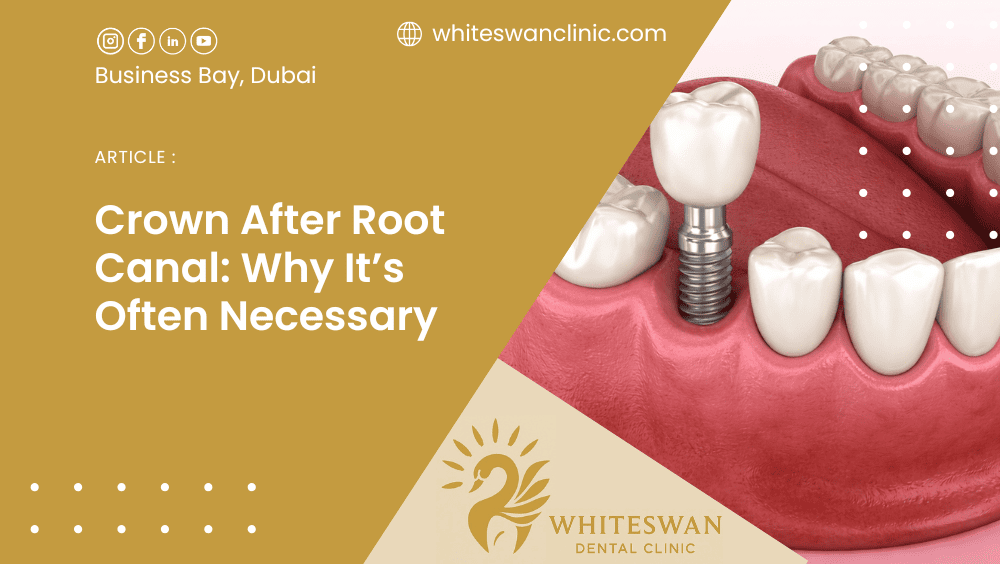
Crown After Root Canal: Why It’s Often Necessary

A root canal is a difficult process for painful teeth.The nerve is cleaned out after the infection is gone, and the tooth finally stops hurting.

A lot of clients at White Swan Dental Clinic inquire, “If the pain is gone, why do I still need a crown?”

A crown after a root canal is not an extratreatment.It secures your treated tooth against the wear and tear of everyday chewing, changes in temperature, and long-term use. If it doesn’t have that protection the tooth will break, leak, or crack beyond repair. From this below information you can know why dentists suggest a crown, how to know if you need it, and what happens if you delay.

What Happens to a Tooth After a Root Canal?

A root canal treatment removes infected pulp from inside the tooth. Nerves and blood vessels are in that pulp. After removed that the tooth become

  • Less hydrated over time 
  • If there was a big hole, an old filling, or degradation then the structure was weaker.
  • More vulnerable to cracks because the tooth no longer has the same internal support

Many root canals are also done on teeth that are already in bad shape. 

The dental crown protects the tooth and reduces the risk of crack. Looking for a Dental Clinic in Business Bay?

The Main Reason: Root-Canal Teeth Crack More Easily

The truth is that teeth, especially back teeth, are prone to crack after getting a root treatment. Cracks can also be sneaky.You might not feel it right away, but over time you can see:

  • Sharp pain when chewing
  • Sensitivity that comes and goes
  • A piece of the tooth breaking off
  • Gum swelling near the tooth again

A properly fitted crown after the root canal spreads biting forces more evenly. In this way, it helps secure a small crack from becoming a big crack.

Front Tooth vs Back Tooth: Does Everyone Need a Crown?

No.The need depends heavily on which tooth has the root canal and how much tooth structure is left.

Back teeth (molars and premolars)

These teeth have more chewing pressure. Because of that, dentists almost always recommend a crown for molar root canal cases. Molars grind food thousands of times a day. So the chance of cracking is fast.

Front teeth (incisors and canines)

The front teeth cut food .If there is a small tooth damage and there is sufficient enamel thickness, a simple dental filling is enough. But if the tooth is broken, cracked, or discolored you can fit the crown. Get details on Root Canal Treatment in Business Bay.

Key Signs You Likely Need a Crown After Root Canal

A crown is often advised if you have one or more of these:

  • Large filling already present
  • Tooth structure missing due to deep decay
  • A tooth that has cracks or “craze lines”
  • Root canal done on a molar or premolar
  • Tooth has had multiple restorations before
  • Bite pressure is high 

In these situations, the crown isn’t just “nice to have.” It’s the difference between keeping the tooth for years vs losing it early.

What If You Skip the Crown?

Some people postpone the crown because the tooth feels healthy. That is reasonable.Still delaying is risky.

Without a crown, the tooth can:

  1. Fracture under chewing forces
  2. Develop micro-leakage around the temporary filling
  3. Get reinfected, needing retreatment
  4. Break below the gumline—then extraction may be the only option

And the difficult thing is a tooth can break suddenly while eating something normal such as nuts and even bread crust. So there is a chance for it to happen without any warning. Looking to a Best Clinic for Tooth Removal?

Why a Filling Alone Often Isn’t Enough

A regular filling restores the “hole,” but it doesn’t fully protect the tooth’s cusps especially in molars. Over time, those cusps can flex and crack.

After a root canal, a dental crown covers and supports the whole biting surface. It also secures the tooth better than large fillings which helps keep bacteria from leaking out.

Crown Types Commonly Used After Root Canal

At White Swan Dental Clinic, the type of crown you get depends on your bite, the position of your teeth,and budget. Common options include:

1) Zirconia crown

Strong and natural-looking. Moreover it is suitable for back teeth because it can handle a lot of pressure from biting.

2) Porcelain-fused-to-metal 

It is a strong choice with a metal base and porcelain top. It can be long-lasting, although it may show a darker line near the gum in some cases.

3) E-max 

Highly aesthetic, often used for front teeth. Strong, but usually selected where appearance is a top priority.

Your dentist will suggest the best fit based on function first—because a crown has to survive daily life, not just look good. Get details on Dental Checkup in Business Bay.

Do You Need a Post and Core Too?

Yes. If there is not enough tooth tissue to hold the crown in place, your dentist might recommand a post and core treatment.

  • Post: placed into the root canal space to help retain the core
  • Core: rebuilds the tooth foundation so the crown has proper support

However, posts are not automatically needed. In fact, if there are enough healthy teeth remaining, avoiding a post can be better. It depends on the case.

How Soon Should You Get the Crown After Root Canal?

After the root canal, within a few weeks you should get the crown. Temporary restorations are not last long; they are only protect the tooth for a short period of time.

If you delay, cracks and leakage increase. 

So, if you have recently had root canal treatment in Dubai, it is better to plan for the crown placement immediately and avoid last-minute confusions.

What the Crown Process Usually Looks Like

Most crown procedures follow a simple sequence:

  1. Assessment & X-ray to confirm the root canal is healing well
  2. Tooth preparation
  3. Impressions or digital scan for accurate fit
  4. Temporary crown placed for protection
  5. Final crown cementation once ready
  6. Bite adjustment for comfort and proper chewing

After placing the root canal you will be able to eat normally, smile beautifully, and you can stop worrying about the tooth cracking.

Related Articles:

» Root Canal vs Extraction + Implant

» When Should I Have Root Canal Retreatment?

» The Importance of Periodontal Care in Dubai’s Dental Scene

» Whitening for Sensitive Teeth Safely

» Causes of Toothache and Quick Relief

Caring for a Crowned Root-Canal Tooth

A crown will secure the tooth, but we need to give basic care. So:

  •  With fluoride toothpaste you have to brush everyday.
  • Floss everyday
  • if you grind your teeth use a night guard
  • Avoid biting ice and very hard foods
  • Visit your dentist regularly for check-ups and cleaning

If you follow good habits,a crown can last many years.

FAQs on “Crown After Root Canal: Why It’s Often Necessary”

1) Is a crown mandatory after a root canal?

Not always. However, it’s often necessary for molars and teeth with large fillings or weak structure.

2) Can I wait a few months before getting the crown?

Yes, you can, but it increases the risk of cracking or leakage. So earlier is safe.

3) What happens if my root canal tooth breaks?

It depends on the crack. Some fractures can be restored, but deep cracks may require extraction.

4) Do front teeth always need crowns after root canal?

Not always. If the tooth is strong and minimally restored, a filling may work. Still, crowns are common if damage is extensive.

5) Why does a root canal tooth become brittle?

This is because the nerve and blood supply are removed, and the internal structure of the tooth is often weakened by decay or old fillings.

6) Will the crown hurt when it’s placed?

No. The tooth has no nerve after the root canal, and local anaesthesia can be used for gum comfort.

7) What’s better: zirconia or porcelain crown after root canal?

For back teeth, zirconia is often preferred for strength. For front teeth, aesthetic porcelains may be ideal.

8) Do I need a post for every root canal crown?

No. A post is only used when there isn’t enough tooth structure to hold the crown securely.

9) Can a crown tooth get infected again?

Yes, reinfection can occur due to leakage, new decay, or cracks.

10) How long does a crown last after the root canal?

Depending on bite forces, hygiene, and crown material it lasts 10-15 years.

11) Will my crown look natural?

Yes. Modern crowns look natural, especially for visible teeth

12) Is it normal to feel bite discomfort after crown placement?

If the bite is high you feel mild discomfort. A quick adjustment resolves it.

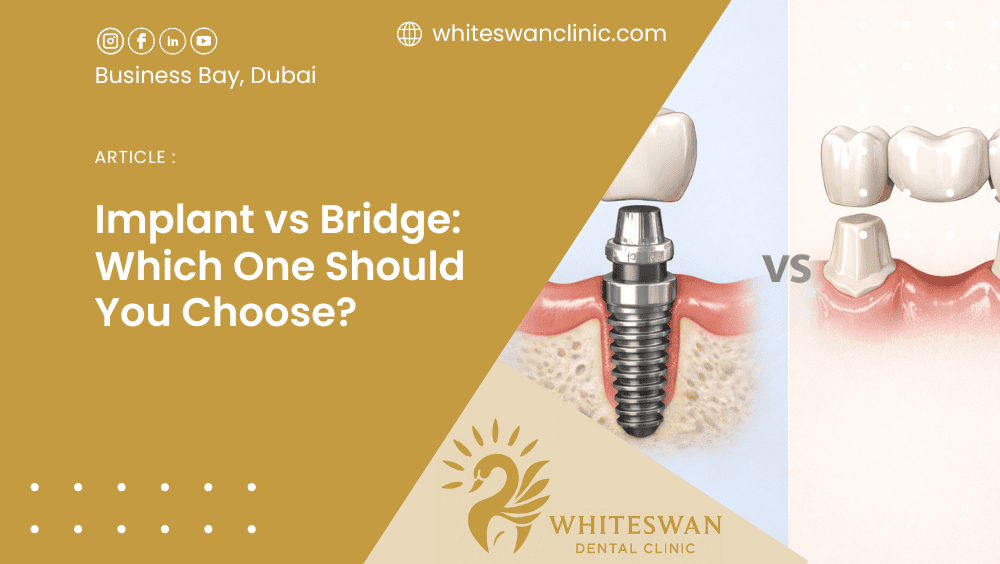
Implant vs Bridge: Which One Should You Choose?

When you lose a tooth your smile will not change. But it can affect the way you chew,speak and the confidence of posing photos and attending meeting.The good thing is today we can replace a missing tooth without more complications.You can get a dental implant or a dental bridge to replace your teeth.We need to choose the proper one based on what we require.

At White Swan Dental Clinic, many patients have a confusion about choosing the suitable one. Two options work perfectly. But the best option depending on your preferences, your mouth, your timeline, your budget.

We can keep it simple and practical.

First, What’s the Difference?

Dental Implant

A dental implant is a replacement “root” for the missing tooth.. A small titanium post is put into the jawbone. After it heals and joins with the bone then a crown is put on top.

In simple teerms, an implant is a new root and a new tooth that stands on its own.

Dental Bridge

A dental bridge replaces the space by using the teeth next to the tooth that is lost as support. The teeth next to the false tooth are shaped, crowns are put on them, and the false tooth is attached in the middle.

In simple terms, a bridge is a new tooth that is held up by teeth that are close by.

Both can look natural. Both can restore function. But they work it in different methods. Looking for a Dental Clinic in Business Bay?

Why This Choice Matters More Than You Think

Over time, nearby teeth can tilt into the space of missing teeth. So your bite may change,and jawbender the missing tooth will shrink slowlly.So you have to decide as soon as possible.

But,you should not make a decision based only on what is fast and cheap. You can think like this,

  • Bridges are often faster.
  • Implant is often more independent and long-term focused.

Now let’s compare properly.

Implant vs Bridge: Real-Life Comparison

1) Effect on Nearby Teeth

This is one of the huge differences.

  • Implant:it will not depend on neighbouring teeth. Your nearby teeth stay untouched.
  • Bridge: it needs nearby teeth to be trimmed and crowned to hold the bridge.

If your nearby teeth are already crowned or heavily filled, a bridge will be a sensible option. But, if those teeth are perfectly healthy, many people do not like to shave them.

2) Jawbone Health

When you lose a tooth, the jawbone beneath it may slowly lose its volume.

  • Implant: Helps keep the bone active because the implant works like a root.
  • Bridge: This does not stimulate the bone beneath the area where the tooth is missing.

So, for long-term bone preservation, implants have the edge.

3) Treatment Timeline

If you’re replacing a front tooth, you may want a solution quickly for confidence reasons.

  • Bridge: Often completed in a few weeks (depending on your case).
  • Implant: Usually takes longer because the implant needs healing time.

That said, many implant plans include a temporary tooth, so you don’t have to walk around with a gap.

4) Strength and Bite Feel

  • Implant: It feels just like a natural tooth and handles chewing forces well.
  • Bridge: Strong too, but the support teeth carry the load.

For back teeth , chewing pressure is higher. Because of that, many patients prefer implant crowns in the back.

5) Cleaning and Daily Maintenance

Most of the people don’t think about the cleaning and maintainace.

  • Implant: You should brush and floss them like a natural tooth. Moreover clean the gums carefully.
  • Bridge: You should clean under the bridge using floss threaders or special brushes.

If bridge cleaning is ignored, food can trap and the support teeth can develop decay or gum issues. So, bridges need cleaning and maintainance.

6) Longevity

Both will last for many years, but which one will fail first will vary.

  • Implant: The implant will last long; the crown may need replacement after wear.
  • Bridge: Can last well too, but it depends on the health of the support teeth.

So, a bridge is only as strong as the teeth holding it. Get details on Dental Bridges in Business Bay.

Cost: Why the “Cheaper” Option Isn’t Always Cheaper

People often assume:
Bridge = cheaper and Implant = expensive.

Upfront, that can be true. However, your real cost depends on what you need and what happens later.

Implant cost factors

  • Bone grafting (if needed)
  • Type of crown material
  • Surgical complexity
  • Number of implants

Bridge cost factors

  • Number of units (3-unit vs longer bridge)
  • Crown material choice
  • Condition of support teeth (sometimes extra treatment is needed)

 If the nearby teeth are healthy some patients choose implants because they see them as a long-term investment. Looking for a General Dentistry in Business Bay?

Who Should Consider a Dental Implant?

You will be a good candidate for dental implants if:

  • You want a long-term replacement that feels natural
  • Your neighbouring teeth are healthy and you want to keep them untouched
  • Your jawbone is sufficient (or you’re open to grafting if required)
  • You’re okay with a longer timeline for healing
  • You want better support for bone and bite stability

Who Should Consider a Dental Bridge?

A dental bridge can be a smart option if:

  • You want a quicker result
  • You prefer a non-surgical approach
  • Your adjacent teeth already have crowns or large fillings
  • Bone level is low and you prefer not to do grafting
  • You want a predictable plan in a shorter period

Front Tooth vs Back Tooth: Does Location Change the Choice?

Yes, it often does.

  • Front teeth: Looks matter a lot, and gum shape matters too. Both options can look excellent when planned well.
  • Back teeth: Strength matters more. Implants are often preferred for molars because they take better chewing pressure over time.

Related Articles:

» How to Care for Implants: A Cleaning Routine That Actually Works?

» Dental Implants in Dubai: Step-by-Step Process

» Implant-Supported Dentures Benefits

» Loose Crown or Bridge: What To Do Immediately?

» What to Expect at a Dental Exam?

So… Which One Should You Choose?

Here’s an easy way to choose:

  • If you want a replacement that stands alone, protects neighbouring teeth, and supports bone health then you can choose a dental implant
  • If you want a quicker, non-surgical option and the supporting teeth are suitable then you can choose a dental bridge.

At White Swan Dental Clinic, we don’t push a “one-size-fits-all” answer. We look at your bite, your gum health, your bone level, and the condition of nearby teeth—then we recommend what makes sense long-term.

FAQs on “Implant vs Bridge”

1) Which lasts longer: implant or bridge?

In many cases, implants last longer because they don’t depend on neighbouring teeth, but both can last well with proper care.

2) Is getting an implant painful?

Most patients thought it was easier than expected. It is done under anaesthesia, and post-treatment discomfort is manageable only.

3) How long does an implant take?

Often a few months because the implant needs to integrate with bone. However, temporary teeth may be used during healing.

4) How long does a dental bridge take?

Many bridges can be completed in a few visits across a few weeks, depending on your case.

5) Do bridges damage adjacent teeth?

A bridge requires shaping the support teeth. That’s why the condition of those teeth matters a lot.

6) Can I get an implant if I have low bone?

Yes,depending on the situation bone grafting or other techniques may help.

7) Which looks more natural?

Both can look natural. Implants often feel more like a “real tooth” because they emerge from the gum like a natural tooth.

8) Which is cheaper?

Bridges can be cheaper upfront. Implants may offer stronger long-term value for many patients.

9) Can a bridge replace more than one tooth?

Yes, bridges can replace multiple teeth, but longer bridges place more load on support teeth.

10) Can implants replace multiple missing teeth?

Yes. Multiple implants can support crowns or implant-supported bridges for bigger gaps.

11) Is cleaning harder with a bridge?

Usually yes, because you must clean under the bridge. Special floss or brushes are needed.

12) How do I know what’s right for me?

A proper dental evaluation is the best way. Bite forces, gum health, bone level, and nearby teeth condition all guide the decision.

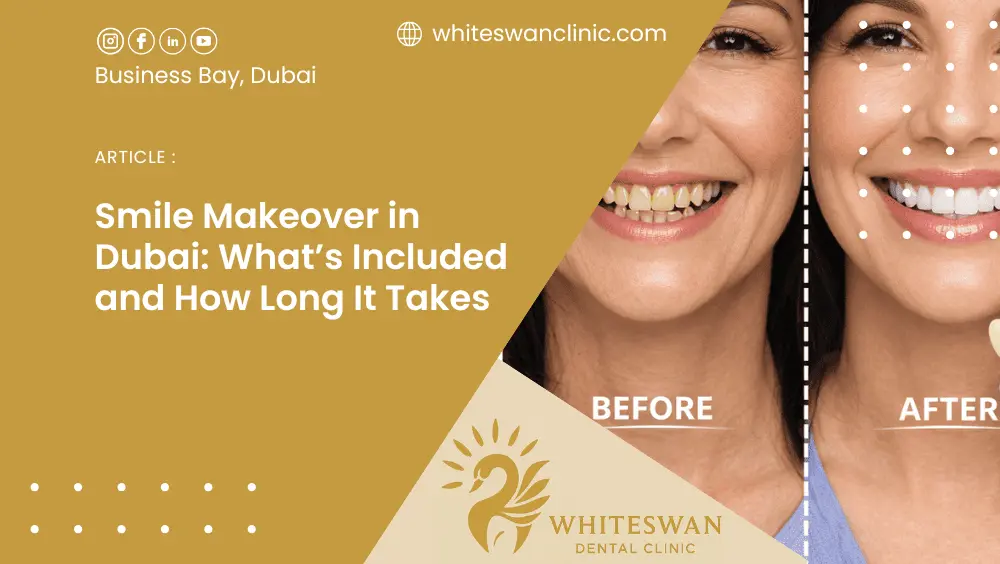
Smile Makeover in Dubai: What’s Included and How Long It Takes

A smile makeover in Dubai is not the same for everyone. It is about your teeth, gums, bite, and facial features all need to match.Some people need to fix chips, uneven edges, old crowns, or gaps that show up in every smile. Some patients want brighter teeth for photos or a wedding. And sometimes, it is not only cosmetic but also people want comfort when chewing, less sensitivity, and a bite. 

At the White Swan Dental Clinic in Business Bay, Dubai, the first step in a smile makeover is to listen. Then we design each step so that the end outcome seems real. It will be not too white, not bulky, and not look artificial .Here you can see what is usually included and how long it typically takes.

What Exactly Is a Smile Makeover?

A smile makeover is a customized dental plan that makes your smile better. It could be something simple, like whitening and bonding, or something more complicated, such aligners, gum shaping, crowns, and implants.

Most smile makeovers goal to improve:

  • Tooth colour (whitening and stain control)
  • Tooth shape (fixing uneven edges, short teeth and chips)
  • Symmetry (matching both sides of the smile)
  • Alignment (straightening with clear aligners)
  • Gum line (fixing uneven gums)
  • Missing teeth ( bridges or implants)
  • Bite comfort (making sure teeth meet properly)

The best part is designed around you. Your age, your smile line, your lifestyle, and your face are all important. Get details on Dental Clinic in Business Bay.

Who Needs a Smile Makeover in Dubai?

If you observe these things, you will be a good candidate for a smile makeover in Dubai:

  • Yellow teeth, discolored after brushing
  • Cracks or Small chips 
  • Uneven front teeth or edges that don’t match
  • Gaps that bother you in photos
  • mild crowding or crooked teeth 
  • Old fillings or crowns that look dark near the gum
  • Uneven gums or a smile that shows too much gum
  • Missing teeth that affect your confidence and chewing

But if you have gum disease, deep decay, or infections,then those things should be consulted first. Otherwise smile makeover treatments will not last long.

What’s Included in a Smile Makeover?

Not everyone needs all treatments. In fact, many patients get amazing results with just 1–2 procedures. Still, here are the most common parts of a makeover:

1) Consultation + Smile Assessment

This first visit is where we check teeth, gums, bite, and overall oral health. We also talk about what you want and what you don’t want. (Some people want Hollywood white. Others want a softer natural shade.)

This stage often includes photos, bite evaluation, and planning.

Why it matters: Even costly cosmetic work can look bad or feel weird if you skip proper planning.

2) Digital Smile Design / Smile Planning

Smile design is like a preview phase. We plan:

  • Tooth length and proportions
  • Shade (how bright your teeth should be)
  • Shape (more rounded, more square, more youthful edges)
  • Symmetry (left and right balance)

This helps you understand what dentistry can really do for you.

3) Professional Teeth Whitening

For many people, whitening is the easiest “makeover starter.”It is effective on real tooth enamel. Before veneers, people whiten their teeth so that the final treatments match the brighter color.

Time needed:Most of the time, you only need one session, although some people use take-home trays for a few days. Looking for a Teeth Whitening near Business Bay?

4) Composite Bonding

Composite bonding repairs chips, fills gaps, and changes tooth contours with tooth-colored resin. It’s fast, safe, and cheap when compared to porcelain veneers.

Best for: small to medium changes in appearance

 Time needed: usually the same day, especially for the front teeth.

5) Porcelain Veneers

Front teeth are covered by thin, custom-made porcelain veneers. If it is done properly, they can improve shape, color, and consistency.

Best for: uneven teeth, tough stains, worn edges, and changing your appearance

 Time needed: 2–3 visits over the course of 1–2 weeks

6) Crowns

If a tooth is weak, has a lot of fillings, or is broken a veneer could not be strong.Crowns cover the tooth and make it stronger and look better. Get details on Dental Crowns.

Best for: broken teeth, damaged teeth, big fillings,

 Time needed: commonly 1–2 weeks

7) Clear Aligners (Teeth Straightening)

Clear aligners will be the best first step if your major concern is crooked teeth or teeth that are too close together. First, straightening teeth can make it less required to reshape them later.

Best for: gaps, crowding, and mild to severe misalignment

Time needed:

  • Mild: 3–6 months
  • Moderate: 6–12 months

8) Gum Contouring (Gum Shaping)

When the gum line is uneven or too low the teeth look small. Gum contouring can change the form of the gum line to make the smile look even.

Time needed: 1 session, healing around 1–2 weeks.

9) Implants or Bridges for Missing Teeth

Missing teeth gives you an underconfidence and makes it harder to bite down. A smile makeover will include dental implants or bridges to replace missing teeth.This makes your smile look complete and makes biting feel normal. 

Time needed: 3 to 6 months for implants because it takes time for the recovering of bone. Get details on Dental Checkup in Business Bay.

How Long Does a Smile Makeover Take in Dubai?

Timelines based on what you need. Most patients fit into one of these groups:

Fast Smile Refresh: 1–3 Days

This is common when the plan includes:

  • Whitening
  • Small bonding fixes
  • Polishing and reshaping

Good for: people who want a noticeable upgrade quickly.

Standard Smile Makeover: 1–3 Weeks

This usually includes:

  • Veneers or crowns (front teeth)
  • Whitening + gum contouring
  • Final bite adjustments

Good for: patients wanting a big cosmetic change without long orthodontics.

Comprehensive Makeover: 3–12 Months

This may include:

  • Clear aligners
  • Implants
  • Gum treatment first
  • Bite correction or multiple restorations

Good for: full transformations and long-term stability.

So yes, a makeover can be “quick.” But a quality result is planned, not rushed.

The Usual Smile Makeover Order 

A common mistake is doing cosmetic work first and alignment later. In most cases, sequencing looks like this:

  1. Health first (cleaning, fillings, gum treatment)
  2. Straightening (if needed)
  3. Whitening
  4. Bonding / veneers / crowns
  5. Final bite check + polishing
  6. Maintenance plan

This order helps results look better and last longer.

Related Articles:

» Jaw Pain and Clicking (TMJ): Dental Causes and Solutions

» Dental Checkup in Dubai: What’s Included and How Often You Need It?

» Professional Teeth Whitening in Dubai

» Implant-Supported Dentures Benefits

» Jaw Pain & Crowding: Can Orthodontics Help?

How to Maintain Your Results

Smile makeovers cost money. So you must be consistent in maintaining that.

  • Brush twice daily and floss regularly
  • Visit for cleaning every 6 months
  • Reduce to drink staining drinks like coffee and tea 
  • If you clench or grind teeth use a night guard
  • Don’t bite pens, nails, or package seals

If you give good care a makeover can stay attractive for years.

Smile Makeover Results & Timeframe

A smile makeover in Dubai could be life-changing.The important thing is choosing the appropriate treatments for your teeth, not just copying someone else’s smile. If you plan correctly and respect the bite, the result will appear natural, feel good, and last a long time.

FAQs on “Smile Makeover in Dubai”

1) What treatments are included in a smile makeover?

Depending on your needs, it can include teeth whitening, composite bonding, veneers, crowns, clear aligners, gum contouring, and implants.

2) How long does a smile makeover take?

It can take 1–3 days (simple) or 3–12 months (aligners/implants).

3) Is a smile makeover painful?

Most steps are comfortable. If tooth prep is needed, numbing is used. Mild sensitivity can happen but usually settles quickly.

4) Do I need veneers for a makeover?

No. Many patients get a great result with whitening + bonding or aligners + whitening.

5) How many veneers do most people get?

Often 6–10 upper veneers for a balanced smile, but it depends on how wide your smile shows.

6) Can whitening change my crowns or veneers?

No. Whitening changes natural enamel only. Restorations may need adjustment or replacement for shade matching.

7) Should I straighten teeth before veneers?

In many cases, yes. Aligners can reduce tooth reduction and improve long-term symmetry.

8) What if I have a gummy smile?

Depending on the cause, gum contouring might help. A consultation is necessary to make sure of the finest choice.

9) How long do veneers last?

If you give good care, they can last for a long time. Biting hard things, grinding, and not cleaning up can all shorten your life.

10) Is bonding permanent?

Bonding is strong but not “forever.” It can stain or chip over time, yet it’s easy to repair or refresh.

11) Can a smile makeover improve chewing too?

Yes. If bite issues or missing teeth are included, many patients notice better chewing comfort and less strain.

12) How do I know what I need?

A proper exam is the best step. We look at your teeth, gums, and bite, and then we make a plan that works with your objectives and timetable.

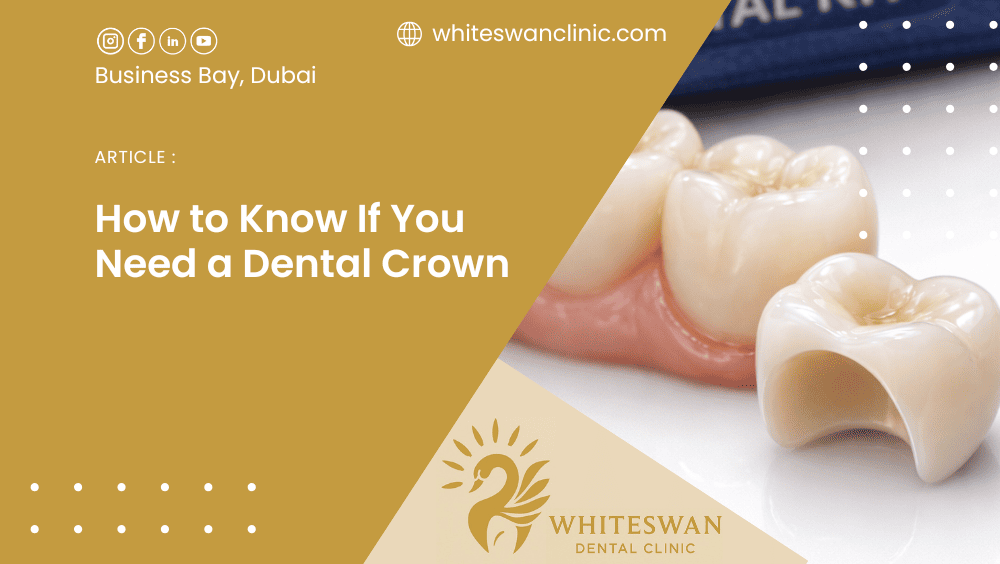
How to Know If You Need a Dental Crown

Sometimes a tooth problem looks “small” on the outside,but it is getting “weake”r on the inside. That is the reason for many people’s confusion when they hear You might need a crown” and ask “Can’t you just put a filling and finish it?”

Yes,a dental filling is perfect in many cases.But, when a tooth loses its strength, a filling can act like a quick patch on a wall that’s already cracking. It will secure for a short time, but it will not protect the tooth long-term.So, a dental crown is the best choice to secure the tooth from splitting, breaking, or turning into an emergency later.

Here we can see the real-life symptoms that inform you when a tooth needs a crown vs filling, and why dentists recommend one over the other.

Filling vs Crown: what’s the real difference?

A filling repairs the part of the broken tooth. The dentist removes the decay, cleans the area, and fills it with a powerful substance that will cure it. 

A filling works effectively when the tooth has strong walls and good enamel to hold it in place.

A crown fits over the tooth.It keeps the whole tooth safe from biting pressure and stops weak spots from bending or breaking.

An easy way to imagine it:

  • A filling is like repairing a pothole.
  • A crown is like resurfacing and strengthening the whole road section.

Both are useful. The “right” one depends on tooth strength, not just the size of the hole. Get details on Dental Clinic in Business Bay.

Signs you may need a Dental Crown (and not only a filling)

1) The cavity is large or the tooth wall is thin

A filling works great if the cavity is small. But when decay spreads or gets deeper, the walls of the tooth start to thin. Thin tooth walls don’t like chewing pressure. They can crack without warning.

That’s why dentists commonly recommend a crown for a large cavity because it fixes the whole tooth instead of just one part.

2) You already have a big old filling

Older fillings could weaken the tooth over time. The filling itself might be okay, but the tooth around it becomes fragile. If you’ve had the same tooth filled again and again, you may notice it feels “delicate” or sensitive.

In this case, a crown can stop the cycle of: filling → break → bigger filling → break again. Looking to a Best Dental Clinic for Teeth Filling?

3) Pain when chewing… but it disappears afterward

This one is very common. Many people say that It hurts when I bite on it, but after that it feels okay.”

That could be a symptom of a crack or a weak cusp. The tooth bends a little when you bite it. That movement can trigger pain.

A filling can’t always stop that flexing. A crown for cracked tooth often can, because it holds the tooth firmly together.

4) Sensitivity that won’t settle down

It might not be a big deal if you really feel cold for a second or two. But if you sense sensitivity that doesn’t go away or severe pain that becomes worse, it could signal more serious harm.

But if the tooth is poor in structure, a crown may be suggested to better seal and protect it.

5) The tooth is cracked, chipped, or has a broken corner

Small chips can sometimes be treated with bonding. But when a chunk breaks off from a chewing tooth, or when there’s a visible crack line, the tooth is at higher risk of splitting further.

Crowns are often chosen here because they prevent the tooth from opening up under pressure.

6) You had a Root Canal Treatment

A tooth after a root canal can still function well. But it’s usually weaker than before, especially the back teeth. Molars take heavy pressure every day, and a root canal tooth is more likely to fracture without protection.

This is the reason that dentists recommend a crown after root canal, specfically,on molars and premolars.

7) Your filling keeps falling out or the tooth keeps re-decaying

If a tooth needs repair in the same spot continuously, it could be your bite, the size of the cavity, or simply that the tooth doesn’t have enough healthy structure left.

At that point, a crown becomes the “stronger rebuild,” instead of another patch.

8) You grind or clench your teeth (bruxism)

If you clench at night, teeth take a lot of force. Fillings can crack, edges can chip, and tooth walls can split. Grinding also wears teeth down and makes them flatter.

In many cases, a crown can restore the tooth’s strength—and a night guard helps protect it after. Get details on Root Canal Treatment in Business Bay.

When a filling is usually enough

A filling is often the best option when:

  • the cavity is small to moderate
  • the tooth has thick, solid walls
  • there is no crack
  • it’s the first or second time the tooth needs treatment
  • bite forces are not extreme

So yes,fillings are not “inferior.” They’re simply designed for different situations.

What if you choose a filling when a crown is needed?

Some people delay crowns because they want the cheaper option. That’s reasonable. It’s still good to know what could happen.

If a weak tooth is treated with a big filling, it may:

  • crack while chewing (even on soft food)
  • break below the gum line (harder to save)
  • start hurting suddenly and need urgent care
  • end up needing a root canal or extraction

In other words: the filling may not fail because the dentist “did it wrong.” It fails because the tooth wasn’t strong enough for a filling to begin with. Get details on Dental Crowns.

How dentists decide between Crown vs Filling

At White Swan Dental Clinic, dentists look at a few practical things before recommending a crown:

  1. How much healthy tooth is left (if it thin walls means it’s a high risk)
  2. Which tooth it is ( molars take more pressure)
  3. Existing repairs (large or old fillings weaken teeth)
  4. Cracks and bite pain (especially sharp pain on chewing)
  5. Root canal history (often needs full coverage)
  6. Grinding habits (crowns may be safer with protection)

The clinical check is just as important as the X-rays.Sometimes the tooth “looks okay” in a photo, yet it’s painful under pressure. That’s where experience and bite checks come in.

What a crown procedure usually looks like

Most crowns follow these steps:

  • Examination + X-ray
  • Removing decay and shaping the tooth
  • Digital scan or impression
  • Temporary crown (if required)
  • Final crown cementation + bite adjustment

A crown should feel like part of you after it has been placed on, not heavy or strange. You could feel a little sensitive at first, but it must fade away.

Quick self-check: Do you likely need a crown?

If you’re planning to get a dental crown, you should be leaning to it.

  • “My cavity is big.”
  • “That tooth already has a large filling.”
  • “It hurts when I bite.”
  • “A corner chipped off.”
  • “I had a root canal there.”
  • “My fillings don’t last in that tooth.”
  • “I grind my teeth.”

If none of these apply, a filling might be enough.

Related Articles:

» Loose Crown or Bridge: What To Do Immediately?

» Tooth Swelling & Infection: When to Seek Immediate Care

» Dental Checkup in Dubai: What’s Included and How Often You Need It?

» Implant Maintenance: Hygiene Tips for Long-Term Success

» Dental Implants in Dubai: Restoring Your Smile with Precision

Protecting Your Tooth with a Dental Crown

Filling is a great way to repair a tooth.But if the tooth is weak because of a big hole, cracks, a heavy bite, or previous treatment, a dental crown will be the best way to secure it from breaking even more.

FAQs on “How to Know If You Need a Dental Crown”

1) Can I always choose a filling instead of a crown?

Of course you can, but if the tooth is weak, the filling could break, which would cause bigger problems.

2) Is a crown only for severe damage?

Not always. Crowns are also used when a tooth is likely to crack, even if the decay isn’t massive.

3) Does pain when chewing mean I need a crown?

Yes. When you chew, you might feel pain because of cracks or weak cusps. A crown can help secure the tooth.

4) Do crowns stop sensitivity?

Yes, it often helps especially if sensitivity is caused by cracks or weak walls in the teeth. But before that you need to consider the right diagnosis for sensitivity.

5) Why do dentists suggest crowns after root canals?

Teeth that have had root canals might become weak, especially molars. So crowns help to secure teeth  from breaking.

6) How long does a crown last?

Crowns may last for many years if you clean and floss well and consult the dentist regularly. Grinding can shorten lifespan if not handled.

7) Is the crown procedure painful?

Not generally because local anesthesia has been used. It is normal to feel a little painful.

8) Can a cracked tooth be saved without a crown?

Sometimes you can bind little chips together, but deeper gaps need full coating to stop them from spreading.

9) What if I delay the crown?

Delaying can make the chance of breaking a tooth higher. If a tooth breaks very deeply, it’s difficult to save.

10) Do crowns look natural?

Yes. Modern crowns are made to match the color and shape of your teeth, especially if you plan in advance.

11) Is a crown stronger than a filling?

Yes, because it covers the entire tooth and spreads chewing force more evenly.

12) How do I protect my crown after placement?

Brush your teeth twice a day, floss correctly, avoid to chew ice, and wear a sleep guard are the best way to protect the crown after the placement.

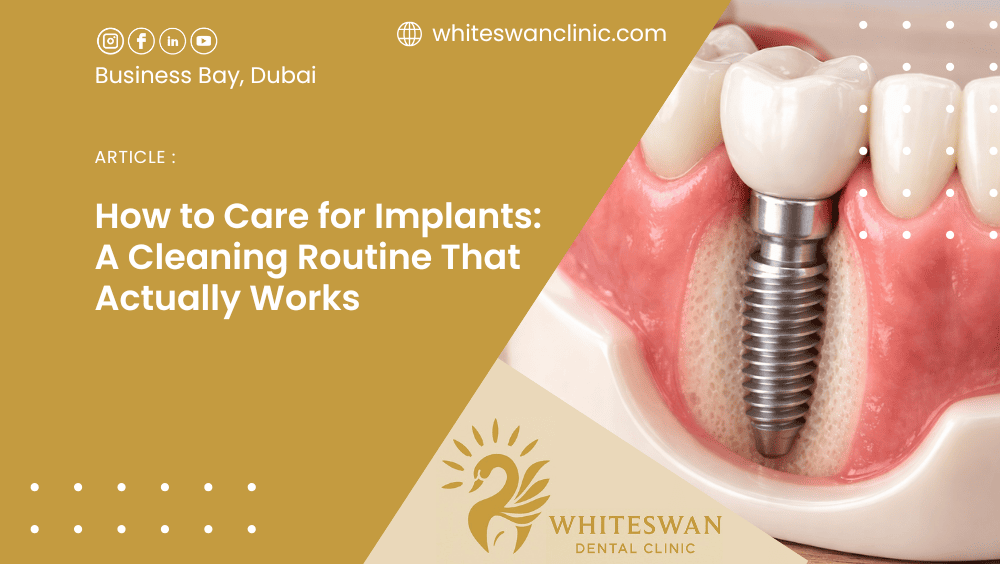
How to Care for Implants: A Cleaning Routine That Actually Works

Once you are accustomed to the dental implants, they will feel and behave like normal teeth. So it’s easy to think they will look after themselves. But implants still require daily care — because while an implant crown can’t develop a cavity, the gums and bone surrounding it can become inflamed if plaque accumulates.

At White Swan Dental Clinic, we see this time and again: people give the implant a good scrub like they would a normal tooth, but they miss out on the gumline bits and in-between space. Then bleeding, bad taste or gum swelling can appear over time. The good news is this: A consistent routine (not a complex one) will help keep implants clean and comfortable for years.

This guide breaks down a realistic dental implant cleaning schedule that is congruent to real life—morning, bedtime, and everything in between. It also covers what tools help most and what to do if something feels “off”.

Why implants need a slightly different cleaning approach

A crown on implant is cemented in place and closely approximates the gum tissue. That edge where the crown meets the gum is plaque’s primary danger zone. When plaque sticks around, the tissue can become inflamed.

You may hear terms like:

  • Peri-implant mucositis: inflammatory condition of gums, which around the implant (early stage).
  • Peri-implantitis:deeper infection that can cause bone loss (more severe)

You do not have to remember the names. Just bear this in mind: Implant care is gum care. Protect the washer, and you protect the implant. Get details on Dental Clinic in Business Bay.

The “routine that works” mindset

A routine only works if you can actually do it daily. So instead of an extreme plan, focus on four habits:

  1. Brush gently and thoroughly twice a day
  2. Clean between teeth/implants once a day
  3. Keep the mouth hydrated and reduce food traps
  4. Get professional implant maintenance regularly

If those four happen consistently, you’re doing better than most people. Looking for a Root Canal Treatment in Dubai?

Morning implant routine (3–5 minutes)

1) Brush with purpose, not pressure

Start with a soft toothbrush or an electric brush with a soft head. Either is fine. The real difference is technique.

  • Aim the bristles toward the gumline
  • Move slowly around the implant crown
  • Use light pressure (hard scrubbing irritates gum tissue)

A typical mistake is going over the top chewing surface thoroughly while speeding past the gumline. The bacteria are at the gumline, so pay that a little more mind.

2) Quick rinse (optional)

If you’re a coffee/tea drinker, or wake up in the morning with a dry mouth, rinsing your mouth out with water could help. It’s not a stand-in for brushing, but it does freshen and reduces stickiness.

Midday habit (30 seconds that helps)

You don’t need a full cleaning routine in the middle of the day. However, if you get food stuck easily, try this:

  • Rinse with water after meals
  • If you’re out, sugar-free gum can stimulate saliva (saliva naturally protects gums)

This is especially useful if you have an implant bridge or multiple implants. Less trapped food = less irritation. Get details on Dental Checkup in Business Bay.

Night implant routine (the one that matters most)

If you only improve one part of your day, improve the night routine. Night-time cleaning prevents plaque from sitting for hours while you sleep.

Step 1: Clean between implants (choose the tool that suits your mouth)

There isn’t one “perfect” method for everyone. The best option depends on whether you have a single implant crown, multiple implant crowns, or a bridge.

Option A: Implant-friendly floss (soft, thicker floss)

Implant floss is often slightly “spongy” or thicker than regular floss. It can clean along the gumline without snapping into the gum.

This works well for many single implants.

Option B: Interdental brushes

Interdental brushes can be brilliant, but size matters. If the brush is too big, it can cause gum soreness. If it’s too small, it won’t clean effectively.

Use a brush that fits snugly without forcing.

Option C: Water flosser (excellent for bridges and tight spaces)

A water flosser is a strong choice if you:

  • Have implant bridges
  • Have limited dexterity
  • Find string floss frustrating
  • Get food stuck often

Direct the water towards the gums and floss bridged areas where food can get caught.

Step 2: Brush for a full two minutes

Now brush as you would normally — outside, inside, chomp surfaces — but ease up around the implant crown.

If you’re an electric-brusher, direct the toothbrush to each individual tooth rather than zipping around haphazardly. Steady slow strokes is what you need to remove plaque.

Step 3: Clean your tongue

Many of the reports of “bad taste” were due to tongue bacteria, not from the implant. A tongue scraper or the soft brushing of your tongue, 10 seconds and it’s a big difference.

Step 4: Mouthwash (only if it suits you)

A gentle rinse can refresh. Skip the alcohol-strong mouthwash if it drys out your mouth. Besides, don’t use mouthwash as your primary cleaning method–plaque doesn’t disappear on its own (brushing + interdental cleaning). Looking for a Teeth Whitening near Business Bay?

What products are safe for dental implants?

Implants usually respond best to gentle, consistent products.

Toothbrush

  • Soft manual brush, or
  • Electric brush with soft head

Toothpaste

  • Fluoride toothpaste is generally ideal
  • Avoid harsh abrasive whitening pastes if your gums are sensitive

Interdental cleaning tools

  • Implant floss / soft floss
  • Interdental brushes (correct size)
  • Water flosser (especially for bridges)

If you’re unsure what is best for your implant shape, we can check the area and recommend tools that match your spacing.

Common implant care problems (and what to do)

“My gums bleed when I clean”

This isn’t unusual, especially if getting into the habit of flossing (or using a water flosser) or interdental cleaning has been sporadic at best. Bleeding is generally indicative that your gum is inflamed.

What helps:

  • Gentle brushing (no scrubbing)
  • Daily interdental cleaning
  • A professional clean if bleeding lasts beyond 10–14 days

If bleeding is heavy, painful, or increasing, don’t wait—get it checked.

“There’s a smell or bad taste near the implant”

This can happen when food gets trapped under a crown edge or bridge. It can also be plaque sitting at the gumline.

Try:

  • Water flossing at night
  • Interdental cleaning daily
  • A dental review to check for hidden traps or inflammation

“Food keeps getting stuck”

Food trapping isn’t always your fault. Sometimes crown or bridge contours create small collection points. In some cases, a simple adjustment improves comfort and makes home cleaning easier. Get details on Teeth Cleaning and Polishing.

Weekly habits that keep implants strong

These small habits reduce long-term issues:

  • Replace brush heads when bristles flare
  • Wash flosser tips and allow to dry.
  • Inspecting your gums (redness, swelling or recession) in the mirror
  • Wear your night guard if you grind your teeth

Grinding can overload implants and crowns. So if you’ve been advised to use a guard, it’s part of implant care too.

Why regular professional maintenance matters

Despite the best home care, hardened plaque can accumulate in places that you don’t clean well. Professional maintenance promotes healthy gum and bone around implants.

During an implant evaluation or hygiene appointment, we will:

  • Check gum health around the implant
  • Measure pocket depth
  • Remove hardened deposits safely
  • Check your bite and crown fit
  • Improve your home technique with tiny, practical tips

A small change in brushing angle or interdental tool size can make a big difference.

Related Articles:

» Dentures vs Implant-Supported Dentures: Comfort and Stability

» Dental Implants in Dubai: Step-by-Step Process

» Root Canal vs Extraction + Implant: How to Decide?

» Implant-Supported Dentures Benefits

» Implant Maintenance: Hygiene Tips for Long-Term Success

A quick do’s and don’ts list

Do

  • Brush twice daily
  • Clean between implants daily
  • Focus on the gumline, not just the crown surface
  • Use a water flosser if you have bridges or food traps
  • Book regular implant maintenance appointments

Don’t

  • Don’t scrub hard
  • Don’t stop cleaning because of mild bleeding
  • Avoid using sharp objects to dislodge any trapped food
  • No loosening, swelling or pus allowed

When you should book an urgent check-up

Call your dentist if you notice:

  • Implant crown feels loose
  • Pain that’s getting worse
  • Swelling, pus, or persistent bleeding
  • Sudden bite changes
  • Gum recession around the implant

 Early intervention prevents the bone from being destroyed, and keeps the implant secure.

FAQs on “How to Care for Implants”

1) How often should I clean my implant?

Brush 2 times each day, and once per day clean between teeth/implants.

2) Can implants decay like normal teeth?

The implant crown cannot get a cavity, but plaque can collect leading to gum infection.

3) Is an electric toothbrush safe for implants?

Yes. So long as you use a soft head and light pressure, it can be very beneficial.

4) What floss is best for dental implants?

Implant-friendly soft floss works well for many cases.Bridges may require a floss threader or water flosser.

5) Do I need a water flosser if I already floss?

Not always. But it’s super for bridges, close spots and food traps.

6) Are interdental brushes safe around implants?

Yes, if the size is correct. It can irritate the gums to force a big brush.

7) Why do my gums bleed around the implant?

Bleeding usually means inflammation. Regular, gentle cleaning and professional help can become the solution.

8) Can mouthwash keep implants clean?

Mouthwash helps with freshness, but it doesn’t clean plaque away like brushing and flossing.

9) What toothpaste should I use for implants?

Usually, a fluoride toothpaste that isn’t too abrasive is best.

10) How do I clean under an implant bridge?

Water flossers, floss threaders and bridge flosses can work — go with what works for your bridge design.

11) How often should I visit the dentist for implant maintenance?

That will depend on your risk factors, but professional maintenance is important.

12) What are warning signs of peri-implantitis?

If there’s ongoing bleeding, swelling, pus or ooze, bad taste, pain or looseness — make an appointment soon.

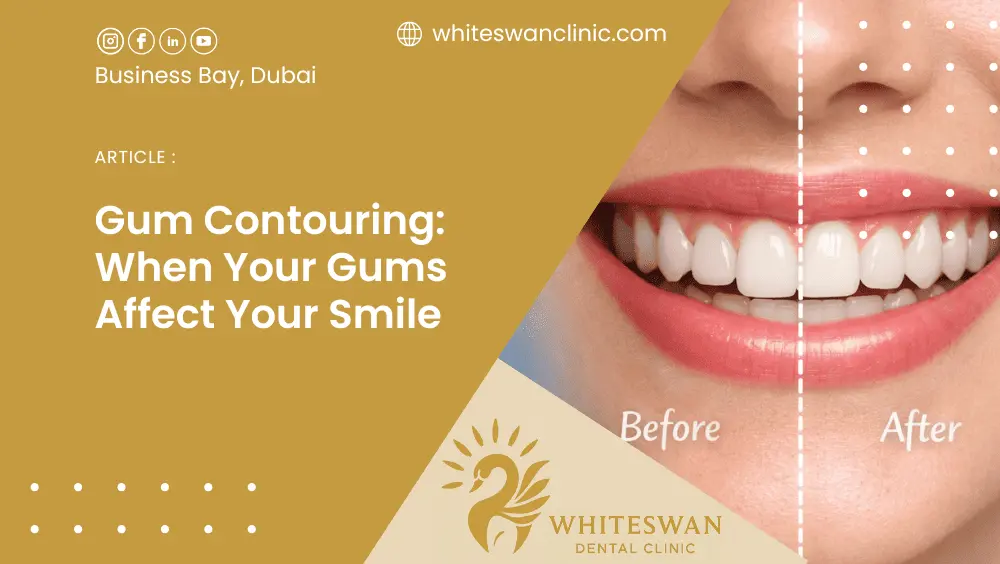
Gum Contouring: When Your Gums Affect Your Smile

It’s not always your teeth that cause you to think twice before smiling — it can also be your gums. You can have clean, straight, white teeth and still feel like there’s something that looks “weird” in photos. The gum line is often the culprit. If your gums rest on too low or too high on the front teeth and you feel it is affecting the look of your smile. This is precisely where gum contouring, also known as gum reshaping or gum line correction, comes into the picture.

One of those people we see a lot of at White Swan Dental Clinic are people who say: “My teeth are great, but my smile still isn’t right.” And when we examine closely, most of the time the gums are what’s missing. And the best part? This is easy to remedy in many instances, and creates a surprisingly big visual improvement.

What Is Gum Contouring?

Gum contouring, or reshaping the gum line to enhance how your smile looks — and occasionally, how it works — is a dental procedure. It could include, depending on your case:

  • Removing a small amount of gum tissue to reduce a gummy smile
  • Making uneven gum heights level, so that your smile looks symmetrical
  • Exposing more tooth to make the teeth look longer and more proportional
  • Aiding restorations (such as veneers or crowns) in allowing them to sit naturally along the gumline

Gums are much like the border of picture frame. If the frame isn’t level, then the picture won’t appear centred — even though it actually might be. Get details on Dental Clinic in Business Bay.

When Your Gums Change How Your Smile Looks

Gum problems aren’t always immediately obvious to everyone. But if any of the following seem familiar, your gums could be more involved in your smile than you think.

1) You Show Too Much Gum When You Smile

If your gums are very visible when you laugh or smile, your teeth can look short. This is the classic gummy smile concern, and gummy smile treatment often includes laser gum contouring.

2) Your Gum Line Is Uneven

And even if your teeth are straight, uneven gums can make the teeth look as though they’re different sizes. Gum line correction is used to bring that balance back.

3) Your Teeth Look Small

Sometimes the teeth are a normal size, but the gums are covering too much of them. With gum reshaping, you can uncover more enamel and make your teeth look longer and more beautiful.

4) Some Teeth Look Longer Than Others

This could be due to gum recession or thinning of the gum. In this instance, you may need an alternative solution (such as gum grafting) instead of a more typical contouring treatments.

5) Your Smile Looks “Heavy” or Less Defined

Individuals with full or puffy gum line can take years off the face with a more balanced smile. As the gum line is perfected, often the smile appears more angular and cleaner without altering a single tooth. Looking for a General Dentistry in Business Bay?

Why Do Some People Have Excess Gum or Uneven Gums?

There are a few reasons it can occur, and it matters because that helps determine treatment.

Genetics

Some people naturally have more gum tissue around the front teeth. This is very common and isn’t necessarily linked to poor oral hygiene.

Delayed Tooth Eruption

Sometimes teeth erupt normally, but the gums don’t settle back to the ideal spot.The result: Teeth look shorter than they actually are.

Inflammation (Swollen Gums)

If you have gingivitis, or ongoing irritation of your gums, they might appear puffy and irregular. In these examples, we concentrate on gum health rather than cosmetic shaping first.

Certain Medications

Some drugs can trigger gum… to overgrow. If that’s part of what you’re going through, we take careful stock and coordinate the best way forward.

Orthodontics and Tooth Movement

Braces or aligners can correct a bite and straighten teeth, but levels of gum may require some final adjustment to ensure the best cosmetic outcome. Get details on Dental Checkup in Business Bay.

Laser Gum Contouring vs Traditional Gum Reshaping

Patients often ask, “Do you do it with a laser?” The answer is: many modern clinics use lasers for cosmetic gum reshaping because it can offer:

  • High precision for fine sculpting
  • Less bleeding (laser helps seal blood vessels)
  • Often quicker healing
  • A smoother experience for many people

That said, there are in fact losers and winners. In some cases we may use traditional tools or you made need a procedure such as crown lengthening (where bone level is adjusted) if the gum problem is deeper than superficial tissue.

What Happens During a Gum Contouring Procedure?

Here is the process in a simple, realistic way — not scary and not complicated.

Step 1: Consultation & Smile Assessment

We examine your gum health, gum thickness and symmetry and how much tooth is showing when you smile. If there is gum disease, we treat that first. It’s important to have healthy gums for a safe, long lasting result.

Step 2: A Clear Plan

We talk about what you’d like to be different, and what’s possible. Often, we can contour the teeth that are visible when you smile, so the result will be natural — not overboard.

Step 3: Numbing the Area

Local anaesthesia is typically used. You’ll be comfortable throughout the procedure.

Step 4: Reshaping the Gum Line

The gum is then sculptured by the dentist to suit the desired form. This part goes faster than most people expect.

Step 5: Aftercare Instructions

They will provide clear instruction so you know how to eat, brush and keep the area clean as it heals. Looking for a Teeth Whitening near Business Bay?

Is Gum Contouring Painful?

For the majority of people, it turns out to be much easier than they feared. You will be numb during the process, but it doesn’t hurt. Later you may experience mild soreness — generally described as a little irritation or burning sensation — for a few days.

If multiple teeth are treated, you might feel more soreness. Still, most patients manage it well with the aftercare advice given.

Gum Contouring Recovery: What It’s Really Like

Recovery is usually simple if you follow instructions.

In the first few days:

  • Stick to soft foods (rice, pasta, yogurt, soups that aren’t too hot)
  • Avoid spicy foods and crunchy snacks
  • Brush gently around the gum line
  • Don’t poke the area with your tongue (many people do this without realising)

Over the next week:

  • The gums start settling into their new shape
  • Any mild swelling reduces
  • The smile line starts looking cleaner and more even

And importantly, if you already take good care of your teeth, healing tends to be smoother. Get details on Root Canal Treatment in Business Bay.

Who Is a Good Candidate for Gum Line Correction?

You may be a good candidate if:

  • Your gums are healthy (or can be treated first)
  • You have uneven gum heights across the front teeth
  • You feel your teeth look short because too much gum covers them
  • You want a more balanced, photogenic smile
  • You’re considering veneers, crowns, or cosmetic bonding and want the gum line to match

However, if your main problem is gum recession, you might need periodontal care or gum grafting instead. That’s why proper assessment matters — we don’t guess.

When Gum Contouring Alone Isn’t the Best Solution

Sometimes a gummy smile isn’t only gum tissue. It can be related to:

  • Lip movement (your lip lifts high when you smile)
  • Jaw structure
  • Bone position around the teeth
  • Tooth wear (worn teeth can look short)

In these cases, gum contouring may also be beneficial, but could be done in conjunction with another therapy as well. The aim is for a result that looks natural too, and holds. Looking to a Best Dental Clinic for Teeth Filling?

Benefits of Gum Contouring 

Yes, this is often a cosmetic treatment. But it can also give practical benefits:

  • Makes teeth look more proportionate and even
  • Improves smile symmetry
  • Enhances results of whitening, veneers, or bonding
  • In some cases, makes cleaning easier around the gum line
  • Boosts confidence — because you stop thinking about your smile

And the biggest benefit? Many people feel like they finally look like themselves in photos.

Related Articles:

» Bleeding Gums: Causes and Fixes

» Receding gums: Treatments that work

» Bleeding Gums: When to See a Dentist in Dubai?

» What to Expect at a Dental Exam

» How to Remove Dental Stains Safely?

How to Maintain Results After Gum Contouring

To keep your gum line looking neat and stable:

  • Brush twice daily with a soft brush
  • Floss once daily (gently)
  • Book professional cleanings regularly
  • Don’t brush too aggressively (it will only push gums back over time
  • If you grind your teeth, a night guard may help.

Good gums aren’t built in one appointment — they’re maintained with habits.

FAQs on “Gum Contouring: When Your Gums Affect Your Smile”

1) What is gum contouring?

Gum reshaping or tissue sculpting is a procedure where the gumline is changed to more evenly balance and enhance the smile.

2) Is laser gum contouring better?

For many, yes — laser gum contouring can be more exact and less bloody, but it really depends on your specific gums.

3) How long does gum contouring take?

It varies. A tiny space might require less than an hour; a full smile line, longer.

4) Will it look natural?

When planned properly, yes. The aim is a clean, even gum line — not an artificial look.

5) Is gum contouring permanent?

Results are generally permanent in most cases. But gum health and brushing habits still count over time.

6) Does gum contouring hurt after the procedure?

The majority of people describe mild discomfort that subsides after a few days. It is usually treatable with the aftercare advice of a dentist.

7) Can gum contouring fix a gummy smile?

Yes, if excess gum tissue is the cause. In cases where the cause is related to bone or lip movement, other treatments may also be suggested.

8) Can I do gum contouring before veneers?

Yes. Gum contouring prior to veneers can make the mouth look more symmetrical and help the porcelain veneer teeth appear more natural.

9) Do I need gum disease treatment first?

Yes, if your gums are inflamed or infected. Healthy gums are a prerequisite prior to cosmetic recontouring.

10) Will my gums grow back after contouring?

Unused gum tissue generally does not grow back to the same level, but oral hygiene and your biology will determine how well everything heals and how stable your gums are afterward.

11) What should I avoid after gum contouring?

Minimize hot, spicy, or (and) crunchy foods and refrain from smoking for a couple of days.

12) How do I know if I need contouring or crown lengthening?

A dental exam is the best way. If bone level or tooth eruption is involved, crown lengthening may be a better fit than simple gum reshaping.

How Long Does Teeth Whitening Last?

And you know how, right after a whitening session — when you glance at your smile in the mirror and think: “Yeah… that’s a glow-up”? Then the second thought arrives quickly: how long does teeth whitening last before my teeth return to their old color?

The plain truth is this: Whitening isn’t forever, but it does last a good long time if you treat your teeth as though you want them to stay white. We see women in Dubai who come to our clinic for natural looking whitening (not that fake white) and they need it to stand the test of coffee, karak, shisha evenings, business meetings and weekend brunches.

So let’s get it straight: What’s realistic, what affects the results, and how can you keep that clean shade for as long as possible?

So… How Long Does Teeth Whitening Last?

 Professional teeth whitening is typically between 6 months and 3 years for most people.

Yes, that’s a big range—but your daily habits are the reason. Whitening doesn’t “wear off” like a phone battery. Instead, your enamel accumulates new stains over the years. If you’re drinking a lot of dark stuff or smoking regularly, the whiteness diminishes faster.” On the other hand, hurt it and avoid basic maintenance and whitening can last a whole lot longer than people expect. Looking for a Dental Clinic in Business Bay?

A simple way to think about it:

  • Best-case: 2-3 years (good care + cleaning every two days)
  • Common: 12-18 months (average diet and staining drinks)
  • Shorter: 6–9 months (heavy coffee/tea + smoking/vaping)

Whitening Options and How Long Each One Usually Lasts

Not all whitening methods are equal. Some lift deeper stains, while others only polish the surface.

Whitening method

Typical result duration

What it’s best for

In-clinic professional whitening

1–3 years (with good aftercare)

Fast, strong, noticeable changes

Dentist-supervised home trays

6–18 months

Controlled whitening + easy top-ups

Store-bought strips/gels

2–6 months

Mild stains, quick short-term boost

Whitening toothpaste

Maintenance only

Keeping surface stains under control

If what you want is the most predictable and long-lasting change, in-clinic whitening has been the winner.

Why Whitening Fades (Even If Your Dentist Did It Perfectly)

Whitening lifts stains, but it doesn’t build a permanent shield around your teeth. Your enamel is still enamel—it can stain again.

Here are the main “fade factors” we see often:

1) Coffee and tea (including karak)

Dubai runs on coffee. Unfortunately, coffee and tea have tannins that cling to teeth. If you drink them daily, you’ll likely need maintenance earlier.

Easy tip: after coffee, rinse your mouth with water. It sounds too simple, but it works.

2) Smoking, vaping, and shisha

Nicotine-related stains are stubborn. They come back faster and often look more yellow or brown.

If you smoke and whiten, you can still get good results—but expect quicker fading.

3) Dark sauces and spices

Think soy sauce, tomato sauces, foods heavy with masala and even certain chutneys. These don’t ruin your whitening overnight, but they do gradually dull the whiteness.

4) Skipping flossing or cleanings

Plaque collects stains. So if flossing is “sometimes” and cleanings get delayed, stains build up faster. Get details on Teeth Whitening near Business Bay.

The First 48 Hours After Whitening Matter More Than You Think

Right after whitening, teeth can be a little more likely to absorb stains. That’s why dentists often mention a “white diet” window.

For the first 48 hours, try to avoid:

  • coffee, tea, cola
  • red wine
  • curry-heavy meals (especially turmeric)
  • berries
  • soy sauce
  • smoking/vaping

Choose safer options like:

  • rice, pasta, bread
  • yogurt, milk
  • chicken, fish
  • potatoes
  • bananas

It’s not forever. It’s just two days. But those two days can help your teeth whitening results stay brighter for longer. Looking to a Best Dental Clinic for Teeth Filling?

Does Whitening Last the Same for Everyone?

Not really—and it’s not your fault if your results fade sooner than your friend’s.

Natural tooth colour matters

Some have naturally more yellow dentin beneath their enamel. Whitening only lightens the outer layer and the underlying color still impacts the shade.

Enamel thickness and texture matter too

“If you have thin enamel or your enamel is a little porous, these spots — depending on the drink or food that’s being used to stain the tooth — can come back quicker.”

Fillings, crowns, and veneers don’t whiten

This surprises people. The whitening gel does not whiten caps, crowns or fillings. So if you have crowns and fillings that can be seen, your dentist can carefully map out the shade so that it doesn’t produce a mismatch. Get details on Dental Checkup in Business Bay.

In-Clinic Whitening vs Home Trays: Which Lasts Longer?

In-clinic professional whitening

This gives the quickest visible change. It’s ideal when you want results now—before a wedding, event, or important photos.

Why people love it:

  • faster results
  • controlled and supervised
  • strong stain-lifting power

Dentist-supervised home trays

These are great for steady, controlled whitening and maintenance. Many people use trays after doing in-clinic whitening once.

Why trays are popular:

  • easier top-ups
  • flexible schedule
  • can be gentler for sensitivity

A common plan is: in-clinic whitening first, then home tray top-ups when needed. Get details on Whitening Trays.

How to Make Teeth Whitening Last Longer (Without Overthinking It)

You don’t need a strict lifestyle. You just need small habits that add up.

Brush twice daily (properly)

Soft brush and fluoride toothpaste Brushing is a good way to practice self-care. Don’t brush too hard — aggressive brushing can irritate gums and make sensitivity worse.

Floss once a day

This is underrated. Stains love hiding between teeth, and flossing helps keep colour even.

Rinse after staining foods/drinks

Water after coffee is a simple “reset.” It reduces stain contact time.

Get regular professional cleaning

Scaling and polishing removes surface stains and helps your whitening look fresh longer.

Do maintenance top-ups when needed

If you’re a heavy coffee drinker, a small top-up can be better than waiting until teeth get noticeably dull again. Looking for a Broken Tooth Treatment in Business Bay?

What About Sensitivity—Does It Change How Long Whitening Lasts?

Sensitivity doesn’t usually reduce the longevity of whitening. But it can affect how willing you are to do touch-ups.

If you tend to get sensitivity, dentists often recommend:

  • desensitising toothpaste
  • fluoride support
  • lower-strength gel
  • shorter whitening sessions

The goal is a bright smile without suffering.

When Should You Whiten Again?

Most people notice fading slowly—especially in photos, or when front teeth start looking less “clean” than they did after whitening.

A practical schedule many patients follow:

  • Top-up around 6–12 months (if needed)
  • Full professional whitening later when you really want a bigger boost again

You definitely don’t want to over-whiten so you are always safest with a dentist-directed plan.

Related Articles:

» Professional Teeth Whitening in Dubai

» Post-Whitening Care and Maintenance: Keep Your Bright Smile Longer

» Teeth Whitening at Home vs Dentist

» Whitening for Sensitive Teeth Safely

» Dental emergencies: what to do first?

Keeping Your Smile Brighter, Longer

If you’re wondering, how long does teeth whitening last, you’re already on the right track of thinking. Whitening isn’t a one-and-done “forever” thing — but it can last a beautiful long time with some basic care.”

It’s really the coffee culture that keeps us busy here in Dubai and, on average, our patients are getting a visibly whiter smile that lasts 12–24 months if they follow some tips for aftercare and do some touch-up maintenance every now and again.

FAQs on “How Long Does Teeth Whitening Last?”

1) How long does professional teeth whitening last?

Typically 6 months to 3 years depending on use and care.

2) Can coffee make whitening fade faster?

Yes. Coffee stains over time. Rinsing with water after helps.

3) How soon can I drink tea or coffee after whitening?

Ideally, wait 48 hours.

4) Does whitening toothpaste make results last longer?

It does aid surface stains, but it’s not a substitute for professional whitening.

5) Do smokers need whitening more often?

Usually yes. Nicotine-related stains return faster.

6) Will crowns or veneers whiten too?

No, whitening does not cause dental restorations to discolour.

7) Is home whitening as effective as clinic whitening?

Dentist-supervised home trays work, but clinic whitening is quicker and often stronger.

8) Why do my teeth look yellow again after whitening?

Most common: staining beverages, smoking, plaque buildup or failing to take care of the teeth within 48 hours.

9) How often can I safely whiten my teeth?

Some people do a top-up every 6-12 months, but it’s subjective and up to your dentist.

10) Does whitening work on deep internal stains?

Some deep stains respond less. In those instances, other aesthetic alternatives might be considered.

11) What should I eat in the first 48 hours after whitening?

Opt for lighter foods like rice, pasta, chicken, potatoes, yogurt and bananas

12) How can I maintain whitening results in Dubai?

Avoid staining drinks, rinse after coffee/tea, maintain regular cleanings, and do small top-ups when required.

Wisdom Tooth Pain: Signs You Need Removal

Let’s face it — wisdom tooth pain loves to creep up on us in small ways. One day there’s a bit of pressure at the back of your jaw, and the next week you’re chewing on one side, waking up with an aching jaw and wondering why your ear hurts to boot. We do the same thing too often at White Swan Dental Clinic in Dubai – people put it off because it “comes and goes” and by then we have swelling, infection, or a tooth next door that gets damaged.

So, how can you be sure when it’s simply teething pain… and when it’s an indication that you really do need wisdom teeth removal?

This guide explains it in simple, real-life terms — what to watch for, what it means and when you can stop guessing and get it checked.

Why wisdom teeth hurt (even if you brush well)

Wisdom teeth are the last teeth to show up. By the time they try to erupt, your jaw is already “full.” That’s why they often:

  • get stuck under the gum (impacted wisdom teeth)
  • come out halfway and leave a gum flap that traps food
  • grow sideways and press into the tooth in front
  • become difficult to clean, so decay starts fast

Given that, pain can arise from pressure, infection or swelling — even a cavity. And because the region is in close proximity to the jaw joint and nerves, the pain doesn’t always remain localized to a single location. Looking for a Dental Clinic in Business Bay?

10 clear signs you may need wisdom tooth removal

Not every sore gum needs surgery. But, if you notice a pattern — particularly with reoccurring symptoms — your wisdom tooth could be the culprit.

1) Pain that keeps coming back

“If the pain goes away and comes back once every few weeks — it’s not random.” It frequently indicates a partially erupted or inflamed tooth flaring up when there is more plaque buildup..

2) Swollen gum behind the last molar

One of the most common red flags is a puffy, tender gum in the back of your mouth. This swelling often indicates an infection is brewing beneath the gum flap.

3) Bad taste or bad breath that brushing doesn’t fix

When infection drains from around a wisdom tooth, people describe a “metallic” or foul taste. Also, trapped food back there can smell—even if your overall hygiene is good.

4) Pain when chewing (especially on one side)

If biting down causes a sharp twinge near the back molar, your wisdom tooth could be pressing into the adjacent tooth or aggravating the surrounding gum.

5) Jaw stiffness or trouble opening wide

This is a big one. If your jaw feels tight, particularly in the morning, deeper inflammation may be at work. Some patients may even have difficulty yawning.

6) Redness and bleeding around the back gum

Actually almost at the back, where your toothbrush hardly reaches?That’s often a sign of irritated or infected tissue holding this totally inconvenient corner wisdom tooth in place.

7) Swelling in the cheek or jawline

If your face looks puffy on one side, don’t wait. Cheek swelling can mean infection has moved beyond the gum line.

8) Earache or headache that feels “connected”

Wisdom tooth pain can refer to nearby areas. So yes—sometimes what feels like an ear problem is actually dental pressure or inflammation.

9) Crowding or pressure on nearby teeth

Not everyone notices it right away, but wisdom teeth can push into the second molar area and cause a constant “tight” feeling. If you’ve had braces before, this can be extra frustrating.

10) Repeat infections even after antibiotics

Antibiotics will settle things down, but they won’t take away the cause. If it comes back repeatedly, wisdom tooth extraction may be the only permanent solution. Get details on Dental Checkup in Business Bay.

The biggest culprit: impacted wisdom teeth

Impacted wisdom teeth are teeth that don’t come out normally. They may be:

  • stuck under gum
  • stuck in the bone
  • angled forward into the second molar
  • trapped behind the last tooth

This is where problems usually start—because the tooth becomes a bacteria trap. Also, it can damage the tooth in front (your second molar), and that tooth is far more valuable to save.

When wisdom tooth pain becomes urgent

Most wisdom tooth issues are not life-threatening, but infections can spread. Seek urgent care if you have:

  • fever or chills
  • rapidly increasing swelling
  • difficulty swallowing
  • severe pain that doesn’t settle
  • pus discharge, strong bad taste, or facial puffiness

If you’ve reached this stage, don’t “sleep it off.” The sooner you treat an infection, the easier it is to manage. 

Do all wisdom teeth need to be removed?

No. Some wisdom teeth erupt fully, sit straight, and stay clean. In those cases, we often just monitor them.

However, removal is commonly advised when you have:

  • repeated pain or swelling
  • recurring gum infection (pericoronitis)
  • decay in the wisdom tooth
  • damage or decay starting on the second molar
  • gum disease around the area
  • cysts or bone changes seen on X-ray

An exam and panoramic X-ray usually make the answer clear. Looking for a Best Clinic for Tooth Removal?

What to expect at White Swan Dental Clinic (Dubai)

When you come in for wisdom tooth pain, we don’t guess. We check it properly.

Typically, the visit includes:

  1. Quick history – how long it hurts, what triggers it, where it radiates
  2. Oral exam – gum swelling, infection, bite issues, tenderness
  3. X-ray – to confirm the tooth position and impaction level
  4. Plan – monitoring, medication, or wisdom tooth removal if needed
  5. Aftercare instructions – so recovery is smooth and predictable

“Will it hurt?” — the honest answer

During the procedure, you won’t feel pain because the area is fully numbed.

Afterwards, discomfort is normal—but for most people it’s manageable with proper aftercare, rest, soft foods, and medication as advised. The key is following instructions and not trying to “rush” recovery.

Home relief (short-term, not a cure)

If you’re in pain right now, these can help temporarily:

  • warm saltwater rinses 2–3 times a day
  • cold compress on the cheek for swelling
  • avoid chewing on that side
  • keep the area clean with gentle brushing
  • take pain relief only as advised

Still, if the pain keeps returning, don’t rely on home remedies. They’re helpful for comfort, not for solving the cause. Get details on broken tooth treatment in business bay.

Why the tooth next door matters

A wisdom tooth doesn’t always damage itself first—it often damages the second molar in front of it.

We commonly see:

  • hidden cavities between the teeth
  • gum pockets that trap bacteria
  • bone loss near the back molar
  • sensitivity that keeps worsening

So, even if your wisdom tooth pain feels “on and off,” it can quietly create bigger dental work later. 

Related Articles:

» Wisdom Tooth Pain: Removal Timing & Recovery

» Receding gums: Treatments that work

» Implant Maintenance: Hygiene Tips for Long-Term Success

» How Long Does Invisalign Take?

» Cracked Tooth: Repair Options

Final word: don’t wait for it to get unbearable

Wisdom tooth pain usually doesn’t stay mild forever.It either goes away because the tooth comes out just fine… or it gets worse because all that space keeps getting infected.

If you are experiencing repeated pain, swelling, jaw tightness or a bad taste in your mouth, it’s time to get it checked out. A simple glance, and one X-ray, can save you weeks of misery — and preserve the healthy tooth next to it.

FAQs on “Wisdom Tooth Pain: Signs You Need Removal”

1) How do I know if I really need wisdom tooth removal?

If the pain returns, there is swelling/infection or the tooth appears impacted on X-ray, removal is generally recommended.

2) What does an impacted wisdom tooth feel like?

Tension in the rear of jaw, aching or pain when chewing, swelling and/or pain that extends to the ear or temple.

3) Can wisdom tooth pain go away permanently without extraction?

Sometimes—if it erupts fully and stays clean. But if it’s partially erupted or impacted, pain often comes back.

4) What is pericoronitis?

It’s an infection of the gum tissue around a partially erupted wisdom tooth, usually caused by trapped food and bacteria.

5) Do antibiotics fix wisdom tooth infections?

They can help to prevent infection in the short term, but they don’t remove the cause. Repeat infection usually indicates extraction is necessary.

6) Is wisdom tooth extraction safe?

Yes. It’s a routine dental procedure. The dentist plans it based on X-ray position and nearby structures.

7) How long does the procedure take?

Simple cases can be quick. Surgical removal takes longer depending on impaction and tooth position.

8) How long does swelling last?

Swelling often peaks around day 2–3 and then reduces. Most people feel much better within a few days.

9) What foods should I eat after removal?

Mashed foods like yoghurt, eggs, mashed potato, soft rice and soup (not too hot). Avoid crunchy foods early on.

10) What is dry socket?

It occurs when the blood clot is dislodged and produces intense pain. Stay away from smoking, straws and vigorous rinsing for the first little while.

11) Should I remove wisdom teeth even if they don’t hurt?

Sometimes yes—if they are impacted or damaging the second molar. An X-ray helps decide.

12) When should I see a dentist urgently?

You should see a doctor for fever, severe swelling, difficulty swallowing or rapidly worsening pain, and if there is pus drainage.

Jaw Pain and Clicking (TMJ): Dental Causes and Solutions

If you’ve heard your jaw click while yawn­ing, or ex­pe­ri­enced a dull jaw pain when chew­ing, you’re not alone. For many, it begins with something small — a random pop or crack beside the ear. But it can become tightness, headaches or that irritating “stuck” feeling when you try to open wide. Typically, this signals the TMJ (temporomandibular joint) and the muscles responsible for jaw movement.

The good part? Temporomandibular joint problems can get so much better with the right dental approach—particularly if we catch triggers early and address them in a calm, step-by-step way.

What is TMJ, and why does it click?

The temporomandibular joint (TMJ) is a hinge that connects your jaw to the temporal bones of your skull. It works anytime you speak, chew, swallow, laugh — that is to say, pretty much all day. In the joint, there’s a little disc that helps the jaw to slide.

A clicking jaw occurs, in general, when the disc doesn’t move just right along with the joint — or when something pulls it off track a little bit. Sometimes clicking is harmless. But if the clicking accompanies pain, stiffness or locking, it’s a signal your jaw requires attention. Looking for a Dental Clinic in Business Bay?

Common signs of TMJ disorder (TMD)

TMJ symptoms are “random,” but they tend to make a pattern. For example, you might notice:

  • Jaw pain near the joint or in the cheek muscles
  • Clicking / popping when opening or closing
  • Pain in front of the ear (many patients think it’s an ear issue at first)
  • Headaches, especially around the temples
  • Tight jaw in the morning (even if you slept “fine”)
  • Difficulty opening fully
  • Jaw locking (open or closed)
  • A bite that suddenly feels odd or shifted
  • Soreness when chewing, especially on one side

If you’re ticking more than a couple of these boxes, it’s worth getting checked. Get details on Dental Checkup in Business Bay.

Dental causes of jaw pain and clicking (what’s really behind it)

TMJ problems rarely have one single cause. Instead, it’s usually a mix—your bite, your habits, your level of stress and the state of your teeth all contributing ingredients.

1) Teeth grinding and clenching (Bruxism)

This is one of the great villains. Bruxism is when you grind or clench your teeth — often at night, sometimes during the day without even realizing. Over time that constant pressure overloads the jaw muscles and the joint.

Signs you may be grinding:

  • Flat or worn teeth edges
  • Sensitive teeth
  • Morning jaw tightness
  • Temple headaches
  • Cracks or chips that “keep happening”

2) Bite imbalance (your teeth don’t meet evenly)

If your bite interferes don’t close the same every time. That repeated hitch puts the joint and muscles under stress. Over weeks, or even months, the jaw will begin to push back — with a click (or clicks), pain or fatigue.

Sometimes it’s subtle. But imbalances, even relatively small ones, can prompt a big reaction when you’re already clenching.

3) Missing teeth (and chewing on one side)

The mouth does its best to adjust when a tooth is lost. Teeth can shift, and most adults end up chewing on predominantly one side. This results in overloading of one TMJ compared with the other. Sooner or later, one side will get sore or start clicking.

4) High filling or crown (yes, it can matter)

Most dental work fits well. However, if a new filling or crown feels even slightly high, your jaw may adjust to avoid that spot. Then you clench more. Then muscles tighten. And then TMJ symptoms set in.

If your jaw pain was provoked by dental work, the timing is crucial.

5) Overuse habits (gum, nails, pens, ice)

A few habits may appear benign, but they keep your jaw in “work mode.” Whether you’re chewing gum for hours, biting your nails or pens, crunching on ice chips or even cracking some nuts at a candlelit dinner with friends during a stressful week — any of these things can overload the joint and muscle.

6) Stress and jaw tension (a very real link)

Stress doesn’t directly hurt the TMJ, but it does tend to generate clenching, poor posture and muscle tension. In other words, stress is fuel on the fire. So that even a slight bite imbalance can feel a lot worse if you’re stressed and tight. Looking for a General Dentistry in Business Bay?

When clicking is “okay” and when it’s not

Here’s a simple way to think about it:

Clicking without pain, no locking, and normal opening — usually we monitor it.
Clicking with pain, stiffness, limited opening, or repeated locking — you should get it assessed.

Also, if your bite feels like it’s changing, don’t ignore that. A shifting bite can happen when the joint or muscles are irritated.

Dental solutions for TMJ pain and jaw clicking

At White Swan Dental Clinic, we aim for conservative care first. That means we reduce strain, settle inflammation, and guide the jaw into better function—without rushing into aggressive treatments. Get details on Broken Tooth Treatment in Business Bay.

1) Proper TMJ evaluation (not just “look and guess”)

A real TMJ assessment includes:

  • Checking jaw opening pattern (does it deviate?)
  • Feeling the muscles for tenderness and trigger points
  • Listening for joint sounds
  • Looking for tooth wear, cracks, or grinding signs
  • Checking bite contacts and chewing balance
  • Reviewing habits and lifestyle triggers

Sometimes we recommend dental imaging, depending on symptoms. However, many cases can be diagnosed clinically first and managed safely.

2) Custom night guard / TMJ splint

If clenching or grinding is part of the problem, a custom night guard can help protect your teeth and reduce overload on the jaw muscles. It won’t “fix everything overnight,” but it often reduces morning pain and flare-ups.

Important note: store-bought guards aren’t always ideal. A poorly fitting guard can actually worsen symptoms for some people. Custom is usually safer.

3) Bite correction (only if needed)

If a tooth contact is clearly contributing to an imbalance — for instance, if you have a filling that’s too high — then making the necessary small adjustment could help. Likewise, if bite is compromised due to missing teeth that are replaceable (crown/bridge/implant where indicated), replacing them can restore jaw balance.

And yet, we don’t immediately leap to changes in bites unless the evidence is really there.

4) Lifestyle + habit coaching (small changes, big relief)

This part sounds simple, yet it works well when done consistently:

  • Keep a relaxed resting posture: lips together, teeth apart
  • Avoid gum chewing during flare-ups
  • Switch to softer foods for a few days if chewing hurts
  • Don’t open extremely wide when yawning (support your jaw gently)
  • Avoid one-sided chewing

5) Supportive therapies (when muscles are the main issue)

If jaw muscles are severely tight, we may advise supportive options, including:

  • Warm compress routines
  • Gentle jaw stretches (only within comfort)
  • Physiotherapy referral when appropriate
  • Posture and neck tension support

TMJ is not “just the joint.” Many times, it’s muscle-driven—so releasing muscle tension is a key part of recovery. Looking for a Root Canal Treatment in Dubai?

Home relief tips (what you can do today)

If your jaw is currently flaring, try this routine for 5–7 days:

  • twice daily Home use Warm compress 10-15 min 2-3 times daily
  • Soft diet (avoid chewy meat, hard bread, nuts, gum)
  • Do not open wide while eating and do not chew for too long
  • Relax the jaw during the day (set a reminder if you must)
  • Sleep on your back, if you can, or support the alignment of your jaw/neck.
  • Reduce caffeine if you notice it increases clenching

Consistency matters. Don’t do everything “hard.” Do it steady.

Related Articles:

» Dental Checkup in Dubai: What’s Included and How Often You Need It?

» Dental Implants in Dubai: Step-by-Step Process

» Wisdom Tooth Pain: Removal Timing & Recovery

» Tooth Abscess Symptoms and Treatment

» Dental emergencies: what to do first

When you should book a TMJ check quickly

Please don’t wait too long if you have:

  • Jaw locking that repeats
  • Pain that wakes you up or makes eating difficult
  • Sudden change in bite
  • Limited mouth opening that’s worsening
  • Symptoms persist for more than 2–3 weeks despite attempts at self-care

Effective Dental Solutions for TMJ Jaw Pain

Sometimes, a clicking jaw is no big deal. But add in jaw pain, tightness, headaches or locking and suddenly your body is the one begging for help. The best strategy is often straightforward and practical: Determine the triggers, reduce overload, protect the teeth and let the joint rest.

FAQs on “Jaw Pain and Clicking (TMJ): Dental Causes and Solutions”

1) Is jaw clicking always a TMJ disorder?

No. Some people have painless clicking for years. Still, if clicking comes with pain or locking, it should be checked.

2) Can TMJ problems cause ear pain?

Yes. TMJ pain feels a lot like earache, after all the joint is sitting right next to the ear.

3) Why does my jaw click more in the morning?

Frequently due to night clenching or grinding (bruxism) which allows muscles to stiffen overnight.

4) Can stress really worsen TMJ pain?

Yes. The stress often leads to more clenching and muscle tension, which can set off flare-ups.

5) Will a night guard stop my jaw pain?

It can help a lot if grinding/clenching is involved. Results vary, but many people feel reduced morning tightness.

6) Does TMJ go away on its own?

Some mild cases resolve with rest and lifestyle modifications. But, you can’t ignore chronic aches.

7) Can a high filling cause TMJ clicking?

It may be involved via alteration of the bite contacts and the promotion of jaw displacement or clenching.

8) Should I stop chewing gum if I have jaw pain?

Yes—at least during flare-ups. Gum keeps the joint and muscles overworked.

9) Can missing teeth affect the TMJ?

Yes. With missing teeth, there is a shift in the balance of your bite which can cause one sided chewing and stress on one joint over the other.

10) What’s the difference between TMJ and TMD?

TMJ is the joint. TMD refers to the disorder affecting the joint and surrounding muscles.

11) Do I need surgery for TMJ?

Most patients don’t. Conservative dental care is often enough, especially early.

12) Should I see a dentist or ENT for jaw clicking?

If symptoms involve chewing, bite, clenching or jaw movement, begin with a dentist. If necessary, you can also be referred to the appropriate specialist.