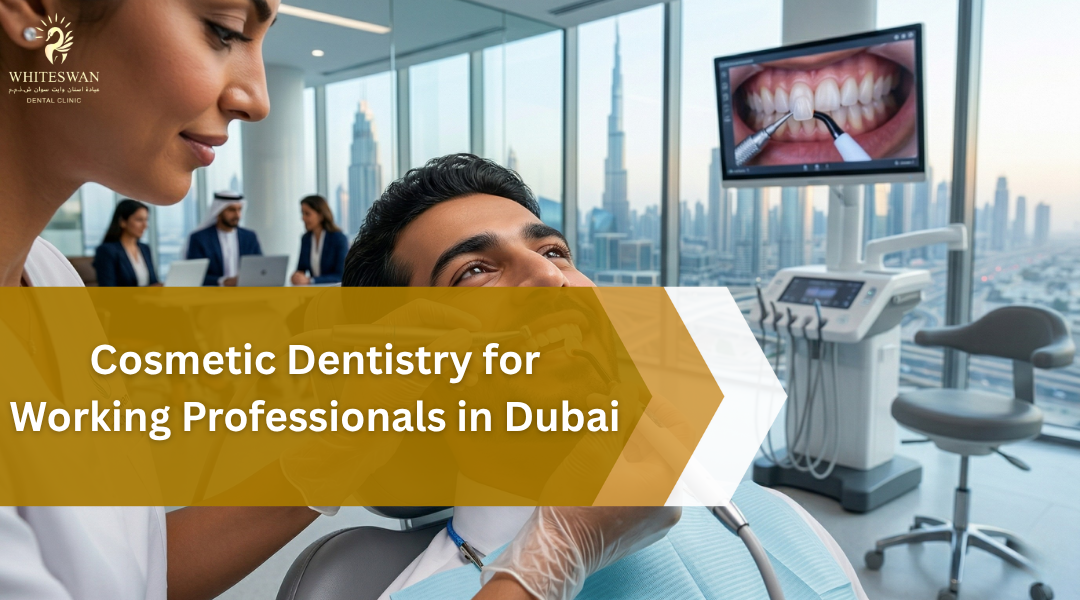
Cosmetic Dentistry for Working Professionals in Dubai

Let’s cut through the corporate jargon for a second. If you are sitting in a boardroom in the DIFC or pitching a venture in Dubai Internet City, you are being judged. Not just on your KPIs or your pitch deck, but on your presence. In a city where “looking the part” is practically a job requirement, your smile is often the first thing people notice and the last thing they remember. If you are subconsciously hiding your teeth because of a snaggletooth or some heavy coffee staining from those back-to-back espressos, you are not projecting the authority you’ve worked so hard to earn.

At White Swan Clinic, we call this “Smile Equity.” It’s the visual ROI of looking like a leader before you even open your mouth. But for the modern Dubai executive, the old ways of dental work—clunky braces and repeated, time-consuming visits—just don’t fit the schedule. You need efficiency, you need discretion, and you need a result that looks like you were born with it.

The Strategy of the Executive Smile

Why does this actually matter in the world of high finance and big tech? It’s basic human psychology. We are hardwired to associate a healthy, aligned smile with discipline and success. In a market as hyper-competitive as the UAE, these tiny visual cues can tip the scale during a negotiation. When you hesitate to smile, it can be misread as a lack of confidence or, worse, a lack of transparency.

The shift today has moved away from the “artificial” look. Those blindingly white, opaque veneers that look like piano keys? They’re a relic of the past. Today’s C-suite ambition is all about the Natural Elite aesthetic. It’s about appearing refreshed and capable without looking like you’ve had “work done.” You want people to think you have incredible genes and a disciplined lifestyle, not that you’ve spent your weekend under a surgical lamp.

The Executive Time Crisis: Results at the Speed of Business

If your calendar is a Tetris board of international flights and board meetings, your biggest barrier to self-improvement is time. You don’t have eighteen months to spend in metal braces. This is where Digital Smile Design (DSD) has completely flipped the script.

By using high-speed 3D oral scanners, we build a digital twin of your face. We can show you the final outcome on a screen before we even pick up a tool. This “blueprint first” approach means fewer visits, zero guesswork, and clinical efficiency that respects your hourly rate. It’s architectural planning for your face, delivered at the pace the Dubai economy demands.

Veneers: The Permanent Power Move

For those looking for a total brand refresh, porcelain veneers remain the undisputed gold standard. Forget the horror stories of teeth being filed down to stubs. Modern, ultra-thin veneers are essentially like high-tech contact lenses for your teeth. They provide a massive aesthetic upgrade while keeping your natural tooth structure largely intact.

These shells are remarkably tough. They won’t pick up stains from your morning caffeine fix or the red wine at a business dinner at Gaia. It is a one-time investment that keeps your professional kit looking sharp for a decade or more. When done by a true artisan, the result isn’t a new smile; it’s just the best possible version of the one you already have. It gives you that final, polished edge that signals you belong at the head of the table.

Invisalign: The Stealth Strategy for the C-Suite

Maybe your teeth are mostly fine, but there is a slight crowding that has bugged you for years. You can’t exactly walk into a pitch meeting with metal train-tracks on your teeth at age forty-five. This is where Invisalign wins for the corporate crowd. It is the ultimate background task for your appearance.

These clear aligners are practically invisible. You can host a three-hour seminar and nobody will have a clue that you are currently straightening your bite. More importantly, the latest iterations of the tech have slashed treatment times. It is a stealth strategy for your face that runs while you are busy building your career. By the time next year’s annual general meeting rolls around, your smile is as straight as your logic.

The Lunch Break Refresh: Professional Whitening

Sometimes, you don’t need a full reconstruction. You just need to undo the damage of a decade of stress and high-octane living. Professional boutique whitening at White Swan Clinic isn’t the same as those flimsy kits you find at the pharmacy. We use high-grade lasers and specialized gels to lift deep stains in about sixty minutes. It is the fastest way to look five years younger and significantly more energized. Think of it as a high-end valet service for your facial aesthetics—quick, effective, and immediately transformative.

Composite Bonding: Because Life Happens Fast

In Dubai, life moves at a hundred miles an hour. Maybe you chipped a tooth during a working lunch or noticed a gap that is suddenly driving you crazy. If you have a flight to Riyadh tomorrow and need a fix today, composite bonding is the play. We sculpt a high-grade resin directly onto your tooth in a single session. There is no lab wait and zero downtime. You walk in with a flaw and walk out with a symmetrical smile. In this city, this kind of immediacy isn’t a luxury; it’s a necessity for anyone living in the fast lane.

Choosing the Right Clinical Partner

You wouldn’t hire a junior intern to manage your private equity, so why trust a budget clinic with your face? For a working professional, the choice comes down to technology, artistry, and an understanding of the corporate lifestyle. You need a team that speaks your language and understands that your time is precious.

White Swan Clinic isn’t a high-volume factory. It is a boutique space where we treat dental work as a form of fine art. We look at your facial symmetry, your lip line, and even how you pronounce your S and V sounds. The goal is a smile that doesn’t just look good in a mirror, but one that functions perfectly in a high-pressure environment. You can see our results and our philosophy at https://whiteswanclinic.com/ and decide if your brand is ready for an upgrade.

Maintaining the High-Performance Asset

We treat a new smile like any other high-performance asset. It needs maintenance. For the grinders and the clenchers—which, let’s face it, is most of us in the Dubai corporate scene—a custom night guard is a non-negotiable piece of equipment. Protecting that investment from the physical toll of stress is just as vital as the initial procedure. Regular hygiene sessions are the “scheduled servicing” that keep the engine running smoothly. You’ve spent the effort to get here; now make sure it stays perfect.

Conclusion: Aligning Appearance with Ambition

In the end, cosmetic dentistry isn’t just about teeth. It is about removing a barrier between you and your potential. When you aren’t thinking about your smile, you are thinking about your strategy. You are focused on the person across the table. You are present. And in the world of high finance and big tech, presence is everything.

Dubai is a city built on big dreams and even bigger impressions. Don’t let a dull or crooked smile be the one thing that feels off in your professional package. You have put in the work to get to the top of your field; it’s only right that your smile reflects that level of excellence. Whether it’s a quick whitening or a full set of veneers, the results are life-changing. It is time to align your appearance with your ambition.

FAQs

How long will veneers last with a heavy travel schedule? If you take care of them, you are looking at ten to fifteen years of durability. They are built for a lifestyle of coffee, dining out, and constant activity.

Will Invisalign actually mess with my speech during a pitch? There is a tiny adjustment period of maybe twenty-four hours where you might notice a slight lisp, but your tongue adapts fast. Most clients speak fine within a day.

Is professional whitening safe for sensitive teeth? Yes. We can adjust the intensity and use specific desensitizing agents so you don’t get those “zaps” often associated with cheaper, over-the-counter treatments.

Can bonding fix a crooked smile? It can hide minor misalignments and gaps very effectively, but for major structural changes, we might suggest a short course of Invisalign first.

How many visits do I need for a full smile makeover? Usually, it is about three main appointments: the consultation and scan, the preparation, and the final fit. We work around your travel schedule.

What if I don’t want that “fake” white look? That is our specialty. We use a range of shades and translucencies to ensure your teeth look naturally bright, not like plastic or porcelain tiles.

Is there any downtime after these procedures? For most cosmetic work, there is zero downtime. You can literally head from the clinic straight to a dinner at the Burj Al Arab or a late-night meeting.

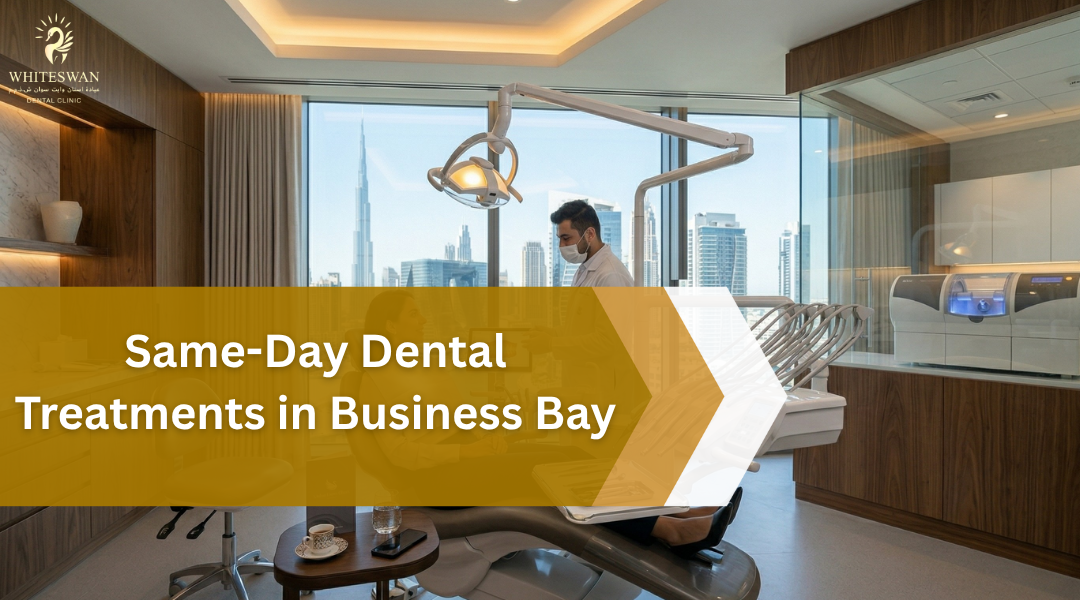
Same-Day Dental Treatments in Business Bay

Business Bay doesn’t just run on coffee; it runs on momentum. When you’re bouncing between the Burj Daman and a high-stakes meeting at the Opus, “waiting” is a dirty word. Time is the only thing we can’t buy more of here. Yet, for the longest time, dental work in this district was stuck in the slow lane. You’d chip a tooth, get some messy silicone shoved in your mouth, and then wait two weeks for a lab to ship back a crown. By then, your schedule has shifted, the temporary has probably fallen off during a lunch at The Dubai Mall, and you’re back to square one.

Honestly, who has the patience for that anymore?

The shift toward same-day dentistry isn’t just a tech upgrade. It’s a response to the way we live now. We expect our flights to be on time, our deliveries to be instant, and our healthcare to keep up. At the heart of this local shift is White Swan Clinic. They’ve basically looked at the traditional dental model and decided it was too slow for the 2020s.

Why the “Temporary” Fix is Dying

We’ve all been there. That awkward stage where you’re wearing a resin placeholder while the “real” tooth is being baked in a lab across town. These temporaries are a nightmare. They’re bulky, they stain the second you look at a cup of coffee, and they never quite feel right.

Modern tech has finally killed that inconvenience. By bringing the lab inside the clinic, the process is now a straight line. We’re talking about high-grade ceramic restorations milled right while you check your emails in the lounge. It’s digital dentistry in its purest form. At White Swan Clinic, you go from a 3D scan to a permanent, bonded porcelain crown in about ninety minutes. You walk in with a problem and leave with the final result before your next Zoom call starts. No “to be continued.” No second appointments.

Precision Over Pressure

There’s this weird myth that “fast” means “sloppy.” In medicine, that’s a dangerous assumption. But the irony here? Digital dentistry is actually way more accurate than the old-school manual way.

Think about the old process. That tray of goop? It can shift. The plaster mold? It can shrink. Every human hand that touches the model adds a tiny margin of error. Digital scanners don’t have that problem. They map your mouth with thousands of data points per second, accurate to the micron. When White Swan Clinic uses these scans, the fit is usually better than anything a human could carve by hand. It’s about using computer logic to perfect dental artistry.

More Than Just a Quick Crown

In Business Bay, “same-day” covers a lot of ground. It’s not just about fixing a broken molar. We’re seeing a massive spike in what people call “Flash Transformations.”

Maybe it’s laser gum contouring or professional whitening that actually works in under an hour. But the real game-changer is guided implant surgery. While the bone still needs its time to heal, the “Same-Day Tooth” protocol means you can get a temporary, aesthetic tooth attached the moment the implant is placed. For a CEO or a public-facing entrepreneur, walking around with a gap in their smile for three months isn’t an option. It’s about maintaining the image while the biology catches up.

The White Swan Ecosystem

What makes a clinic actually work in a place like Dubai? It’s the infrastructure. You can’t claim to be “same-day” if you’re still waiting on a courier to bring parts from a lab in Al Quoz.

White Swan Clinic works because it’s a self-contained hub. They’ve packed diagnostic imaging and high-tech milling units into one space. This removes the bottlenecks that usually kill your afternoon. You walk in, the X-rays are instant, the design happens on a screen right in front of you, and the machine starts carving your tooth immediately. It’s transparent. You aren’t just a patient; you’re seeing the craftsmanship happen in real-time.

The Mental Shift: Removing the “Dread”

Let’s be real: dental anxiety is usually just “waiting anxiety.” It’s the fear of the unknown and the annoyance of multiple visits. When you resolve the issue on the spot, the stress disappears.

The people living and working in Business Bay prioritize efficiency because their mental bandwidth is already maxed out. Knowing a dental issue can be handled in a single afternoon—no “return visit” required—changes the relationship people have with their health. It turns a chore into a quick pit stop. That’s why we’re seeing better long-term health outcomes; people stop putting off the work when the work doesn’t take forever.

Setting the Dubai Standard

Dubai doesn’t do “average” in anything else, so why settle for average dental care? The benchmark has moved. We now expect our clinical experiences to feel as seamless as a five-star concierge service.

Looking at the Business Bay skyline, it’s obvious that White Swan Clinic isn’t just selling healthcare; they’re selling time. Whether it’s a sudden ache that needs a root canal and crown or a quick aesthetic boost before a gala, doing it in one session is the new gold standard.

The Bottom Line

The era of the “two-week wait” is over. As these tools get smarter, the limits of what we can do in an afternoon keep pushing outward. For the Business Bay crowd, the choice is simple: stay stuck in the old way, or pick a clinic designed for the pace of 2026. White Swan Clinic isn’t just keeping up with Dubai; it’s setting the tempo.

Does a same-day crown actually last?

Yes. They use the same high-strength ceramic blocks as top-tier labs. If anything, the fit is often tighter because the digital scan is so precise. Expect a decade or more of use.

Does it hurt more because it’s faster?

Actually, it’s usually more comfortable. You only get numbed once, and you skip the “goop” impressions that make most people gag.

How long will I actually be in the chair at White Swan Clinic?

For a standard crown or a major whitening session, plan for a couple of hours. You can usually work on your laptop while the tooth is being milled.

Is there any special “aftercare” for same-day work?

No. Treat it like a real tooth. Brush, floss, and don’t skip your regular check-ups. It’s built to live your life.

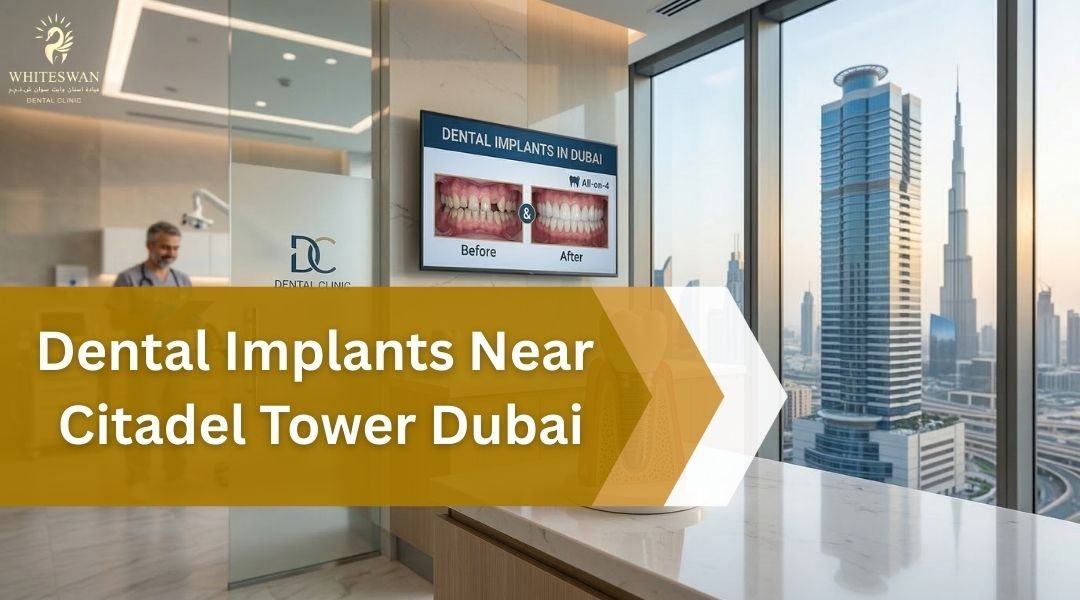
Dental Implants Near Citadel Tower Dubai

Let’s be real for a second. If you’re working out of the Citadel Tower, you’re not exactly hurting for choice when it comes to dentists. Business Bay is practically paved with dental clinics. But here’s the kicker: most of them feel like clinical assembly lines. You walk in, they quote you a price for a “screw in your jaw,” and you walk out feeling like a line item on a balance sheet.

In a neighborhood where your personal brand is basically your currency, a missing tooth or a failing bridge isn’t just a “medical issue.” It’s a distraction. It’s that nagging thought in the back of your head during a pitch at the Opus or a dinner at the Dubai Mall. You want it fixed, you want it done right, and you’d prefer not to trek across the city to do it.

That’s where White Swan Dental Clinic comes in. And no, they aren’t just “nearby.” They are literally in the building—Suite 2502.

The ROI of a Titanium Root

We talk about dental implants like they’re a luxury, but from a business perspective? It’s a capital investment. If you lose a tooth, the bone underneath starts to vanish. It just… retreats. Think of it like a foundation settling poorly under a skyscraper.

An implant isn’t just a porcelain cap; it’s a titanium post that tricks your body into thinking the tooth is still there. This stops the bone loss. At White Swan, the focus isn’t just on making the tooth look pretty (though that’s a given), it’s about the bio-mechanics. They use high-grade biocompatible materials because, frankly, you don’t want your body rejecting a “budget” metal in the middle of a busy fiscal quarter.

Why White Swan Actually Fits the Business Bay Hustle

I’ve seen plenty of clinics that claim to be “premium,” but then they close at 6:00 PM. Who has time for that?

What’s actually impressive about the team at White Swan is their understanding of the Dubai work ethic. They stay open till 9 PM on weekdays. Even on Sunday they remain open. If you’ve got a tooth emergency or finally decided to pull the trigger on that implant, you don’t have to burn a half-day of annual leave to make it happen. You can literally take the elevator down from your office after your last meeting and get seen.

The Tech: It’s Not Just for Show

Look, I’m a sucker for good tech, but only if it actually works. In 2026, if your dentist is still using 2D X-rays to plan an implant, you should probably run.

Up on the 25th floor, they’re using 3D digital mapping (CBCT). This allows the surgeons to see your jaw in high-def before they ever touch a drill. They use guided surgery, which is basically GPS for your mouth. It makes the procedure faster, the recovery shorter, and the placement way more precise. It’s the difference between guessing where a wall stud is and using a laser level.

Let’s Talk About the “Fear” Factor

I know guys who can handle a hostile takeover without breaking a sweat, but turn into a puddle at the sight of a dental chair. It’s fine. We’ve all been there.

The “Fear-Free” approach at White Swan isn’t just a marketing slogan. They actually do the work IV sedation, “laughing gas,” or just a doctor who knows when to stop and let you catch your breath. They’ve built a reputation for being the “gentle” clinic in Business Bay. If you’ve been putting off an implant because you’re terrified of the pain, this is the place that’ll actually listen to you.

What’s the Damage? (The Cost Conversation)

Dubai isn’t cheap, and neither is world-class dentistry. You can find “deals” in other parts of the city, sure. But do you really want a discounted surgery?

At White Swan, you’re paying for the fact that the person holding the drill has done this thousands of times. You’re paying for the 9-to-10 accessibility. They’re transparent about the costs, no “surprise” fees for the abutment or the crown once you’re already in the chair. Plus, they handle the insurance headache for you, which is a blessing in itself.

The “Teeth in a Day” Reality Check

You’ve seen the ads. “Walk in with a gap, walk out with a smile.” Is it true?

Mostly. White Swan can often do “immediate loading,” meaning you get a temporary tooth the same day as the implant. You won’t be eating a 12-ounce ribeye that night, but you also won’t be whistling through a gap during your morning stand-up meeting. The real healing takes a few months, but aesthetically? You’re back in the game immediately.

The Verdict

If you’re based in or around the Citadel Tower, staying local for your dental work is a no-brainer. But don’t just go there because it’s close. Go there because White Swan has managed to marry high-end surgical expertise with a schedule that actually respects yours.

It’s about confidence. It’s about being able to smile in a high-stakes meeting without wondering if anyone notices that bridge or that gap. In a city where image is everything, it’s probably the best investment you’ll make all year.

The FAQs

Does White Swan take my insurance?

They work with a huge range of providers. The best bet is to give them a quick WhatsApp with your card details—they’ll usually check it for you before you even step foot in the Citadel Tower.

How long am I going to be out of commission?

Honestly? Not long. Most people have the procedure on a Thursday or Friday and are back in the office by Monday. If you use their minimally invasive tech, the swelling is usually pretty negligible.

I’m terrified of needles. Can you help?

Absolutely. They specialize in sedation dentistry. You can opt to be completely “out” or just very relaxed. You won’t even remember the needle.

Is White Swan really open on Sundays?

Yep. It’s perfect for those of us who spend the work week jumping from one meeting to the next.

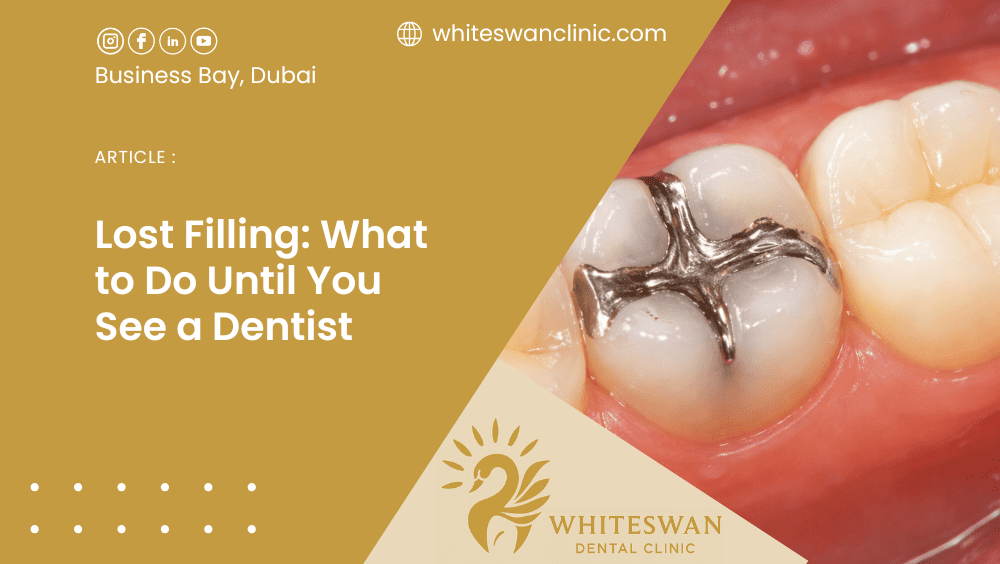
Lost Filling: What to Do Until You See a Dentist

You won’t expect a filling to come out in the middle of a day. Maybe you were having coffee. Eating lunch. Or noticed a rough spot on the tooth with your tongue. Though, it was not there before. Then the sensitivity starts. Cold water feels too cold. Sweet food stings. Biting down feels strange. This can be unsettling.

A lost filling may look like a major problem. But it must not be ignored. When the filling is gone. The tooth loses its protection. That exposed area can become sensitive, collect food, and in some cases crack further if you keep chewing on it. White Swan Dental Clinic meets patients who manage it for a few days. But they end up with more pain than expected. The best approach is to avoid making it worse and protect the teeth. Also visit a dentist as quickly as you can. 

Why a lost filling matters

A filling will be there for a reason. This covers a part of the tooth. That was damaged before. Usually by wear or decay. If it falls out, the area becomes exposed. So the tooth reacts to pressure, temperature, sugar or air moving across it. A few patients feel mild irritation. Others would get a jolt when they drink something cold. 

The bigger concern is not about the discomfort. But an open area in the tooth. This gives bacteria and food an easy place to settle. So when you leave it for long, the cavity deepens. The tooth weakens. Repairs become more complicated than simple replacement filling. Looking for a Dental Clinic in Business Bay?

How will you know a filling has fallen out

It is obvious. The patient feels the filling comes loose when eating. Also notice a small hard piece in their mouth. But that does not always happen. People realise something is wrong as the tooth may feel different. 

You may notice:

  • a rough or jagged edge on the tooth
  • a small hole you can feel with your tongue
  • food getting stuck in one area
  • sudden tooth sensitivity
  • discomfort with cold, hot or sweet food 
  • pain while chewing

When that sounds familiar. There is a chance you deal with a missing filling.

Why do fillings come out

People think the filing can last forever. But they don’t. Fillings undergoes daily pressure. With temperature changes, chewing and general wear. They break or loosen over time. 

Some causes include: 

1. Normal wear over time

Older fillings weakens after years of use. This is common in the back teeth. As they handle the chewing pressure.

2. Decay forming around the filling

The new cavity will develop at the edge. Or underneath the old filling. When this happens, the tooth structure holding it in place may get weaker. 

3. Biting something hard

Popcorn kernels and ice. Hard sweets and small seed can also dislodge a filling. 

4. Grinding and clenching

Night grinding would place repeated pressure on fillings and teeth. Overtime the force loosens them. 

5. Cracks in the tooth

The filling is not only the issue sometimes. The tooth around it starts to crack. This makes the filling less secure. Get details on Dental Implants in Dubai.

What to do right away

If you have lost a filling, do not panic. There are some steps recommended to take before the appointment. 

Rinse your mouth gently

Use warm water. It helps remove trapped food. Keeps the area clean. A mild salt water rinse will feel soothing. When the nearby gum is irritated. 

Keep your tooth clean

Use a soft toothbrush to clean. Don’t scrub hard. Brushing aggressively will make the sensitivity worse. 

Chew on the other side

This will matter more than people realise. When you keep using the affected tooth, you cause damage and increase pain. 

Avoid extreme temperatures

Iced drinks. Hot tea and sugary snacks trigger pain. When the filling is missing. So milder foods are the safe option. 

Use a temporary dental repair product if needed

Some pharmacies sell temporary dental filling repair material. This covers the exposed space for a short time. But it is a temporary measure. Not a real fix. 

Call your dentist

Arrange a dental visit even when the pain is manageable. A lost tooth filling should be checked properly. Looking to a Best Dental Clinic for Teeth Filling?

What not to do

When people get worried, they sometimes try random home solutions. That usually creates more trouble.

Please avoid the following:

  • do not use glue or any household adhesive
  • do not poke the tooth with sharp objects
  • do not chew hard foods on that side
  • do not ignore the problem for too long
  • do not assume the tooth is “fine” just because it is not hurting much

Pain is not always the best measure of damage. Some teeth stay quiet for a while and then flare up later.

How to ease discomfort until the appointment

A lost filling causes mild sensitivity to toothache. Do a few things when you wait to see the dentist. 

Do warm salt water rinses. They keep the area cleaner and may reduce irritation. Take the over the counter pain reliever. Follow the instructions given in the label. Stick to soft foods for some days after the filling comes out. 

Try not to test the tooth again and again with your tongue. People most often do that. This makes the area more irritated. Leave it as it is. Get details on Broken Tooth Treatment in Dubai.

When must you seek urgent dental care

Every lost filling won’t be a midnight emergency. But a few situations require quick attention. 

Contact a dentist when you have: 

  • strong or throbbing pain
  • swelling around the tooth or face
  • a bad taste or smell from the area
  • visible cracking of the tooth
  • pain that makes eating difficult
  • bleeding that does not settle
  • signs of infection, such as pus

These symptoms may suggest that the problem has gone deeper than the filling alone.

What your dentist may do

Treatment depends on the condition of the tooth. In some cases, replacing the filling is enough. This is the best case scenario. The dentist checks for decay after cleaning. Then place a new filling. 

When the tooth has weakened badly. Broken or developed deeper decay, a protective solution is needed. This can mean an onlay, inlay or crown. If the inner nerve of the tooth is affected, root canal treatment may also be recommended.

Timing matters. The early the tooth is examined. The better to keep the repair simple. Looking to a Best Clinic for Tooth Removal?

Can you fix a lost filling at home

No. You will cover it for a short time using a temporary material from a pharmacy. But this is not the same as the treatment. Home repair kits don’t strengthen the tooth. They do not remove the decay. They do not tell if there is a crack underneath. 

Temporary products will help you get through the day. They just should not become your long-term plan.

Can a lost filling cause more serious damage?

Yes, it can. Once the protected area is exposed, the tooth is more vulnerable. Chewing pressure may cause a weak part of the tooth to chip. Food may get trapped there and make cleaning difficult. Bacteria moves deeper into the tooth. This leads to pain, decay or infection. 

That is why a filling fell out situation should be treated sooner rather than later. Waiting often makes the final treatment more expensive and more involved.

Reduce the chance of losing fillings in future

Filling doesn’t last forever. But good habits make them last longer. 

  • Brush twice daily and floss properly
  • Go for regular dental check ups 
  • Avoid chewing ice and other hard objects
  • Get help for teeth grinding if you clench at night
  • Have worn fillings checked before they fail completely

A small repair caught early is usually easier than an emergency visit later.

Related Articles:

» Dental Abscess: Warning Signs That Need Immediate Care

» Crowded Teeth: Treatment Options and Timeline

» Early Signs of Tooth Decay You Shouldn’t Ignore

» Implant Maintenance: Hygiene Tips for Long-Term Success

» Root Canal vs Extraction + Implant: How to Decide

Managing a Lost Filling: Stay Comfortable Until Your Dentist Appointment

A lost filling is one of those dental issues people often try to put off, mostly because life is busy and the pain may come and go. Still, it is better not to leave it open. Though the tooth feels not too bad. The exposed area requires proper treatment and protection. 

Keep the area clean. Rinse gently. Avoid chewing on the side. Visit a dentist as quickly as you can. White Swan Dental Clinic always reminds patients that fast action can prevent a bigger problem. And really, when it comes to teeth, early care usually saves a lot of trouble.

FAQs on “Lost Filling: What to Do Until You See a Dentist”

1. What can I do first if my filling falls out?

Keep the area clean. Rinse your mouth using warm water. Avoid chewing on the side. Contact your dentist.

2. Will a lost filling always be an emergency?

No. It becomes urgent when you have pain and swelling. Or signs of infection.

3. Can I be able to eat with a missing filling?

Yes. It is better to choose soft foods. Chew on the opposite side.

4. Why does the tooth get sensitive after the filling comes out?

The inner part of the teeth is less protected. So they react to pressure, temperature and sweet food.

5. Can I wait a week before visiting a dentist?

Don’t wait for long. The longer the tooth is exposed, the higher the damage would be.

6. May I use a temporary filling kit from a pharmacy?

Yes. Only for short-term help. This is not a substitute for proper dental treatment.

7. What foods can I avoid after losing a filling?

Avoid very cold and very hot foods. Also sugary and hard foods.

8. Will a lost filling lead to infection?

Yes. When the bacteria enters the exposed area. When the tooth is left untreated. Then infection will develop.

9. Does the dentist always put in another filling?

Not always. When the tooth is badly damaged or weak. A crown or another treatment is better.

10. Why do the fillings fall out in the first place?

Common causes are wear, age, hard foods, decay under the filling. Also teeth grinding.

11. Will I be able to put the old filling back in myself?

No. It will not seal the tooth properly. Or sit safely without a professional treatment.

12. How will I stop fillings from coming out again?

Good oral hygiene. Regular check ups. Avoid hard foods. Treat grinding habits. These all can help.

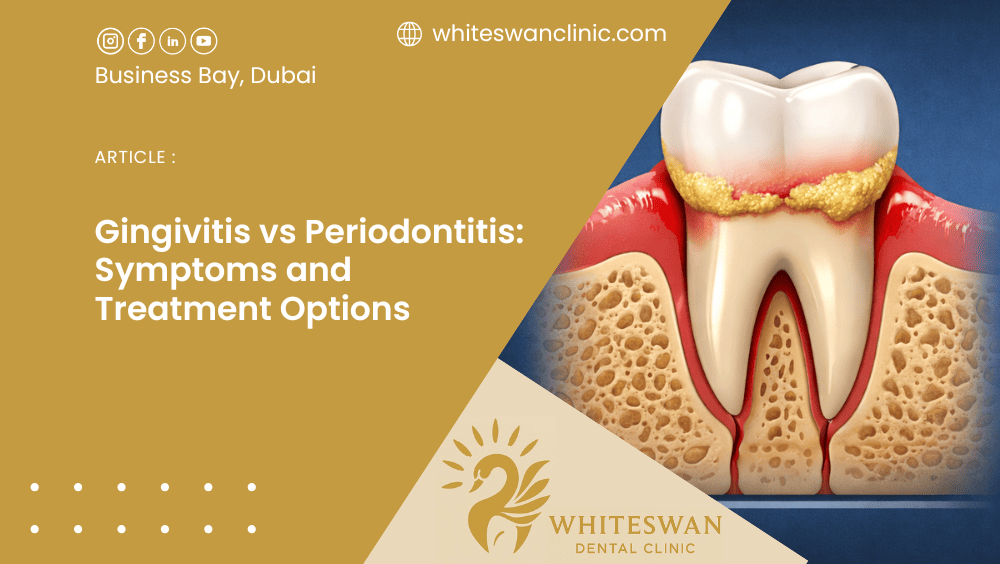
Gingivitis vs Periodontitis: Symptoms and Treatment Options

Healthy gums support your teeth more. It protects the roots. Hold the teeth firm in place and maintain oral health. But gum disease damages the foundation when ignored too long. The common gum conditions are periodontitis and gingivitis. Though people use these terms interchangeably. They aren’t the same. 

Understanding the difference of gingivitis and periodontitis is necessary. Tooth loss is reduced in early treatment. Also pain and costly dental procedures later. White Swan Dental Clinic helps patients in Dubai to identify the gum problems early. Also choose the best treatment before the condition gets worse. 

What Is Gingivitis

Gingivitis is the early stage of gum disease. It happens if a sticky film of bacteria starts building around the gum line. This plaque irritates the gum. Also causes inflammation over time. 

In this stage, the damage is limited to the gums. Gingivitis treatment is simple when the problem is caught early. The condition is reversed in most cases with better home care and professional cleaning. 

Common symptoms of gingivitis

  • Bad breath
  • Swollen gums
  • Tender gums
  • Gum irritation
  • Bleeding when flossing 
  • Bleeding when brushing

People ignore these warning signs. As it doesn’t always cause pain. But bleeding gums must not be treated as normal. Looking for a Dental Clinic in Business Bay?

What Is Periodontitis

Periodontitis is a serious and advanced form of gum disease. This develops when gingivitis is left untreated. In this stage, the infection moves deep below the gum line. This starts affecting the tissues and bone that support the teeth. 

Periodontitis causes permanent damage. The gums pull away from the teeth. Pockets form. Also the supporting bone begins to weaken. So the teeth become loose and fall out when treatment is delayed. 

Symptoms of periodontitis

  • Loose teeth
  • Persistent bad breath
  • Bleeding gums
  • Pain when chewing
  • Receding gums
  • Pus between gums and teeth
  • Changes in bite alignment 
  • Teeth appearing long

The difference between periodontitis and gingivitis is not only about severity. It is how deep the infection affects the mouth. Get details on Teeth Cleaning and Polishing.

Gingivitis vs Periodontitis – The Main Difference

The best way to understand gingivitis and periodontitis is to think of it as two stages of gum disease. 

Condition

Affects

Can It Get Reversed

Signs

Gingivitis

Gums only

Yes

Swelling, redness and bleeding

Periodontitis

Bone, gums and supporting tissues 

Damage is not fully reversible

Deep pockets, gum recession or loose teeth

Gingivitis is the warning stage. But periodontitis can be a destructive stage. 

What Cause Gum Disease

Plaque buildup is the cause of periodontitis and gingivitis. But many factors increase the risk. 

Cause and risk factors

  • Poor flossing 
  • Poor brushing habits
  • Diabetes
  • Tobacco use or smoking
  • Hormonal changes
  • Dry mouth
  • Certain medications 
  • Stress
  • Family history of gum disease 
  • Poor nutrition

Some people develop gum disease due to these factors. Though your symptoms may look mild at first.

Early Signs One Should Not Ignore

Patients wait until they feel the pain before visiting a dentist. However, gum disease progresses quietly. That is why routine dental visits are important.

Book a dental check up when you notice:

  • Blood on your toothbrush 
  • Bad taste in mouth
  • Swollen gums
  • Chronic bad breath
  • Tooth sensitivity near the gum line
  • Gums pulling away from teeth

These signs look minor. But they point to a start of a big issue. Looking for a Root Canal Treatment in Business Bay?

How Dentists Will Diagnose Gingivitis and Periodontitis

The diagnosis at White Swan Dental Clinic starts with an oral examination. Dentist checks the conditions and colour of your gums. Measure the spaces between your gums and teeth. Also look for plaque and tartar. 

Diagnosis include

  • Pocket depth measurement
  • Gum examination
  • Assessing tooth movement
  • Checking for gum recession
  • Dental X-rays

When the pockets around your teeth are deeper than normal, it suggests periodontitis. X-rays show if the bone around your teeth has been affected.

Treatment Options for Gingivitis

The best part in treating gingivitis is that they are manageable without complex procedures. 

1. Professional dental cleaning

A dental cleaning can remove plaque and tartar that is not removed by brushing alone. It is the first step in the treatment of gingivitis. 

2. Best oral hygiene

The dentist will guide you on: 

  • Flossing correctly
  • Brushing twice daily
  • Replacing your toothbrush most often 
  • Using an antibacterial mouthwash 

3. Regular dental visits

A follow- up visit will make sure the gums are healing properly. Also staying healthy. 

When treated early, the gums return to a healthy state. So early care makes a big difference. Get details on Crooked Teeth Treatment in Dubai.

Treatment Options for Periodontitis

Periodontitis treatment is advanced as the infection moves deeper below the gums.

1. Scaling and root planing

This deep cleaning removes tartar and bacteria below the gum line. It can smooth the tooth roots. So the gums will reattach easily. 

2. Antibiotic therapy

Dentists use oral or local antibiotics to control infection in some cases. 

3. Gum surgery

When deep pockets remain, surgical treatment is needed. It involves flap surgery to clean deep areas and reshape the gum tissue. 

4. Regenerative procedures or Bone grafting

If periodontitis causes bone loss, some patients require procedures that support bone and tissue repair. 

5. Maintenance care

Routine periodontal maintenance is required after treatment. With proper follow up the gum disease can return. 

When a periodontitis treatment controls the disease and protects your smile, it is more demanding than treating gingivitis. Looking for a Wisdom Tooth Removal in Business Bay?

Will the Gingivitis Turn Into Periodontitis

Yes. It will. This is the important reason to treat the bleeding gums early. If gingivitis is ignored. The bacteria can spread below the gum line. So the inflammation begins to destroy the bone and tissue supporting the teeth. 

That is why prompt dental care matters. A simple cleaning today may prevent major gum treatment later.

Prevent Your Gum Disease 

Prevention is better. A few daily habits lowers the risk. 

Ways to prevent gingivitis and periodontitis

  • Floss every day
  • Brush your teeth twice a day
  • Avoid smoking
  • Clean your tongue
  • Make use of fluoride toothpaste
  • Limit sugary snacks
  • Drink enough water
  • Visit dentist regularly for check up and cleaning

Regular oral care can protect more than your smile. It can support your overall health as well.

Why Gum Health Matters for Overall Health

Gum disease not only affects the mouth. Research shows a link between gum inflammation and broad health concerns like heart health or diabetes. When gum disease begins in the mouth, the effect can go beyond that.

So taking care of gums must be a full wellness routine. Not only your dental routine. Get details on Smile Makeover in Business Bay.

When to Check with a Dentist

See a dentist when noticing: 

  • Gums bleeding often
  • Gum swelling that does not improve
  • Loose teeth
  • Gum recession
  • Bad breath that stays
  • Pain around the gums

The early the condition gets diagnosed. The more conservative the treatment would be. 

Related Articles:

» Orthodontic Assessment Ages: When to Check Your Child’s Bite

» Dental Implants in Dubai: Step-by-Step Process

» Early Signs of Tooth Decay You Shouldn’t Ignore

» Wisdom Tooth Pain: Signs You Need Removal

» Receding gums: Treatments that work

Healthy Gums and Stronger Smile

The message is clear when comparing periodontitis with gingivitis. Early gum problems get easier to treat than advanced gum disease. Gingivitis is reversible. But periodontitis leads to lasting damage when ignored. So the mild symptoms like bleeding gums will deserve attention. 

White Swan Dental Clinic focuses on personalised care. Also early diagnosis and practical treatment plans. This allows patients to protect their gums. Maintain their natural teeth longer. When your gums are swollen, sore or bleed when brushing. Now will be the time. 

FAQs on “Gingivitis vs Periodontitis”

1. Mention the difference of gingivitis and periodontitis?

Gingivitis affects the gums. They are reversible. Periodontitis is an advanced infection. It  damages the supporting tissues and bones around the teeth.

2. Will gingivitis go by its own?

No. Better brushing can help. But professional cleaning is required. This removes plaque and tartar.

3. Are bleeding gums always be a sign of gingivitis?

The common sign of gingivitis is bleeding gums. But they also indicate other gum problems.

4. Will periodontitis be cured?

It is controlled and managed. But the lost tissue or bone will not fully return without specialized treatment.

5. Will gingivitis cause any pain?

No. Many people do have gingivitis without any pain. This is why it is often unnoticed.

6. What are known as periodontal pockets?

The spaces that form between the gums and teeth when infection causes the gum tissue to pull away.

7. How will periodontitis be treated?

Treatment includes antibiotics, scaling and root planing, regular periodontal maintenance and gum surgery.

8. Will children get gingivitis?

Yes. Teenagers and children develop gingivitis. Even when the oral hygiene is poor.

9. Can bad breath be related to gum disease?

Yes. Periodontitis and gingivitis cause persistent bad breath because of bacterial buildup.

10. How often must I get my gums checked?

People should have a dental check up every six months. A few patients with gum disease require frequent visits.

11. Will smoking make periodontitis worse?

Yes. Smoking increases the risk of severe gum disease. It slows the healing after your treatment.

12. When can I visit White Swan Dental Clinic for gum problems?

Book a visit when you notice swelling or bleeding gums. Also loose teeth, gum recession or ongoing bad breath.

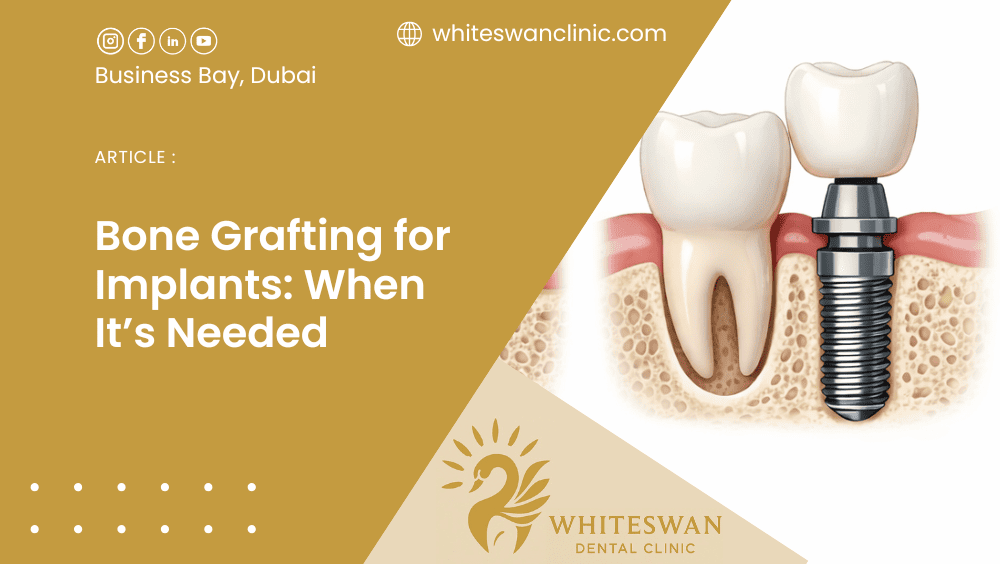
Bone Grafting for Implants: When It’s Needed

Losing a tooth not only leaves a gap in a smile. But they also affect the jawbone underneath. The bone shrinks after a tooth loss, trauma, gum disease or long term denture use. Thereby patients do not have healthy bones to hold the dental implant. That is when bone grafting for implants becomes important. A bone graft can rebuild the jaw. It creates a strong foundation for future implant placement.

In White Swan Dental Clinic patients ask questions like, Do I need a bone grafting before implants? The honest answer would be that not everyone needs it. But when the jawbone is soft, thin or low in volume, grafting is the best step for a long term implant success. Mayo Clinic says that implants require enough bone support as chewing places a strong pressure on the jaw. The treatment fails when the bone does not support the implant properly.

Bone grafting for dental implants

Bone grafting for dental implants is the procedure. It rebuilds or adds bone in the jaw where the support is missing. This creates a stable base for the implant screw. As per Cleveland Clinic, a dental bone graft can replace bone that has been missing in the jaw or lost. This is mainly performed before implant treatment. 

The graft would act like a support builder. The oral surgeon or dentist places grafting materials in the weak area. Over time the body heals. Then the site becomes stronger and suitable for an implant. Looking for a Dental Clinic in Business Bay?

Why bone loss happens before implants

Jawbone loss can happen faster than most people realise. When a tooth is missing, the bone in that area will not receive regular stimulation from chewing. So the body begins to resorb the unused bone. Also infection, injury, gum disease or tooth extraction complications reduces the bone volume. The NHS patient guidance on implant grafting clearly states that bone grafting is needed when there is not enough bone in the jaw that supports implant placement. 

Main reasons for bone loss include: 

  • Tooth loss for a long time
  • Advanced gum disease
  • Trauma to the jaw or face
  • Bone infection
  • Long-term denture wear
  • Natural thin jawbone in some areas

Although your gums look healthy from outside. The underneath bone still requires rebuilding. 

Why bone grafting is needed for implants

Dentists mostly recommend bone grafting before dental implants. When scans show that the jaw does not have enough width, height or density. Mayo Clinic mentions that the jawbone graft is needed when the bone is soft or not thick enough. Likewise, hospital guidance from Guy’s and St Thomas’ says grafting is often used to rebuild the area before the implant is placed.

You may need a graft if:

1. The jawbone is thin

When the bone is narrow, the implant will not fit safely.

2. The jawbone is too soft

Even if there is enough space, weak bone may not hold the implant firmly.

3. Bone height has reduced after tooth loss

This is very common in patients who waited many months or years before replacing a missing tooth.

4. There was infection or periodontal disease

Serious infection can damage the bone around the missing tooth.

5. A sinus lift or advanced support is required

In the upper back jaw, bone can be limited because of the maxillary sinus area. Some patients need extra grafting there before treatment. NHS guidance notes that different grafting options are used depending on where and how much bone is missing. Get details on Dental Checkup in Business Bay.

Types of bone grafts used for implant dentistry

All grafts are not the same. The type selected depends on the treatment area, amount of bone loss and the patient’s overall oral health. 

Autogenous bone graft

It uses the bone from your own body. Mainly from another area of the jaw. AAOMS mentions that autogenous grafts have living bone tissue and growth factors. This is one reason they are valued in reconstruction. NHS guidance also mentions that a small amount of bone is taken from the back of the jaw or chin in minor cases. Whereas larger grafts require bone from another site like the hip. 

Donor bone graft

This uses processed donor tissue from a tissue bank. AAOMS mentions that non-autogenous grafts come from a donor. Not from the patient. 

Synthetic bone graft

A few grafting materials are man-made. They are designed to support bone regeneration. 

Animal-derived graft material

Certain grafts are made from processed natural sources and used safely in dental procedures.

The implant dentist chooses the suitable material based on your case. Hence there is no best option for everyone. Looking to a Best Clinic for Tooth Removal?

Will bone grafting and implant placement happen together

Yes sometimes. It is not sometimes. When the bone deficiency is small, the implant and graft are placed at the same appointment. But when the area requires a major rebuilding, the graft heals first and the implant is placed later. Cleveland Clinic states that healing may take months, and some implant services note that if there is not enough bone, the graft may need around three months of healing before implant placement. Guy’s and St Thomas mention that bone grafts are left to heal for 3 to 6 months. Before the implants are fitted. Due to this, the treatment timeline changes from patient to patient. 

What to expect during the procedure

The procedure begins with treatment planning and detailed imaging. The area is numbed and then the grafting material is placed in the deficient part of the jaw. In some cases, membranes or other supportive materials are used to protect the site while it heals. AAOMS materials mention that bone grafting is a part of rebuilding normal bone architecture in the implant related procedures. 

Bruising, mild swelling or soreness is normal after the procedure. NHS patient information on bone grafting mentions that bruising, swelling and pain occur after surgery. Get details on Broken Tooth Treatment in Business Bay.

Recovery after bone grafting for implants

Healing differs for each patient. Initial recovery may feel manageable within several days, but complete healing of the graft takes much longer. Cleveland Clinic mentions that initial healing takes a week. Whereas full graft healing takes longer depending on the case. 

During the recovery phase, patients are advised to: 

  • follow the prescribed medicines carefully
  • avoid pressure on the surgical site
  • eat softer foods for a while
  • keep the mouth clean as instructed
  • attend review visits on time

Recovery needs patience. So the healing period can help create a stable base for the implant.

Is bone grafting painful

It is one of the common concerns. The procedure is done with local anaesthesia. You must not feel pain during treatment. Afterwards, swelling, tenderness and mild discomfort are to be expected for some days. Patients state that recovery feels easier. Particularly when they follow the aftercare advice. Looking for a General Dentistry in Business Bay?

Benefits of bone grafting before implants

Selecting bone grafting for implants offer many important benefits: 

Better implant support

A stronger jaw will give the implant a reliable foundation. Mayo Clinic notes that grafting creates a solid base for the implant. 

Improved long term stability

Implant may depend on the bone support for durability and function. 

Better smile appearance

Rebuilding lost bone improves the contour of smile and gum. 

More treatment options

A few patients may not be the candidates for implants without grafting. But after grafting, the implant placement becomes possible. Get details on Teeth Cleaning and Polishing.

Will every implant patient need a bone graft

No. Patients receive implants without grafting as well. When the jawbone is strong and healthy, the implant is placed directly. Cleveland Clinic’s implant guidance says that when there is enough bone, the implant can be done right away. 

One way to know for sure is the X-ray, dental examination or 3D scans. 

Why early treatment matters

When the missing tooth is left untreated for long, the bone will shrink. Replacing the missing teeth soon can reduce the need for bigger grafting procedures later. This is the reason why dentists encourage patients not to delay the implant consultations. 

Related Articles:

» How Long Does Teeth Whitening Last?

» Implant vs Bridge: Which One Should You Choose?

» Teeth Shifting After Braces: How to Prevent Relapse?

» Teeth Whitening for Sensitive Teeth: Safe Options

» Scaling and Polishing: What Happens During a Dental Cleaning?

Ensuring Strong Implant Support with Bone Grafting

There is nothing to fear from bone grafting for implants. Consider it as a crucial step that prepares your mouth for implant success. If the jawbone is weak or thin, grafting can rebuild the support of your implant needs. This may extend the treatment time. But it often improves function, stability and final results. Authoritative patient guidance from Cleveland Clinic, Mayo Clinic, AAOMS and NHS sources support the same idea that strong bone is needed for predictable implant treatment. Also grafting is used when the support is missing. 

When you miss one or more teeth and require bone grafting before dental implants, a personalised consultation is the best step. White Swan Dental Clinic will carefully plan as the right foundation leads to a better smile. 

FAQs on “Bone Grafting for Implants”

1. What is known to be bone grafting for dental implants?

This is a procedure that adds or rebuilds bone in the jaw. So the dental implant gets enough support.

2. Will I need a bone graft before an implant?

You may need it. When your jawbone is soft, thin or shrunk after gum disease or tooth loss.

3. Will everyone getting implants require bone grafting?

No. Some patients have enough healthy bone and it proceeds without grafting.

4. How long will a bone graft take to heal?

Early healing can happen within days. But grafts require several months before the implant placement. Some NHS guidance says around 3 to 6 months in most cases.

5. Will the bone grafting be painful?

The procedure is done using local anaesthesia. You must not feel the pain during treatment. It is normal to have mild soreness afterwards.

6. Will the implant be placed on the same day as the bone graft?

Sometimes yes. Particularly in minor cases. But healing comes first in larger grafting cases.

7. What materials can be used in dental bone grafts?

The graft comes from donor bone, own bone, synthetic material or animal derived material.

8. Will the bone grafting be safe?

This is mainly used in dental procedures. Particularly before the implant placement. Similar to surgeries, it has risks. So proper assessment is required.

9. What will happen if I can’t get a needed bone graft?

When the jawbone does not support the implant, it will not be stable for long term.

10. How will dentists know whether I need a graft?

They will assess your mouth with dental imaging, exam and 3D scans that measure the bone width, height and density.

11. Will bone loss happen after tooth extraction?

Yes. Bone loss happens after a tooth is lost or removed. Because the area will not get the same stimulation from chewing.

12. Will bone grafting improve the look of my final implant result?

Yes. Rebuilding bone creates better support for appearance and function in most cases.

Night Grinding (Bruxism): How It Damages Teeth

You might sleep for eight hours and wake up feeling like you have done a workout. Sore cheeks, tight jaw, and a dull headache behind your temples. When this looks familiar, night grinding or bruxism would be the reason. Many people in Dubai clench or grind their teeth at night without even knowing it. The problem is, your teeth don’t get a “break” while you sleep. Instead, they take repeated pressure for hours, and that’s when the real damage starts.

White Swan Dental Clinic meets patients who say, My filling is breaking again and again or I don’t have cavities but why do my teeth hurt? After checking the bite and the wear pattern, the answer is bruxism that is working in the background. 

You can protect the enamel when you catch it early. Stop the jaw pain and save your dental work from getting worse. 

What Is Bruxism?

Grinding or clenching the teeth is Bruxism. This happens on a day when you are focused or stressed. But night bruxism occurs in the sleep. Since you are not awake to control it. The force could be stronger than normal chewing. 

Grinding is not always loud. A few people clench silently. But the constant pressure would be harmful. Looking for a Dental Clinic in Business Bay?

Common signs to notice:

  • Tight cheeks or sore jaw as you wake up
  • Headache pain near the temples
  • Sensitive teeth to hot or cold. It feels sharper than usual
  • Flat looking edges or teeth that seem worn down
  • Chipped teeth or sudden tiny cracks
  • Pain or clicking near the jaw joint
  • Crowns or fillings that are cracking or loosening
  • A partner who hears grinding sound at night

Reason for People to Grind Their Teeth at Night

It is not always one cause. There is a mix of triggers.

1) Stress and a Busy Mind

This is a big one. If you are under pressure with poor sleep, work deadlines, and anxiety. Also when your body holds tension. For many people, this tension goes straight into the jaw. 

2) Bite Problems or Uneven Teeth Contact

When your teeth are not met evenly, the jaw would search for a comfortable position. This movement increases the grinding and clenching. Sometimes a high filling can trigger pressure.

3) Sleep Issues and Breathing Problems

People grind more if they have a disturbed sleep. Mouth breathing, snoring and sleep apnea is included. Not all bruxism patients have this issue. But when you wake up tired or snore louder, it’s worth mentioning. 

4) Lifestyle Triggers

Heavy smoking, caffeine, alcohol and late night screen time affects the sleep quality. Then grinding episodes can become more frequent. Get details on Dental Checkup in Business Bay.

How Bruxism Damages Teeth (And Why It Adds Up Fast)

Bruxism isn’t “just a habit.” It’s pressure and friction applied to teeth repeatedly. Over time, teeth start to wear like a coin that’s been rubbed for years—only it can happen much faster.

1) Enamel Wear – First Line of Defence Gets Thin

The hard outer layer of the tooth is Enamel. Grinding would slowly scrape it down. That’s why teeth start looking flat at the top, especially molars. Front teeth can also lose their sharp edges, which changes your smile shape.

If enamel wears out, the teeth look yellow. It is not staining. A few times the inner tooth layer or dentin shows through. 

2) Sensitivity That Doesn’t Stop

When enamel thins, the teeth become reactive. Hot coffee, cold water, and sweet foods causes sharp feeling. People try toothpaste for this sensitivity and wonder that it barely helps. It is because the grinding is happening every night. 

3) Chips and Cracks That You Won’t Predict

Grinding creates small cracks over time. At first, you won’t feel them. Then one day you bite something soft and a corner breaks. That’s common with bruxism—damage doesn’t always match what you were eating.

Signs of cracking include:

  • Pain when biting on one side
  • A tooth that feels “off” even without a cavity
  • Rough edges you keep feeling with your tongue
  • A filling that keeps breaking again

If a crack reaches deep toward the nerve, treatment may become more complex, like root canal treatment and a crown.

4) It Can Break Fillings, Crowns, and Veneers

A lot of people think, “My teeth are fixed, so I’m safe.” Bruxism put stress on dental work. Crowns loosen, fillings fracture and veneers might chip. When you keep repairing the same tooth, bruxism is the real reason for it. 

5) Gumline Notches and Gum Recession

Some patients develop small notches near the gumline, especially on premolars. These areas can become sensitive and trap plaque more easily. Over time, gum recession can also become more noticeable.

6) Jaw Joint Pain and Face Tension

Jaw muscles are overworked. That is the reason for soreness in the cheeks, clicking when opening the mouth and pain near the ears. Bruxism triggers tension headaches as jaw muscles can connect closely with neck and head muscles. Looking for a General Dentistry in Business Bay?

Early Signs You Must Take Seriously

Bruxism starts quietly. Also rarely stays quiet. 

Pay attention when you have:

  • Morning jaw tightness
  • Frequent headaches on waking
  • Teeth sensitivity without obvious cavities
  • Flattened teeth or chips on the edges
  • Tight face muscles or pain near the ears
  • Repeated broken fillings or crowns
  • Clenching habit when concentrating

Noticing it early will save you from bigger repairs. 

Checking for Bruxism at White Swan Dental Clinic

White Swan Dental Clinic looks for patterns that point to clenching and grinding like: 

  • Flattened bite surfaces and enamel wear
  • Chipped enamel or micro-cracks
  • Change in bite balance
  • Jaw muscle tenderness
  • Strain in the TMJ area
  • Damage in existing restorations 

When your symptoms shows airway or sleep issues, we recommend evaluation as part of a complete plan. Get details on Root canal treatment in Business Bay.

Treatment: How to Protect Teeth and Calm the Jaw

The best bruxism plan usually does two things:

  • protects your teeth right away
  • reduces the triggers over time

1) Custom Night Guard (Most Common and Most Effective)

A custom night guard is made to fit your teeth precisely. This creates a protective layer between lower and upper teeth. Hence grinding force won’t destroy the crack fillings or enamel. 

In comparison to store bought guards, the custom guards: 

  • fits better and feel comfortable
  • less likely affects your bite
  • last longer
  • protects more

2) Bite Review and Minor Adjustments 

When we find high spots on restorations, bite imbalance or missing teeth that affects your bite, we suggest correction. Small improvements will reduce the strain. 

3) Care and Support for the Jaw Pain

When your jaw muscles are sore. This can help: 

  • warm compress at the jaw area
  • avoid gum and hard foods
  • gentle jaw exercises
  • posture support

4) Stress and Sleep Improvements 

It matters more than what people think. Try to: 

  • cut caffeine intake after mid-afternoon
  • reduce screen time before you sleep
  • relaxing routines like breathing exercises and light stretching
  • avoid alcohol intake before bedtime

Small changes will reduce the grinding episodes. Looking to a Best Clinic for Tooth Removal?

What Happens When You Ignore Bruxism

Bruxism usually gets more expensive over time. First it’s sensitivity. Then it’s chips. Then it’s broken fillings. Later it can become cracked teeth, jaw joint pain, and bite problems. That’s why a night guard is often one of the smartest “preventive” steps—because it can stop the damage before it turns into major dental work.

Related Articles:

» Gum Contouring: When Your Gums Affect Your Smile?

» Implant vs Bridge: Which One Should You Choose?

» Teeth Shifting After Braces: How to Prevent Relapse?

» Retainers: Types and How Long You Must Wear?

» Loose Teeth: Causes Linked to Gum Problems

Don’t Let Bruxism Steal Your Smile

When you suspect bruxism or night grinding, don’t wait unless you break a tooth. Protect your teeth early to manage it easier. White Swan Dental Clinic assesses your bite, checks the wear pattern and suggests the right solution. So you sleep better and keep up your smile. 

FAQs on “Night Grinding (Bruxism)”

1) What is bruxism or night grinding?

Clenching teeth or grinding habit in the sleep without realising.

2) Will bruxism damage teeth if I don’t feel anything?

Yes. Cracks and wear builds up for months or years.

3) Why do I mostly wake up with a headache?

Clenching can strain jaw muscles. This tension triggers temple headaches.

4) Do tooth sensitivity indicate a sign of bruxism?

Yes. Particularly when your enamel wears down and there are no cavities.

5) Will bruxism crack fillings and crowns?

Yes. Grinding pressure can break restorations repeatedly.

6) Are store bought night guards fine?

It helps in the short term. But a custom night guard can fit better and protect safely.

7) Can a night guard stop bruxism permanently?

This reduces strain and protects teeth. You may grind still the damage reduces.

8) Can bruxism cause jaw clicking?

Yes. It overloads the jaw joint. This leads to pain, clicking or stiffness.

9) Does stress really cause grinding?

Most often. Stress is the biggest trigger for grinding and clenching.

10) Can bruxism make teeth look shorter?

Yes. Grinding can flatten the teeth. It changes the way the smile looks.

11) Can bruxism get linked with sleep apnea?

Sometimes. When fatigue and snoring are present. Evaluation is required.

12) When to visit a dentist for bruxism?

When you have morning headaches, jaw pain, worn teeth, sensitivity or repeated dental breakage. Book the visit soon.

Laser Gum Treatment in Dubai: Who Is It For?

A lot of people in Dubai first notice gum problems in small ways.You could bleed once in a while. Otherwise your breath doesn’t feel fresh after brushing. It is cosmetic sometimes when your smile can show more gum. This can bother you in photos.

You are here because you came across laser gum treatment and wondered. Is it a trend or is this for me? White Swan Dental Clinic in Business Bay, Dubai looks after patients every week who ask the same thing. Let us make this simple: what laser gum treatment is, whom it suits and when another option can make sense.

What is laser gum treatment

Laser gum treatment is considered as a modern dental technique. Here we use a controlled dental laser that works on gum tissue. As per the case, they help:

  • Remove infected gum tissue
  • Reduce bacteria in gum pockets
  • Support healing after deep cleaning
  • Reshape or contour gums for a better-looking smile

So yes, it can be medical (gum disease treatment). It can be cosmetic like gum reshaping. That’s the reason laser gum treatment means different things for different patients. Looking for a Dental Clinic in Business Bay?

Why Dubai people go for laser gum therapy

Life in Dubai moves fast and people choose treatment that is manageable. Patients prefer laser gum treatment as it is: 

  • More precise in certain areas
  • Less traumatic to surrounding tissue
  • Associated with less bleeding in many cases
  • Comfortable with proper numbing and gentle techniques

But it is necessary to be honest. Lasers are only a tool. The results depend on your gum condition, your care, and how you follow the maintenance plan. 

Laser gum treatment in Dubai is for

1) People with bleeding gums and early gum disease

When your gums bleed when brushing or flossing. It is not normal. It’s usually inflammation. In early stages (gingivitis), treatment is often straightforward—especially when you act early.

In many cases, laser gum therapy is used to support gum healing after professional cleaning and to reduce bacterial activity around the gums.

2) Patients with gum pockets – periodontitis cases

As gum disease progresses, small spaces form between your gum and tooth. They are known as pockets. They trap bacteria in the gum line where your brush can’t reach.

In suitable cases, laser treatment for gum disease disinfects these pocket areas. They also remove unhealthy tissue along with deep cleaning. 

3) People with persistent bad breath linked to gum infection

Bad breath comes from various causes. The common one is hidden gum infection. When your mouth doesn’t feel fresh after changing toothpaste and tongue cleaning, that is the time to check the gums.

Laser support reduces bacteria in areas where brushing doesn’t reach. 

4) Anyone bothered by a gummy smile or uneven gum line

Not everyone who wants laser gum treatment has gum disease. Some simply want a better-looking smile.

When your gums cover too much of your teeth with one side higher than the other, laser gum contouring creates a balanced appearance. 

This is especially common before:

  • Veneers or crowns
  • Smile makeover plans
  • Special events like engagements, wedding and professional shoots

5) Patients preparing for cosmetic dental work

Sometimes the tooth isn’t the real issue—the gum line is. If your gums are uneven, even beautiful veneers can look “off.”

In those cases, gum contouring using lasers can help your final smile look more natural and symmetrical. Get details on Dental Checkup in Business Bay.

6) Patients who are anxious about dental procedures

A few people avoid gum treatment due to pain and stitches. You may not be alone, if you are one of them. 

Laser supported treatment feels less intimidating for patients. That’s when it is combined with proper anesthesia, calming communication, and step by step explanation. 

7) Patients with diabetes or systemic conditions affects gum health

Gum health is connected with the overall health. Diabetes makes gum inflammation harder to control when not managed properly. 

Laser therapy is recommended in some periodontal plans. However after reviewing the medical history and making sure treatment is planned safely. 

8) Smokers and ex-smokers who have gum problems

Smoking increases the risk of gum disease. It also affects healing. Some smokers ask for laser treatment because they want a “cleaner” approach.

Laser support may help reduce bacterial load; however, outcomes still depend heavily on smoking habits and follow-up care. Looking for a Teeth Whitening near Business Bay?

When laser gum treatment may not be the best option

Laser gum treatment is useful, but it isn’t for every case.

Your dentist may recommend another approach if you have:

  • Advanced gum disease with significant bone loss
  • Very deep, complex pockets needing surgical access
  • Loose teeth due to periodontal breakdown
  • Severe recession where reshaping could worsen appearance
  • Bite issues causing repeated gum trauma

A good clinic won’t push lasers. A good clinic chooses the safest and most predictable plan for your gums.

Signs you should book a gum evaluation 

If you notice any of these, don’t delay:

  • Bleeding gums
  • Swollen or red gum margins
  • Persistent bad breath
  • Gum recession (teeth looking longer)
  • Sensitivity near the gum line
  • Food packing between teeth
  • Pain while chewing
  • Teeth is loose or shifting

Early gum treatment can be fast, simple and comfortable than later stage periodontal care. Get details on Best Clinic for Tooth Removal.

What happens when consulting at White Swan Dental Clinic

We don’t guess. A proper gum evaluation includes:

  • Gum pocket measurements
  • Checking bleeding points and inflammation
  • Reviewing bite and hygiene habits
  • X-rays if needed to check bone support
  • Explaining treatment options clearly (including whether laser periodontal therapy fits your case)

Then we create a plan that matches your condition and your lifestyle—because you need something you can actually maintain.

What is the treatment like

The laser gum procedures can be done using local anesthesia. You’ll feel pressure, but pain is typically controlled.

Depending on your case, treatment may be:

  • Done in one visit (small cosmetic reshaping)
  • Done in sections (for gum disease treatment)
  • Done with deep cleaning and follow up reviews

Then you will receive a home care routine and follow up schedule. Looking for a Broken Tooth Treatment in Business Bay?

Recovery and aftercare

Recovery depends on what you had done. Cosmetic gum contouring tends to heal quickly. Gum disease treatment may need closer follow-up.

Common aftercare may include:

  • Gentle brushing instructions
  • Temporary mouth rinse guidance
  • Soft foods for a short period (if advised)
  • Follow-up visits to measure healing and pockets

The biggest secret of long-term results? Maintenance. If plaque builds again, gum inflammation can return.

Related Articles:

» Gum Contouring: When Your Gums Affect Your Smile?

» Implant vs Bridge: Which One Should You Choose?

» Deep Teeth Cleaning vs Regular Cleaning: Which One Do You Need?

» Composite Veneers vs Porcelain Veneers: Pros, Cons, Costs

» Loose Teeth: Causes Linked to Gum Problems

Advanced Gum Treatment for a Healthier Smile

Laser gum treatment in Dubai is the best option. They are suited for early gum disease, cosmetic gum reshaping or gum pockets. Choose it for the right reason and diagnosis.

When you deal with a gummy smile, bleeding gums, or inflammation, a gum evaluation is a better step. Then we confirm whether laser gum therapy suits your case. Also check if another approach is necessary or not.

FAQs on “Laser Gum Treatment in Dubai”

1) Is laser gum treatment painful?

Most patients do fine with local anesthesia. Mild tenderness afterwards is possible.

2) Who is the ideal candidate for laser gum therapy?

Those who are evaluated with gum disease, uneven gum lines and gum pockets.

3) Will laser treatment remove gum disease completely?

It helps control infection. But results are seen with good hygiene and maintenance visits.

4) How many sessions do I need?

This depends on the pocket depth, severity, and areas required for treatment.

5) Do laser gum contours purely cosmetic?

Yes. But they can also balance gum lines before the smile makeovers.

6) Do my gums grow after laser reshaping?

The reshaped gum line is stable in most cases. But inflammation changes the gum appearance over time.

7) How quick is the recovery after laser gum surgery?

Patients mostly feel comfortable within days. But in some periodontal cases it requires longer monitoring.

8) Can I eat normally after treatment?

Yes. Soft foods are recommended first.

9) Are laser gum treatments safe?

Yes. When it is done by trained professionals with the right protocols and settings.

10) Can a laser replace deep cleaning?

Not always. It’s often used with scaling and root planing for gum disease cases.

11) Can smokers choose laser periodontal therapy?

Yes. But the outcome and healing is affected by smoking.

12) When can I book a consultation?

When you have a bad breath, bleeding gums, swelling or recession. Book early to avoid the progression.

Zirconia vs Porcelain Crowns: Which Looks More Natural?

A dental crown selection is not only about fixing a tooth. Most people in Dubai also want the crown to look like a real tooth. With the same shine, same shade and natural feel. That’s fair as well. A crown should protect your tooth and also blend into your smile without shouting “hey I’m a crown!”

The common question we hear at White Swan Dental Clinic in Business Bay Dubai is Zirconia vs porcelain crowns, which looks natural?

Let’s explore in a simple way without any dental jargon.

Quick meaning: what are these crowns?

Porcelain crown

An all ceramic or porcelain crown is tooth coloured and designed to suit high aesthetics. It can copy the natural enamel “glow” really well.

Zirconia crown

Zirconia crown also comes tooth coloured and made with strong ceramic material. They are durable and suit for back teeth and heavy bites.

Both seem good. But the natural look depends on some details like tooth position, crown thickness and your smile line. Looking for a Dental Clinic in Business Bay?

What does a natural looking crown mean?

A crown looks natural when it matches these things:

  • Shade (not too white, not too grey)
  • Translucency (natural teeth are slightly see-through at edges)
  • Surface texture (tiny enamel-like lines and shine)
  • Gum harmony (no dark line at gum level)
  • Light reflection (how it shines under office lights and sunlight)

Not only the material. But the shade selection, craftsmanship and the dentist and lab teamwork.

Zirconia vs Porcelain- which looks natural?

In most front-tooth cases (smile zone)

Porcelain looks more natural as it has good translucency. It mimics enamel naturally for people with thinner front teeth.

In many modern cases today

High translucent zirconia or layered zirconia looks natural as well. But some zirconia crowns look so good that people can’t tell the difference.

So the best answer is:

  • If you want the most lifelike, glassy enamel look → porcelain often wins
  • If you want a natural look + high strength → zirconia is often the best balance

Table: Zirconia vs Porcelain crown (natural look comparison)

Feature Zirconia Crown Porcelain Crown
Natural translucency High (modern zirconia), but varies Very high (often best for front teeth)
Strength Very strong Strong, but can chip easier than zirconia
Best area Back teeth, bridges, heavy bite Front teeth, cosmetic zone
Colour stability Very stable Very stable
Gum line appearance No metal line No metal line
Risk of chipping Lower Slightly higher
Ideal for grinders Often yes + night guard Depends (may not be first choice)

“Figure”: The smile-zone rule

Think of your mouth like 2 zones:

Zone A: Front teeth (most visible)

  • Aesthetics matters the most
  • Porcelain often preferred
  • High-translucent zirconia also works in many cases

Zone B: Back teeth (chewing pressure)

  • Strength matters the most
  • Zirconia often preferred
  • Porcelain possible in selected bites but not always ideal

This can’t be a strict rule. But it helps in the starting point. Get details on Dental Checkup in Business Bay.

Why some zirconia crown look less natural sometimes

Let’s be honest: people complain about zirconia looking “too opaque” or “slightly flat.” This usually happens when:

  • A basic zirconia block is used (not high-translucent)
  • Crown is too thick, blocking light
  • Shade matching was rushed
  • Surface texture is too smooth and “plastic-like”
  • The underlying tooth colour is very dark and needs masking

The solution is not always “change the material.” Often, it’s better shade planning and a better aesthetic finish. Looking for a Best Clinic for Tooth Removal?

Why porcelain crown sometimes look AMAZING

Porcelain is naturally good at copying enamel. For front teeth, porcelain can create that soft natural gradient: slightly deeper colour near gums, and slightly lighter at the edge. That’s what real teeth do.

However, porcelain needs careful handling because:

  • it can chip if bite pressure is high
  • it may not be the best option for heavy grinders unless we plan it properly

Which is better for Dubai lifestyle? (coffee, karak, shisha, busy work days)

Dubai life can be fast: meetings, coffee, travel, sometimes late nights. So you want a crown that is:

  • easy to maintain
  • stain resistant
  • strong enough for daily chewing
  • still looks natural in photos and bright lighting

Both zirconia and porcelain are stain resistant. Yet if you grind teeth (many professionals do, without realizing), zirconia often becomes safer long-term. Meanwhile, if you want a “perfect smile-zone crown,” porcelain may give that extra natural sparkle. Get details on Dental Crowns & Onlays in Business Bay.

Table: Best crown choice by real-life situation

Your situation Often best option Why
Front tooth, very visible Porcelain or high translucent zirconia Maximum natural look
Back molar crown Zirconia Strong chewing support
You grind teeth at night Zirconia + night guard Better durability
You want cosmetic makeover look Porcelain (often) Better translucency
Dark tooth after root canal Zirconia or porcelain with masking Blocks dark colour
Bridge crown (multiple teeth) Zirconia commonly Strength for bridges

How we help you choose at White Swan Dental Clinic, Business Bay Dubai

At White Swan Dental Clinic in Business Bay Dubai, we don’t pick a crown type randomly. We check:

  • your bite pressure and chewing pattern
  • tooth position and smile line visibility
  • gum health (important for aesthetics)
  • tooth shade and neighbouring teeth colour
  • whether you clench/grind
  • your timeline and expectations (some patients want “Hollywood white,” others want “natural-natural”)

Then we recommend the crown that looks natural and stays strong.

Related Articles:

» Smile Makeover in Dubai: What’s Included and How Long It Takes?

» Teeth Shifting After Braces: How to Prevent Relapse?

» Deep Teeth Cleaning vs Regular Cleaning: Which One Do You Need?

» Scaling and Polishing: What Happens During a Dental Cleaning?

» Loose Teeth: Causes Linked to Gum Problems

 Which looks more natural?

If we talk only about “natural look” in the classic sense:

  • Porcelain crown usually look natural, especially for front teeth.

However, if we talk about “natural enough + tough + long-lasting”:

  • Modern zirconia crown can look natural, and they often win for back teeth and strong bites.

So the best crown is the one that matches your tooth location, your bite, and your smile style—simple.

FAQs on “Zirconia vs Porcelain Crowns: Which Looks More Natural?”

1) Does a zirconia crown look natural?

Yes. Modern zirconia crowns look natural. When it is translucent or layered zirconia.

2) Will porcelain crown look more natural than zirconia?

Yes. Porcelain crowns have higher translucency that mimics natural enamel better.

3) Which crown is good for front teeth in Dubai?

Porcelain or translucent zirconia. It depends on bite pressure and shade needs.

4) Which crown is suitable for back teeth?

Mostly zirconia crowns as they are stronger and handle chewing forces.

5) Does the zirconia crown look too white?

They can if shade selection is not done properly. Custom shade matching helps a lot.

6) Will porcelain crown stain from coffee or tea?

Porcelain is stain resistant. But plaque in the crown edges gets stained. So cleaning matters.

7) Which crown lasts more – zirconia or porcelain?

Zirconia lasts longer in pressured areas as they are strong. But both can last for 10 to 15 years or more.

8) Do porcelain crown chips?

Yes. Porcelain can chip in people who grind teeth and bite hard items.

9) Will zirconia crowns be safe for gums?

Yes. Zirconia is biocompatible and gum friendly when fitted in the right way.

10) How to know when I grind my teeth?

Waking up with jaw tightness, headaches and worn teeth. A dentist can confirm during the exam.

11) How long does crown treatment take in Business Bay Dubai?

Many cases need 2 visits over about 5–10 days, depending on lab and case complexity.

12) Where to get natural looking crowns in Business Bay Dubai?

Visit White Swan Dental Clinic, Business Bay Dubai to get crown consultation, shade matching, and crown planning.

Painful Gums: Reasons and Quick Relief Tips

When brushing if your gums are sore, swollen, stingy, you may not be alone. Painful gums could be sudden and they build slowly over the weeks.

Sometimes brushing too hard can be the reason. But it may also indicate an early warning sign of infection, gum disease, or a hidden dental problem.

Gum pain is often seen in White Swan Dental Clinic Business Bay Dubai, particularly among busy professionals who would delay checkups (not ideal, totally normal). But you can reduce the discomfort in many cases. You can also prevent it from returning.

Frequent reasons for painful gums

Inflammation is the root cause of the gum pain. It may cause irritation and swelling. These are the common triggers:

1) Gingivitis and Plaque buildup

Plaque, the sticky layer of bacteria sits around the gumline. When it stays there, gums turn tender and bleed easily. This type of early-stage is known as gingivitis. But it can be reversed with better care and cleaning.

2) Hard Brushing (or wrong brush)

Many people think “harder = cleaner.” Hard brushing would injure the gum tissue. Likewise, a hard- bristle toothbrush will cause gum soreness and recession gradually.

3) Food stuck between teeth

A small piece of meat fiber or popcorn will press into the gums and cause pain. You can feel pain when you floss or chew.

4) Mouth ulcers, irritation, or hot food burns

Hot tea or coffee, spicy food, and sharp chips would irritate gums. Also, gumline ulcers feel like gum pain.

5) Stress and Hormonal Changes

Hormonal shifts also increase the gum sensitivity. Stress plays a major role as it increases the inflammation and weakens the immunity. Stressed people often grind their teeth.

6) Vitamin deficiencies and dehydration

Low iron, dehydration and less vitamin C makes your gum feel sore. Dry mouths cause bacteria to grow faster.

7) Abscess, infection or impacted tooth

When the pain is sharp and spreads to the ear or jaw. It indicates an abscess or infection. Wisdom teeth problems also inflame the gums. Looking for a Dental Clinic in Business Bay?

Table: Gum pain causes + what you may notice

Cause

How it looks or feels

What helps first
Gingivitis Red gums, bleeding on brushing, mild soreness Professional cleaning + better brushing
Hard Brushing Sensitivity, tender gums or receding gumline Gentle technique + Soft brush
Food stuck Local pain in one spot, swelling Floss + warm salt rinse
Ulcer/burn Stinging, sore patch Avoid spicy/hot food + soothing rinse
Dry mouth Sticky feeling, bad breath Sugar-free gum + Water
Abscess/infection Throbbing pain, swelling or bad taste See dentist urgently
Wisdom tooth irritation Pain at back gums, swelling flap Dental exam + cleaning around area

Fast relief tips for painful gums at home

Here are the tips that reduce the discomfort. When the pain stays for 2-3 days you can book a dental visit.

1) Rinse with warm saltwater

Take some warm water and add some salt in it. Swish for 30 seconds twice in a day. This reduces bacteria and calms swelling.

2) Cold compress for swelling

With a sore face and puffy gums, apply a cold pack to the cheek. Keep it for 10 minutes and repeat.

3) Use soft toothbrush with gentle strokes

Switch to the soft bristles. Brush along the gumline gently. Don’t “scrub” like cleaning tiles, please. Get details on Dental Checkup in Business Bay.

4) Floss carefully (don’t skip it)

If your gum pain comes from plaque or food stuck, flossing helps. Be gentle. If flossing causes heavy bleeding every day, you likely have inflammation that needs a cleaning.

5) Avoid triggers for 48 hours

Acidic drinks like citrus and cola. Also spicy foods, smoking, and hot coffee will make your gums worse. So give a break for your gums to heal.

6) OTC pain relief

Ibuprofen or paracetamol reduce inflammation and pain. Avoid mixing medications and follow instructions. Check with the doctor when you develop medical conditions.

7) Opt for a dentist-recommended mouthwash

An antiseptic mouthwash with a milder effect will help in the short term. However, don’t overuse strong mouthwashes for weeks without advice, it can irritate tissues. Looking for a General Dentistry in Business Bay?

Table: “Quick relief checklist” you can follow today

Time What to do Why it helps
Morning Soft brush + gentle floss Removes plaque triggers
Midday Drink water + rinse after meals Reduces bacteria + dryness
Evening Warm salt rinse Calms inflammation
Night Cold compress if swollen Reduces puffiness

Related Articles:

» Loose Teeth: Causes Linked to Gum Problems

» Gum Contouring: When Your Gums Affect Your Smile?

» Bleeding Gums: Causes and Fixes

» Receding gums: Treatments that work

» Diabetes & Gum Care: A 90-Day Plan

When gum pain is NOT “normal”

Please don’t ignore these signs, because they often mean infection or gum disease progression:

  • Gum pain + swelling that increases day by day
  • Pus, bad taste, or bad breath that won’t go
  • Fever or swollen lymph nodes
  • Tooth feels “high” or painful to bite
  • Gum bleeding daily even with gentle brushing
  • Loose teeth or gum recession
  • Pain around wisdom tooth area that keeps coming back

If you’re near Business Bay Dubai, a quick exam at White Swan Dental Clinic can find the real cause. Often, one professional cleaning or targeted treatment gives big relief.

FAQs on “Painful Gums: Reasons and Quick Relief Tips”

1. What is the reason for painful gums?

The plaque buildup causes gingivitis. This causes sore and bleeding gums.

2. How to get relief for painful gums at home?

Use a soft toothbrush. Rinse with warm saltwater. Do gentle flossing and ignore acidic or spicy foods.

3. Do painful gums point to a gum disease?

Not always. But frequent gum pains and bleeding point to a gum disease. This requires a checkup.

4. What if my gums hurt when brushing?

Using a hard brush or brushing too hard. Also due to inflamed gums from plaque.

5. Does stress cause gum pain?

Yes. Stress causes inflammation. It leads to teeth grinding that irritates the gums.

6. How long does gum pain stay?

Mild irritation improves within 3 days. But when it lasts longer, visit a dentist.

7. Will antibiotics help for the painful gums?

For a bacterial infection, the dentist decides to give antibiotics or not. Avoid self medicating with antibiotics.

8. How does the infected gum appear?

It will be red, swollen and ooze pus. You would get a bad taste. Also feel a throbbing pain.

9. Will a wisdom tooth in a person cause painful gums?

Yes. When partially erupted wisdom teeth trap bacteria and food. It causes gum inflammation.

10. Which food helps heal gums quickly?

Vitamin rich foods like eggs, yogurt and leafy greens. Also soups with lots of water can help.

11. Can bleeding gums always become serious?

Bleeding can happen sometimes. But frequent bleeding suggests inflammation and requires cleaning.

12. Can my painful gums be treated in Business Bay Dubai?

Yes. Book a gum cleaning and check up at White Swan Dental Clinic, Business Bay Dubai for quick diagnosis and relief.