Why Regular Dental Cleaning Matters More Than You Think

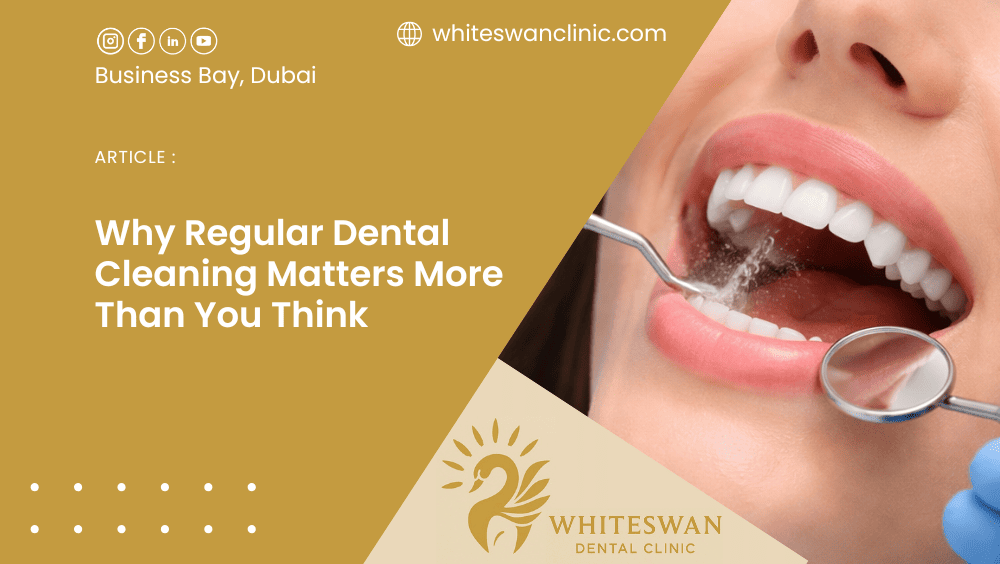
Most people wait until their gums bleed,or have persistent bad breath, before seeking a dental cleaning. Meanwhile, plaque and tartar are silently building up. And once tartar forms, no toothbrush can do enough to remove it.” And that is exactly why routine dental cleaning is far more critical to so many people than they give it credit for.

We see lots of patients at White Swan Dental Clinic and we see plenty who brush twice a day yet still come to us with tartar buildup in those same tricky spots — behind the lower front teeth, around the back molars and along the gumline. So even if you’ve got a good routine, professional cleaning is still very important. It’s easy, it’s quick and quite frankly saves you from more time-consuming treatments. Let’s break it down in a clear, real-world way.

What a “Regular Dental Cleaning” Really Is

Professional cleaning is different from brushing at home. Brushing removes soft plaque. However, plaque can turn into tartar (calculus) within just a few days — particularly if you drink plenty of tea/coffee, smoke or have an inherent propensity to build tartar quickly.

A normal teeth cleaning appointment usually includes:

  • Removing plaque and tartar from teeth and near the gumline
  • Cleaning the tight spaces between teeth
  • Polishing to lift surface stains
  • A quick gum health check (bleeding, pockets & inflammation)
  • Tips on brushing & flossing that fit your mouth shape

So yes, your mouth feels super fresh after. But more importantly, your gums get a proper reset. Looking for a Dental Clinic in Business Bay?

The Thing Most People Miss: Gum Problems Start Quietly

Gum disease doesn’t always hurt in the beginning. In fact, early gum disease is sneaky. You might only notice:

  • Mild bleeding when brushing
  • Slight swelling
  • Bad breath that keeps returning
  • A feeling like food gets stuck often

That early stage is known as gingivitis, and the good news is it’s generally reversible. But if tartar is left on the teeth and under the gums, it can evolve into periodontitis. Then bone support will be lost, and much later teeth may begin to feel loose. Which is why one of the biggest reasons dentists continue to push routine cleaning is gum disease prevention.

1) Regular Cleaning Helps Stop Gum Disease Early

If your gums bleed, most people think they brushed too hard. In fact, it’s usually inflammation caused by plaque and tartar.

Gums become inflamed when tartar sits at the gumline. Then they swell, bleed and begin to pull away a bit. That gives bacteria a deeper hiding place. So the cycle continues until a professional cleaning interrupts it.

Gums usually heal to become healthier, firmer and bleed less with repeated dental scaling and polishing. Also, home brushing is easier since you’re not against crunchy tartar.

2) It’s One of the Best Fixes for Ongoing Bad Breath

It lingers in your mouth and breathes like stale fish,ruined mask it with really bad-tasting mouthwash. The real culprit is probably bacteria caught in the tartar, gum pockets and between the teeth.

A good cleaning helps because:

  • Tartar is removed (bacteria lose their “home”)
  • Gum inflammation reduces (less odour from infected pockets)
  • Polishing lifts stains and plaque film
  • You’ll also get advice for tongue cleaning (huge for breath)

So if your breath feels “off” even after brushing, don’t ignore it. A cleaning often makes a noticeable difference.

3) Cleaning Protects Enamel (It Doesn’t “Weaken Teeth”)

This myth needs to go: professional cleaning does not damage enamel when done properly. Enamel is strong. What wears away enamel over time is acid produced by bacteria, snacks of high sugar content eaten too often and cleaning habits that let plaque linger for too long.

And sometimes, people are sensitive after cleansing.That can happen, yes. It’s often short-lived, and it’s a reflection of tartar being in sensitive spots. Once it is gone, you “feel” those exposed patches for a while. It still settles, for the most part, on people and a fluoride toothpaste accomplishes that.

4) It Helps Catch Small Issues Before They Become Big Problems

A cleaning visit isn’t only about polishing. It also creates a routine checkpoint. During regular appointments, your dentist can spot problems early, like:

  • Small cavities before they turn into deep decay
  • Cracks from teeth grinding
  • Worn fillings
  • Gum pockets that are getting deeper
  • Signs of infection, swelling, or hidden inflammation

And let’s face it — treating something early typically saves more money, time and pain. You’re keeping things tidy, sure, but you’re also preventing future drama.

5) Your Teeth Often Look Brighter Without Whitening

Professional polishing gets rid of surface stains from tea, coffee, some spices and smoking. Hence, many people leave feeling their teeth look whiter.

Of course, it is not the same as bleaching. But if your teeth appear drab due to stains, a cleaning can make quite an improvement. Also, if you plan to do whitening later, cleaning first makes the whitening results more even. Get details on Dental Checkup in Business Bay.

How Often Should You Get a Dental Cleaning?

For many people, every 6 months is a good schedule. However, not everyone fits into the same plan. Some people should come every 3–4 months, especially if they have:

  • A history of gum disease
  • Heavy tartar build-up
  • Smoking or vaping habits
  • Diabetes
  • Braces or aligners
  • Dry mouth from medications
  • Pregnancy-related gum issues

The best answer is: it depends on your gums and how quickly you build tartar, and because of your daily routine. At White Swan Dental Clinic, we typically recommend a time frame following inspection of gum status and not on estimation.

If You Haven’t Done a Cleaning in Years… Don’t Panic

A lot of patients avoid cleanings because of fear, past rough experiences, or simply being too busy. It happens.

If tartar build-up is heavy, your dentist will recommend a deep cleaning (scaling and root planing). It gets below the gumline to clean infected pockets and aid in the healing of your gums. That sounds frightening, but it’s essentially a more thorough cleaning often performed with numbing for your comfort. Looking for a Broken Tooth Treatment in Business Bay?

A Simple Home Routine to Keep the Results Longer

Cleaning at the clinic gives you a clean starting point. Then home care keeps it stable.

Try this:

  • Brush twice a day for two minutes 
  • Use interdental brushes (especially if gaps exist)
  • Use fluoride toothpaste
  • Drink water after coffee or tea when possible
  • Clean your tongue (seriously, it helps breath a lot)
  • If you grind your teeth, ask about a night guard

Related Articles:

» Receding gums: Treatments that work

» Implant-Supported Dentures Benefits

» Professional Teeth Whitening in Dubai

» Tooth-Coloured Filling Aftercare: Sensitivity & Bite Tips

» Dental emergencies: what to do first?

Why Patients Prefer Regular Cleaning at White Swan Dental Clinic

A good cleaning should feel thorough and gentle. Not rushed, not rough. At White Swan Dental Clinic, we focus on:

  • Comfortable cleaning techniques
  • Gum checks (not just “polish and go”)
  • Clear explanations in simple language
  • Practical advice that fits your lifestyle

Because the end goal is not one pretty day. The aim is a mouth that remains healthy for years.

FAQs on “Regular Dental Cleaning”

1) Is dental cleaning painful?

Usually no. However, if gums are inflamed or tartar is heavy, you may feel sensitivity. We can use numbing gel if needed.

2) How long does a cleaning take?

Depending on gum health and tartar build-up, it takes 30–60 minutes approximately.

3) Does cleaning damage enamel?

No. Plaque and tartar are safely removed during professional cleaning when performed properly.

4) Why do my gums bleed when I brush?

Bleeding often means gingivitis. Routine cleaning and daily flossing generally decreases it.

5) How often should I do scaling?

Most people do it every 6 months. Some need 3–4 month intervals, especially with gum issues.

6) What’s deep cleaning?

Deep cleaning goes under the gums to treat pockets and gum infection. It’s more detailed than regular cleaning.

7) Will cleaning make my teeth white?

It removes stains, which can make teeth appear whiter. Natural whitening can’t alter the natural shade like whitening.

8) Can I eat after cleaning?

Yes, in most of the cases. If fluoride was applied, follow your dentist’s suggestions.

9) Does cleaning help bad breath?

Yes, if the smell is from tartar, gum inflammation or food caught between the teeth.

10) Is dental cleaning safe during pregnancy?

Yes, and it is often recommended because gums can be more sensitive when someone is pregnant.

11) I brush daily—do I still need cleaning?

Yes. Ordinary brushing will not loosen hardened tartar, which tends to build up between teeth & along the gumline.

12) What happens if I skip cleanings for years?

Tartar builds up, the chances of gum disease increase and cavities can develop quietly. Early care is always easier.

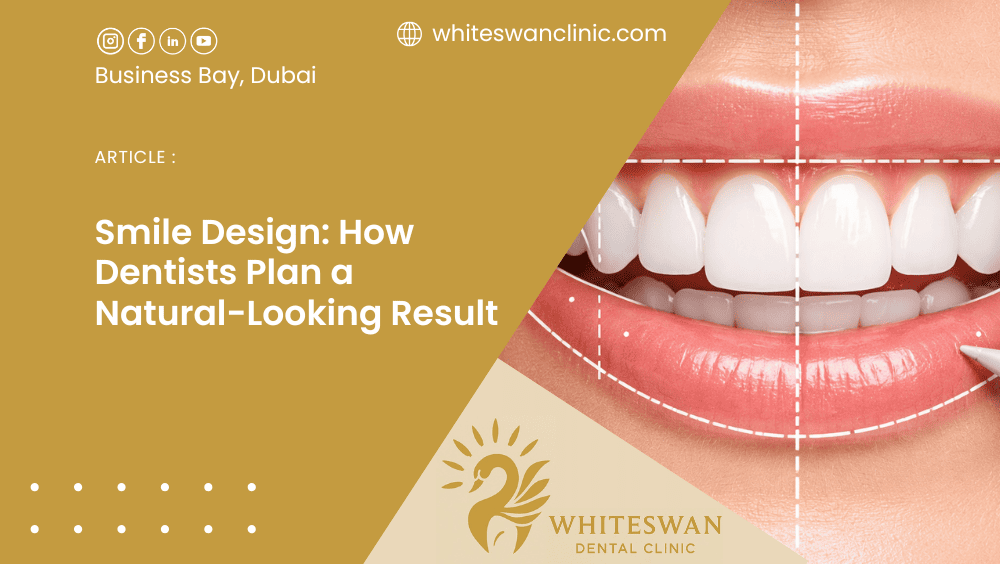
Smile Design: How Dentists Plan a Natural-Looking Result

When people hear “smile design,” sometimes they think super-white, copy-paste teeth. Honestly, that’s not the goal. The best result will be super natural, fits your face, and feels comfortable when you are talking, laughing, or eating. In other words, it should still be you — just healthier and cleaner and more balanced.

Everything at White Swan Dental Clinic is so prepared that a design smile would be planned before any damage. And that prep work is what gives the final product a real, not “too perfect” look.

What Exactly Is Smile Design?

Smile Design (also known as Digital Smile Design) is a customized plan that dentists follow to enhance your smile methodically. It’s not one single treatment. It’s a guide that may contain, instead:

  • Teeth whitening
  • Composite bonding
  • Porcelain veneers
  • Dental crowns
  • Clear aligners (orthodontics)
  • Gum contouring
  • Implants or other tooth replacement options

However, the biggest part is not the treatment list. It’s the analysis of your face shape, lip movement, tooth proportions, gum line and bite.That’s why, when implemented properly, smile design can appear subtle and natural. Looking for a Dental Clinic in Business Bay?

Who Usually Needs Smile Design Planning?

You don’t need “bad teeth” to benefit from a smile plan. Most people just want little tweaks that are huge improvements. For example:

  • Teeth that are stained, patchy, or uneven in colour
  • Chips or worn edges (common if you grind your teeth)
  • Gaps between front teeth
  • Mild crowding or teeth that look slightly twisted
  • Old fillings that look dark at the edges
  • Uneven gum line or a gummy smile
  • Missing teeth that break the balance of the smile

And yes, sometimes it’s just one tooth that ruins the photo. It happens.

Step 1: The Consultation (Where Dentists Listen First)

A proper smile makeover doesn’t start with “pick veneers.” It starts with questions.

Most dentists will ask things like:

  • What do you dislike most about your smile?
  • What kind of result do you want—subtle or dramatic?
  • Do you prefer a bright Hollywood shade or a softer natural one?
  • Is there something you’re not looking for (i.e. very square teeth)?

They also examine your overall oral health. Because if you have inflamed gums, or hidden decay, any cosmetic work will be short-lived. So, health comes first, always.

Step 2: Face and Lip Analysis 

Here’s the part many people don’t realise: dentists don’t design a smile while you’re sitting there with your lips stretched open. They also study your smile naturally.

They look at:

1) Your facial proportions

A smile should match your face. If you have softer features, super sharp teeth may look odd. On the other hand, stronger facial lines can suit slightly bolder tooth edges.

2) How your lips move

Your lips frame your teeth. So dentists check how much tooth shows:

  • when you are relaxed
  • when you speak
  • when you laugh properly

This matters a lot, because a smile that looks nice in one photo might look strange while talking, if it isn’t planned properly.

3) Your smile curve

A natural smile usually follows the curve of the lower lip. When this curve is respected, the smile looks “right,” even if people can’t explain why. Get details on Dental Checkup in Business Bay.

Step 3: Photos, 3D Scans, and Bite Records

Modern Digital Smile Design uses detailed records to avoid guesswork. Typically, this includes:

  • Clear photos (front, side, close-up)
  • Digital scans (3D impressions, no messy moulds)
  • X-rays (and sometimes 3D scans if needed)
  • Bite checks to see how teeth come together

This is where planning becomes very accurate. Plus, it helps you see what is possible before you commit.

Step 4: The Real Rules Behind a Natural-Looking Smile

A natural smile isn’t about “perfect teeth.” It’s about balance and tiny details. Dentists usually plan using:

Tooth proportions

Front teeth need the right width and length. If teeth become too long, they can look horsey (sorry, but it’s true). If they become too wide, they look like blocks.

Midline (the centre line)

Dentists check the centre of your front teeth and compare it with your facial centre. Still, a small shift can be totally normal. In fact, forcing perfection sometimes makes a smile look less natural.

Tooth shape

Teeth can be more rounded, more square, or a mix. A skilled dentist chooses shapes that suit your age, face, and smile personality.

Natural texture

Real teeth aren’t flat and glossy like tiles. Good veneers and crowns include subtle texture and a bit of translucency near the edges. That’s one of the biggest reasons premium work looks realistic. Looking for a Root Canal Treatment in Business Bay?

Step 5: Shade Selection (Whiter Isn’t Always Better)

This is where some smiles go wrong. People choose a shade that is too white for their skin tone, and then the teeth steal the whole face.

Dentists usually consider:

  • your skin tone and undertones
  • your eye colour
  • your age (very bright shades can look unnatural)
  • the colour of existing teeth (for matching)

Often, whitening is recommended first. Then restorations like veneers or crowns are matched to your improved shade. That way, everything blends better.

And yes, many people search for teeth whitening in Dubai, but the truth is: planning the shade properly is more important than just going “whitest possible.”

Step 6: Gum Line Planning (The Quiet Hero of Smile Design)

Even beautiful teeth can look “off” if gums aren’t even. So dentists also plan the gum frame.

They check:

  • Are gum levels balanced left and right?
  • Is there extra gum showing when you smile?
  • Is there a gum recession that needs treatment first?

In some cases, they may be included before cosmetic work in the patient’s plan, depending on what is needed (gum contouring or gum therapy). It’s not beautiful, but it gives the end product a clean and symmetrical appearance. Get details on Teeth Cleaning and Polishing.

Step 7: Bite and Function (Because Pretty Teeth Should Survive)

A smile is not just for selfies. You chew with it every day. So dentists must evaluate:

  • grinding or clenching habits
  • worn teeth and stress fractures
  • jaw comfort and bite movement
  • uneven contact points

If bite problems are ignored, veneers can chip, crowns can crack, and you’ll feel annoyed later. Therefore, in many cases, dentists recommend aligners first, then bonding/veneers after. It takes longer, yes—but it’s usually smarter.

Step 8: Mock-Up / Trial Smile 

This is the step patients love the most.

A good clinic may offer:

  • a digital preview
  • a wax-up model
  • a temporary mock-up placed on your teeth

So you can actually visualize the new shape and length before you have any permanent work done. And you can say things like:

  • “These look a bit long for me.”
  • “Can we soften the corners?”
  • “I want it natural, not shiny.”

That feedback changes everything. And it prevents regret. Looking for a General Dentistry in Business Bay?

Treatments Commonly Used in Smile Design

Different people need different combinations. Here are the common choices:

Composite bonding

Perfect for small chips, minor gaps, and edge reshaping. It’s quick and conservative. When done well, it looks very natural.

Porcelain veneers

Best for shape change, stronger colour correction, and a more uniform look. However, veneers need careful planning so they don’t look thick or bulky.

Crowns

Used when a tooth is weak, heavily filled, or badly damaged. Crowns are strong, but the bite planning must be spot on.

Clear aligners

Great when teeth need repositioning first. Aligners can reduce the amount of tooth trimming needed later, which is a big advantage.

Gum contouring

Helpful for uneven gum heights or gummy smiles. It improves symmetry fast when it’s the right case.

Related Articles:

» Smile Makeover in Dubai: What’s Included and How Long It Takes?

» Teeth Shifting After Braces: How to Prevent Relapse?

» Retainers: Types and How Long You Must Wear?

» Veneers vs Bonding: Which Smile Makeover Suits You?

» Early Signs of Tooth Decay You Shouldn’t Ignore

How Long Does Smile Design Take?

It depends on what you need.

  • Whitening + bonding: often 1–2 visits
  • Veneers: typically 2–3 visits plus planning time
  • Aligners: usually several months
  • Complex cases (bite + missing teeth): personalised timelines

If your dentist is rushing you into permanent work in one visit, that’s usually a red flag. Natural results take planning.

Keeping Your Smile Design Result Looking Great

A smile upgrade lasts longer with basic habits:

  • brush gently with a soft brush
  • floss daily (yes, even with veneers)
  • avoid chewing ice and hard objects
  • use a night guard if you grind
  • visit for polishing and check-ups

Also, don’t overuse whitening products after veneers. (If you’re not careful, you can end up with uneven shades because veneers don’t whiten.)

FAQs: “Smile Design & Natural-Looking Smile Makeovers”

1) What is Smile Design in dentistry?

It is a personalized approach to enhance the formation of teeth, colour, alignment and shape for more naturally appearing results.

2) What is Digital Smile Design?

It’s a type of smile planning involving photos, digital scans and measurements to get a preview of results before treatment begins.

3) Does smile design always mean veneers?

No. Some cases only require whitening, bonding, aligners or gum contouring.

4) How do dentists make veneers look natural?

By mixing up the right proportions, shade, translucence and texture of a given tooth — not just bleach it.

5) Can smile design fix gaps between teeth?

Gaps may be closed with bonding, veneers, aligners or combination treatment.

6) Is smile design painful?

Most steps are comfortable. Most treatments make use of local anaesthetic and any sensitivity is short-lived.

7) How long do veneers last?

With appropriate care, veneers will last for several years. Grinding and bad bite habits can shorten lifespans.

8) Do I need whitening before veneers?

In general, yes — especially if you’re after a lighter overall color. It helps colour matching.

9) Can smile design correct a gummy smile?

Yes. Gum contouring, orthodontics or other procedures may be used to eliminate that gummy look.

10) Can smile design help if I grind my teeth?

Yes, though you’ll have a bite check and night guard may be suggested post-treatment.

11) How do dentists choose the right tooth colour?

They are considerate of skin tone, age, facial structure and current tooth colour for a natural match. gummy appearance.

12) How do I choose the right clinic for smile design in Dubai?

Select a clinic with digital planning, mockups, good explanations and natural aesthetics as well as bite health.

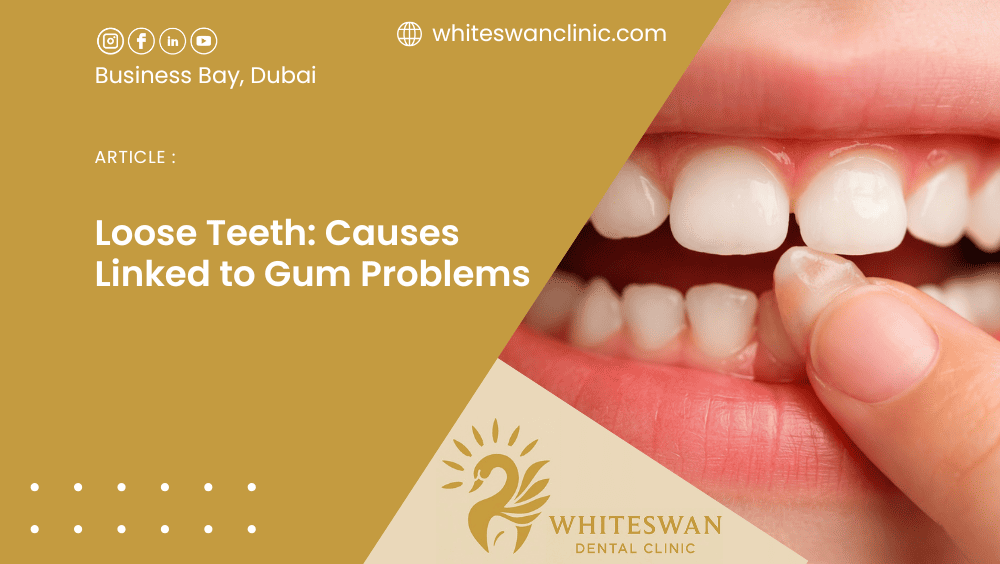
Loose Teeth: Causes Linked to Gum Problems

Feeling a tooth that is even slightly “wobbly” can rattle your confidence quickly. You chew on one side, you don’t eat crunchy stuff and you keep checking the mirror as though things will miraculously change. If you’re suffering through this, let me tell you: Loose teeth are not normal, very much the opposite of it, and especially so in adults. And most of the time, the actual reason is around the tooth — not in it. It’s the gums.

At White Swan Dental Clinic, we see many patients who come in saying, “Doctor, it’s just slightly moving.” In most of those cases, that “slight movement” is linked to gum problems, usually gum disease that has been quietly building for months or even years.

This article focuses on loose teeth associated with gum problems, including the primary causes of ‘tooth mobility,’ and what you can do to save the tooth from further damage.

How Gums Hold Teeth in Place 

Your tooth is not just stuck into the jaw like a nail in wood. It’s supported by a full system:

  • Gums wrap around the tooth and act like a seal
  • A thin tissue called the periodontal ligament holds the tooth like a cushion
  • The jawbone supports the root & keeps it stable

So when gingivitis starts, it is not only bleeding of the gums. It can over time harm the ligament and then may gradually eradicate its supporting bone. That’s when you start to notice that little bit of movement. Looking for a Dental Clinic in Business Bay?

The Most Common Gum-Related Causes of Loose Teeth

1) Gingivitis (Early Gum Infection)

The first stage of gum disease is gingivitis. It typically occurs when plaque simply sits on teeth and gum lines. At this point, the tooth may still be somewhat intact. But the gums provide early warning signs.

Signs you may notice:

  • bleeding gums while brushing or flossing
  • red, swollen gums
  • mild bad breath

If treated early, gingivitis can return the gums to a healthy state. But if it is not paid attention to, it can enter into the next stage where looseness begins.

2) Periodontitis (Advanced Gum Disease)

This is one of the biggest reasons adults develop loose teeth. Periodontitis means infection has gone below the gum line. Bacteria create deep spaces called “pockets,” and these pockets allow more infection to settle in.

Over time, periodontitis can cause:

  • gum recession
  • deep pockets around teeth
  • bone loss around roots

And once the bone support reduces, the tooth loses its grip and starts to move.

Common warning signs:

  • gums pulling back and teeth looking longer
  • bad breath that doesn’t go away
  • pain while biting
  • pus or swelling near the gums
  • new gaps forming between teeth

3) Gum Recession (Gums Pulling Back)

Many people think gum recession is only “a look problem.” Actually, it’s much more. When gums pull back, the roots become exposed. Those root surfaces attract plaque easily and are harder to clean properly.

So recession can start small, and then slowly lead to gum inflammation, infection, and even bone loss. As a result, recession can increase the risk of loose teeth—especially around the front teeth.

4) Tartar Buildup (Hardened Plaque)

Plaques that stay too long become tartar. And tartar is rough, which means bacteria stick to it easily. Brushing alone cannot remove tartar once it forms.

So tartar keeps irritating the gums every single day. Over time, gum disease develops and the tooth support becomes weaker.

This is why professional scaling and polishing is not just a “cleaning.” It’s a protective treatment.

5) Aggressive Gum Disease (Fast Bone Loss)

Sometimes gum disease progresses faster than usual. It may happen in younger people as well, and it can be linked to genetics or a stronger inflammatory reaction in the body.

If you are young and a tooth feels loose, don’t wait thinking, “It’s probably nothing.” Fast gum disease needs fast treatment.

6) Teeth Grinding (Bruxism) + Gum Problems

Grinding puts heavy pressure on the supporting ligament around teeth. On its own, grinding may cause sensitivity or jaw pain. But when gum disease is already present, grinding can speed up tooth movement.

Clues you may be grinding:

  • jaw tightness in the morning
  • headaches near the temples
  • worn-down tooth edges
  • tooth feels loose mostly after waking up

A night guard can reduce pressure and protect your teeth while gums are being treated.

7) Poorly Fitting Crowns or Fillings

Older dental work that doesn’t fit well may trap food and plaque in the margins. Even if it appears OK, the surrounding gum could stay inflamed. If not addressed, this can cause infection to develop under the gum line.

So yes, a loose tooth sometimes can develop around a crown if it’s hard to clean.

8) Smoking and Vaping

If you smoke, blood circulation also gets reduced in the gums. As a result, gum disease can progress silently with fewer bleeding-like symptoms. Gums are fine, many smokers don’t see blood much.

Sadly, by the time a tooth feels loose, the disease may already be advanced.

9) Diabetes and Poor Healing

When blood sugars are not in good control, the body has a tough time fighting infections. That includes gum infections. So diabetes can contribute to gum disease, and speeding the loss of bone.

If you’re a diabetic and notice bleeding or smells from your mouth or gums, or movement in your teeth it’s worth getting yourself an early check up. Get details on Dental Checkup in Business Bay.

Early Symptoms People Usually Ignore (But Shouldn’t)

Loose teeth usually don’t start suddenly. The gums give warnings first. Watch out for:

  • bleeding while brushing
  • swelling or puffiness near the gum line
  • persistent bad breath
  • gums pulling back
  • tooth sensitivity increasing
  • food getting stuck more than before
  • a change in bite or teeth shifting

If you see these signs, it’s better to get a gum check-up now than wait until the tooth becomes unstable.

How Dentists Check Loose Teeth

At White Swan Dental Clinic, we don’t just “tap the tooth and guess.” We usually check:

  • gum pocket depth measurement
  • X-rays to see bone support
  • bite pressure evaluation
  • signs of infection like pus or abscess
  • gum recession and inflammation levels 

This helps us find the real cause and choose the right treatment plan. Looking for a General Dentistry in Business Bay?

Treatment Options for Loose Teeth Caused by Gum Problems

1) Scaling and Root Planing (Deep Cleaning)

This is a deeper cleaning done under the gums. It removes tartar, bacteria, and infection from the root surfaces. After that, gums can heal and tighten.

Many patients feel a big difference in bleeding and swelling after deep cleaning.

2) Periodontal Maintenance

Gum disease can return if bacteria builds up again. That’s why regular maintenance visits are important, especially if you had periodontitis.

3) Splinting (Stabilising the Tooth)

If a tooth is loose, but still repairable, your dentist may splint it to neighboring teeth. This decreases movement while the healing process is taking place.

4) Night Guard for Grinding

If grinding is a major factor, a custom night guard protects teeth and reduces pressure on the ligament.

5) Advanced Gum Treatment

In cases of deep pockets or severe bone loss, additional therapy may be required. such as:

  • local antibiotics inside pockets
  • gum surgery for deeper cleaning
  • bone grafting or regenerative treatment (when possible)

6) Tooth Removal and Replacement (Only if Needed)

Extraction (removing the tooth) may be advised to prevent the spread of infection if the tooth can’t be saved. From then onwards replacement options could be:

  • implant (when gums and bone are stable)
  • bridge
  • partial denture

Related Articles:

» When to Replace Old Fillings: Signs You Shouldn’t Ignore?

» Dental Abscess: Warning Signs That Need Immediate Care

» Sensitive Teeth: Causes and Fixes

» Implant Maintenance: Hygiene Tips for Long-Term Success

» Root Canal vs Extraction + Implant

How to Prevent Loose Teeth from Gum Disease

Small habits matter a lot here:

  • brush twice daily with a soft brush
  • floss daily or use interdental brushes
  • do professional cleaning regularly
  • don’t ignore gum bleeding
  • reduce or stop smoking/vaping
  • manage diabetes and overall health
  • wear a night guard if you grind
  • book a check-up if you see gum recession

From Gums to Teeth: How Health Impacts Your Smile

The loose tooth is not something you “wait and see.” The cause, in many instances, is gum disease, and gum disease is insidious but inexorable. The sooner you treat it, the better your chance of saving your natural tooth.

FAQs on “Loose Teeth: Causes Linked to Gum Problems”

1) Can gum disease really make teeth loose?

Yes. Periodontitis damages bone and ligament support, and that causes looseness.

2) Can a loose tooth heal on its own?

Usually no. However, early gum treatment can often stabilize i

3) Is a loose tooth always permanent?

Not always. If caught early, teeth can tighten after gum care and bite control.

4) Why do my gums bleed when brushing?

Bleeding typically indicates inflammation, which is often caused by plaque buildup or an infection in the gums.

5) Does mouthwash fix gum disease?

It’s good for bacteria, but it doesn’t touch tartar or keep you from losing bone all on its own.

6) Can tartar cause loose teeth?

Yes. If tartar hardens for a long period of time it can cause infections in the gums, resulting in loss of bone.

7) Is deep cleaning painful?

Local anaesthesia is sufficient in most patients. Mild soreness can happen after.

8) How long does gum healing take after deep cleaning?

Many people feel improvement within 1–2 weeks. Deeper healing may take longer.

9) Can braces make teeth loose?

Temporary looseness can occur during orthodontic movement. Gum disease is different and needs treatment.

10) Will a night guard help a loose tooth?

If grinding is involved, yes. It reduces extra pressure on the tooth.

11) Do smokers get gum disease faster?

Often yes. Smoking cuts the blood supply to the gums, and disease can become advanced without symptoms.

12) When should I see a dentist for a loose tooth?

As soon as you notice it. Early care improves the chance of saving the tooth.

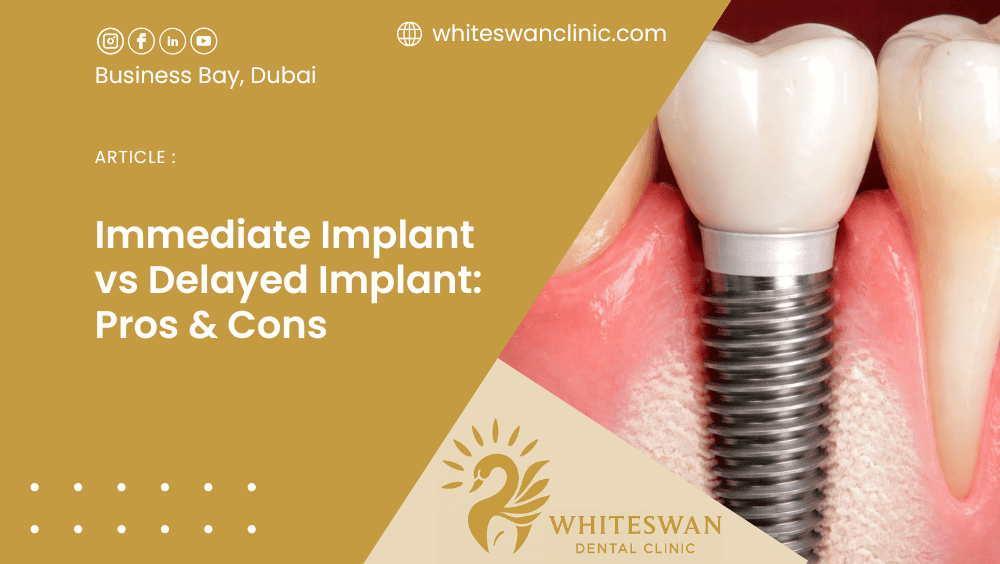
Immediate Implant vs Delayed Implant: Pros & Cons

If you’ve lost a tooth — or if someone has said that one should come out — dental implants can seem like the “best of all worlds” option. They feel natural, they chew like a tooth and they can last for years with good care. But there is one constant question at White Swan Dental Clinic, Business Bay, Dubai:

Immediate implants (in this case an implant that is placed soon after the extraction) or delayed implants (an implant that is placed when the gum and bone are already healed)?

Both are proven methods. But they each have different mouths, different risks and different timelines.

What’s the Actual Difference?

Immediate Dental Implants

This type is placed immediately on the same day where your tooth is extracted (or within a very short period following). A temporary tooth can also be planned in selective cases — particularly if the bite is light and the implant is stable.

Delayed Dental Implants

After healing, a delayed implant is placed. That typically means spending about 8 to 16 weeks waiting after extraction. If infection control or bone graft healing is required. Looking for a Dental Clinic in Business Bay?

Why Timing Matters More Than Most People Think

If a tooth is extracted, the bone and gums do not “stay still.” They change. Bone can shrink, gums can settle and if there was an infection, the area can remain inflamed for a spell. Therefore, timing affects:

  • the amount of bone available,
  • the shape of the gum line,
  • infection risk,
  • how quickly you can get a final crown,
  • and how predictable the result feels.

So yes, speed is part of it—but safety and stability matter even more.

Immediate Implants: The Pros

Here’s why many patients like the immediate route.

1) Faster overall treatment

Since extraction and implant placement are combined, you can shave months off the overall timeline. That matters a lot if you want to return to normal faster.

2) Fewer surgical visits

It can treat extraction and the implant surgery all in one sometimes instead of extracting and coming back later for a surgery. Consequently, it can feel more convenient most of the time.

3) Better chance to preserve the gum shape

The socket immediately surrounding the extraction site is still fresh and resembles the natural tooth root. Thus, immediate placement can preserve the native gum contour — particularly important with anterior teeth.

4) Possibility of a quicker temporary tooth

In selected cases, you may be able to get a temporary tooth planned earlier. Not always on the same day, but sometimes sooner than with delayed cases. Get details on Dental Checkup in Business Bay.

Immediate Implants: The Cons 

Immediate implants are great when the conditions are right. But when they’re not, rushing can backfire.

1) Not ideal with active infection

If the tooth is taken out because of a serious infection or abscess, placing another immediately may increase complications. But waiting is usually the right play in that case.

2) Requires strong “initial grip” in the bone

Dentists call this “primary stability.” In simple terms: the implant needs to feel firm from day one. If the bone is soft or the socket is wide, stability can be lower. Consequently, delayed placement may be recommended.

3) Technique-sensitive

Immediate placement needs accurate planning and careful gum handling. It’s not just “put the implant in quickly.” It’s precision work.

4) You may still need bone grafting

Many patients assume immediate means “no graft.” In fact, small gaps can develop around the implant even when placed immediately. Thus, a graft can still be utilized to maintain future aesthetics and volume of the bone in the long-term. Looking to a Best clinic for Tooth Removal?

Delayed Implants: The Pros

Delayed implants are popular because they can be calm, controlled, and predictable.

1) Healing first can reduce risk

If the extraction site needs time to settle—especially after infection—delayed placement gives your body a clean starting point. As a result, many complex cases become easier.

2) Better option if infection was the main issue

If the tooth was removed due to infection, so that the tissue can heal. As a result, the implant can be inserted in a healthier environment.

3) Easier bone graft planning (when needed)

In the case of bone loss, grafting may be easier to do first with the implant placed at a later stage. That gradual approach frequently builds more sustained support.

4) More flexibility

With extra healing time, your dentist can refine the plan— particularly if you have bite problems, gum recession or more than one missing tooth. Get details on Broken Tooth Treatment in Business Bay.

Delayed Implants: The Cons

Of course, delayed implants have downsides too.

1) The whole process takes longer

This is the main reason some patients feel frustrated. Extraction happens first, healing happens next, then surgery, then healing again before the crown.

2) Bone shrinkage after extraction

Bone naturally resorbs after a tooth is removed. So, if the socket isn’t protected with preservation grafting, there may be less bone later. Consequently, you might need additional grafting.

3) More appointments

Because the steps are spread out, you may need extra visits. For busy schedules in Dubai, that can be a deciding factor.

Immediate vs Delayed Implants

Point

Immediate Implant

Delayed Implant

Timing

Same day as extraction

After healing (8–16 weeks typical)

Overall time

Usually shorter

Usually longer

Infection tolerance

Lower

Higher

Need strong early stability

High

Moderate

Appointments

Often fewer

Often more

Best for

Healthy socket + good bone

Infection, bone loss, complex cases

Who Usually Fits Immediate Implant Placement?

Immediate implants often suit patients who have:

  • healthy gums and good oral hygiene,
  • no active infection at the site,
  • solid bone that can hold the implant firmly,
  • a controlled bite (not heavy grinding),
  • realistic expectations about the healing stage. 

Still, the final decision depends on a proper scan and exam, not just “I want it fast.” Looking for a General Dentistry in Business Bay?

Who Should Consider Delayed Dental Implants?

Delayed implants often suit patients who have:

  • a tooth removed due to infection or abscess,
  • a complicated extraction,
  • bone loss or thin bone walls,
  • gum disease that needs stabilising,
  • medical / lifestyle risk factors such as smoking, uncontrolled diabetes, etc.

In many cases, delay is not “slow.” It is safe & well-planned.

A Common Confusion: Immediate Placement vs Immediate Loading

These two sound similar, but they are not the same.

  • Immediate placement :implant is placed right after extraction.
  • Immediate loading : a tooth is attached to the implant soon after placement.

Immediate loading needs for very strong stability and controlled, carefully managed bite. Otherwise, your doctor will keep the implant protected while it integrates.” Get details on Teeth Cleaning and Polishing.

Pain, Healing, and Daily Life After Surgery

Most patients describe discomfort from implants as something they can tolerate — a soreness rather than sharp pain. And the swelling is usually minor and resolves within 48 hours.

To heal smoothly:

  • stick to soft foods for a while,
  • Don’t smoke
  • avoid chewing hard foods on that side,
  • follow medication instructions,
  • keep your mouth clean as advised,
  • show up for your reviews (small issues are easier when caught early).

In Business Bay, we see many patients who return to work quickly. Still, it’s better to plan surgery when your schedule isn’t packed with meetings. Looking for a Teeth Whitening near Business Bay?

Cost Factors in Dubai

Implant costs are not only about the implant itself. Pricing can vary depending on:

  • CBCT scan and diagnostics,
  • extraction type (simple vs surgical),
  • bone grafting and membranes,
  • sinus lift needs (upper back teeth),
  • implant brand and components,
  • crown material (often zirconia/ceramic),
  • sedation options (if required).

Immediate cases can reduce appointments, but they may include extra planning or grafting. Delayed cases can involve more steps, yet may be smoother in high-risk situations.

How We Choose the Best Option at White Swan Dental Clinic (Business Bay)

We look at:

  • 3D CBCT scan findings,
  • gum thickness and smile aesthetics,
  • presence of infection,
  • bone strength and shape,
  • bite forces and grinding habit,
  • medical history and lifestyle.

Then we recommend the plan that gives you the best chance of long-term success—because nobody wants to repeat implant treatment.

Related Articles:

» How to Care for Implants?

» Crown After Root Canal: Why It’s Often Necessary?

» Veneers vs Bonding: Which Smile Makeover Suits You?

» Dental Cleanings: What Happens and Why It’s Not a Big Deal?

» Crowded Teeth: Treatment Options and Timeline

Immediate or Delayed Implant?

Immediate implants, if performed in a site with robust bone and health, can be great when it is functioning high! Delayed implants are the safer option for infection, bone loss, or complex extraction. Regardless of which way you choose to go, the end goal remains the same: a stable natural-looking tooth that lasts.

FAQs on “Immediate Implant vs Delayed Implant”

1) Are immediate implants safe?

Yes, when the site is clean and stability is strong. Otherwise, delayed placement can be safer.

2) Can an infected tooth get an implant the same day?

Sometimes, but usually delayed is recommended if the infection is active or severe.

3) How long do delayed implants take?

Usually 3–6 months in total depending on the healing and grafting.

4) Is immediate implant placement always faster?

Yes, generally — but with a poor stability and the need for additional protection to the implant those timelines can still develop.

5) Do immediate implants avoid bone grafting?

Not always. Many immediate cases still use small grafts to fill gaps and support the gum line.

6) Which is better for front teeth aesthetics?

Immediate can be excellent in the right case. Delayed can also be highly aesthetic with careful tissue shaping

7) Can I get “teeth in a day”?

Only if stability is high and bite forces can be controlled. It’s not suitable for everyone.

8) Does smoking affect both options?

Yes. Smoking increases the risk of failure and slows down healing. Immediate implants can be less forgiving.

9) Is pain different between immediate and delayed implants?

Pain levels are often similar. Immediate may feel simpler because it combines steps.

10) When can I eat normally after an implant?

Soft foods only, and no chewing directly on the implant side until your dentist gives you the go-ahead.

11) What if I don’t have enough bone?

Beside bone grafting or staged treatment can rebuild support.Delayed placement is commonly chosen in such cases.

12) How do I know which option is right for me?

A clinical exam and CBCT scan are the only reliable way. Your dentist will assess stability, infection risk, and aesthetics.

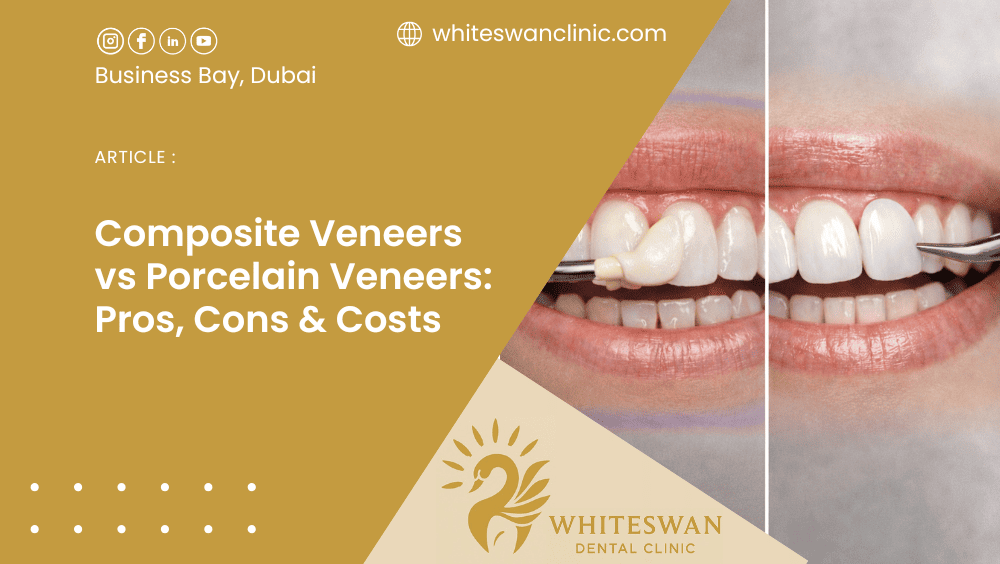
Composite Veneers vs Porcelain Veneers: Pros, Cons, Costs

Some people when they look in the mirror they think they need to enhance their smile. In dubai people mostly ask about veneers. It can hide chipping, make gaps smaller, change imperfections and uneven shapes.

The topic of whether to get composite or porcelain veneers always arises. Both can smile beautifully. But they differ in look, durability, upkeep, and expense.

At White Swan Dental Clinic, we keep it simple: pick what works for your teeth, your lifestyle, and your budget, not simply what looks beautiful on social media..

What Are Veneers?

Veneers are thin layers placed over the front of your teeth to improve shape, colour, and appearance. People choose veneers for:

  • Yellow or stained teeth that don’t whiten easily
  • Chipped front teeth
  • Small gaps (diastema)
  • Uneven edges or worn teeth
  • Slight misalignment (mild cases)
  • “Small teeth” look or uneven smile line

The two best options are composite veneers and porcelain veneers. Looking for a Dental Clinic in Business Bay?

Composite Veneers (Resin Veneers): What They Are

Composite veneers are made from a tooth-coloured resin . In many issues, the dentist applies and shapes the resin directly on your tooth, then polishes it until it looks natural.

Why people like composite veneers

  • Lower cost compared to ceramic
  • Often done in a single visit
  • Usually needs less tooth trimming
  • Easy to adjust later if you want minor changes
  • If a corner chips, it can often be repaired quickly

The downside of composite veneers

  • They can stain over time (coffee, tea, curry, smoking, shisha—yeah, Dubai habits matter)
  • They can lose shine faster and may need polishing every so often
  • They are generally less durable than porcelain
  • If your bite is heavy or you grind, they may chip more easily

Composite veneers can still look amazing, by the way. The result depends a lot on the dentist’s detail work and finishing. Get details on Dental Veneers.

Porcelain Veneers (Ceramic Veneers): What They Are

Porcelain veneers made from a powerful ceramic material. They are custom created to match your smile design, then bonded onto the teeth.

Why people choose porcelain veneers

  • They look very natural because they reflect light like enamel
  • They’re usually more stain resistant
  • They tend to last longer with proper care
  • Great for full smile makeovers where you want a “wow” result

The downside of porcelain veneers

  • Higher upfront cost
  • Usually takes two or more visits
  • Tooth preparation may be more involved in some cases
  • If a veneer cracks badly, it might need replacement

Composite Veneers vs Porcelain Veneers: Real Differences That Matter

1) Which looks better?

Both are good only. But, porcelain veneers keep that shiny, polished look for longer. Composite can look super natural, if you drink lots of tea or coffee but it might fade quickly.

2) Which lasts longer?

This varies, but generally:

  • Composite veneers can last around 4–7 years (sometimes longer with good maintenance)
  • Porcelain veneers can last 10–15+ years in many cases

Porcelain costs more but it might last long term.

3) Which stains more?

 Porcelain veneers are good for those who worry about stains.Composite resin could absorb colour over time especially with staining from foods and drinks.

4) Which is easier to fix?

  • Composite veneers are easier to repair chairside
  • Porcelain veneers might need replacement based on the damage

So, if you are someone who chips teeth or plays sports, this is the best thing.

5) Do they remove tooth enamel?

Sometimes yes, sometimes minimal. In many cases:

  • Composite needs less preparation
  • Porcelain may require more precise shaping for fit

However, every mouth is different. Some people qualify for minimal-prep porcelain, but not everyone. Looking for a Root Canal Treatment in Business Bay?

Costs in Dubai: Composite Veneers vs Porcelain Veneers

Let’s be honest—Dubai pricing can change a lot depending on the clinic, materials, and how complex your case is.

What affects veneer pricing?

  • Number of teeth being treated
  • Smile design planning
  • Tooth condition
  • Bite issues and grinding
  • Lab quality for porcelain
  • Extra steps like gum contouring or whitening before veneers

General idea:

  • Composite veneers cost is usually more affordable per tooth
  • Porcelain veneers cost is usually higher per tooth due to lab work + ceramic material

At White Swan Dental Clinic, we typically recommend a proper evaluation first, because quoting blindly is pointless. Two patients can ask for “10 veneers,” yet need totally different work.

Which Veneers Should You Choose?

Choose composite veneers if:

  • You want a quicker makeover
  • You want a more budget-friendly option
  • You prefer a solution that’s easier to adjust or repair
  • Your changes are small (minor chips, shape tweaks, small gaps)

Choose porcelain veneers if:

  • You want long-term results with less staining
  • You want a premium look for a full smile makeover
  • You want stronger, longer-lasting material
  • You don’t want frequent touch-ups

One more thing: if you grind your teeth at night, it’s not a “maybe” issue. Grinding can shorten the life of both types. In those cases, we often suggest a night guard after veneers. It’s simple but it saves your investment. Get details on Dental Checkup in Business Bay.

What to Expect at White Swan Dental Clinic

A good veneer treatment is not rushed work. The usual process includes:

  1. Smile assessment (shape, gum line, bite, shade, face balance)
  2. Photos + shade planning for natural results
  3. If needed, a mock-up so you can visualise your new smile
  4. Veneer placement with proper bonding and finishing
  5. Aftercare tips so your veneers last longer

When veneers fit properly, they do not look fake and it will not change your smile. It will give a clean and bright smile.

How to Care for Veneers (So They Last)

This part is boring, but it matters a lot:

  • Brush twice daily 
  • Floss daily
  • Avoid biting hard items such as ice, pens, bottle caps
  • Limit stains (especially for composite)
  • Visit for polishing/check-ups as advised
  • If you grind teeth, wear your night guard

Small habits will make a huge differnece.

Related Articles:

» Deep Cleaning vs Routine Scale & Polish—What You Need and When?

» Root Canal vs Extraction + Implant: How to Decide?

» How to Keep Your Teeth Healthy While Wearing Braces?

» Veneers vs Bonding: Which Smile Makeover Suits You?

» Braces vs Clear Aligners: Comfort and Lifestyle

Choosing Between Composite and Porcelain Veneers

Composite veneers provide a fast, flexible, and affordable smile improvement. For long-lasting appearance and stain resistance, porcelain veneers are the greatest option.

FAQs on “Composite Veneers vs Porcelain Veneers”

1) Are composite veneers permanent?

They’re long-lasting, but not forever. Many cases are minimally invasive, and composite can be repaired or refreshed.

2) Do porcelain veneers ruin natural teeth?

They shouldn’t “ruin” teeth if done correctly, but some enamel may be trimmed, so it’s a committed cosmetic treatment.

3) Which veneers look the most natural?

Both can look natural. Still, porcelain veneers tend to keep a more natural glow and shine long-term.

4) Can composite veneers be whitened later?

Not really. Composite doesn’t whiten the same way natural enamel does. It can be polished or resurfaced if it stains.

5) Do porcelain veneers stain?

They’re generally stain resistant. However, teeth around them can stain, so some people whiten before veneer treatment.

6) Can veneers close gaps?

Yes. Veneers close gaps.

7) Do veneers hurt?

No. If any preparation is needed, local anaesthesia will use.so you will not feel pain.

8) How long do porcelain veneers take?

It will take 1 to 2 weeks or 2 visits and it is  dependent on lab steps and smile design planning.

9) Are composite veneers done in one day?

Often yes. Many composite cases can be completed in a single appointment.

10) Which is better for chipped front teeth?

Both work well. Composite is good  for small chips and repairs. Porcelain is the best  for long-term cosmetic correction.

11) Do I need braces before veneers?

Not always. For larger crowding or bite problems, braces might  be better.

12) How do I choose between composite and porcelain veneers?

It depends on your enamel, bite, staining habits, and how long you want results to last. A proper consultation makes the choice clearer.

Scaling and Polishing: What Happens During a Dental Cleaning?

After booking a dental cleaning, if you have a doubt about what exactly is going on with that procedure, you are not alone.. A lot of people imagine sharp tools, discomfort, or some long complicated process. In reality, scaling and polishing is usually straightforward, fairly quick, and honestly one of the best things you can do for your mouth.

At White Swan Dental Clinic, we see patients who brush well but still have tartar in the same usual spots behind the lower front teeth, around the back molars, and near the gumline. In this situation professional cleaning is important.

So, from the details below you can know about what the procedure will do in the deep cleaning.

What Is Dental Cleaning, Really?

A professional teeth cleaning is help to remove two main problem:

  • Plaque which is a soft, sticky film that develop everyday
  • Tartar (calculus) which is a plaque that has hardened and stuck firmly to teeth

Plaque can be removed by brushing when you find it earlier.But, once plaque turns into tartar, it will not go by brushing.You need to do scaling. Looking for a Dental Clinic in Business Bay?

Scaling vs Polishing: What Do Those Words Mean?

“Scaling and polishing” are two different parts of the same appointment.

Scaling

Dental scaling is the “tartar removal” part. The dentist removes tartar from:

  • the tooth surface
  • the gumline area
  • and sometimes slightly under the gums (depending on gum health)

Tartar holds bacteria in place and if bacteria sit long term, gums become swollen, bleed and can slowly pull away from teeth. So scaling is very important.

Polishing

Tooth polishing is the finishing step. It smooths the teeth and helps remove surface stains from:

  • coffee and tea
  • certain foods/spices
  • light smoking stains

Polishing will not change the natural shade of your teeth. But, it makes teeth look cleaner and smoother. Get details on Dental Checkup in Business Bay.

What Happens During a Dental Cleaning Appointment? (Step-by-Step)

Let’s go through it like a real visit.

1) Quick Oral Check Before Cleaning

Before anything starts, your dentist checks your mouth. This is not a full “big exam,” but a basic look at:

  • gums (redness, swelling, bleeding)
  • visible tartar build-up
  • any sensitive areas
  • fillings and crowns (just to make sure nothing is loose or rough)

If you have gum issues, the dentist may check gum pocket depth too. That’s a simple measurement that tells us how healthy the gums are.

2) Identifying Plaque and Tartar Areas

Some tartar is obvious. Some is hiding. Typical tartar hotspots include:

  • behind lower front teeth (very common)
  • near the upper molars
  • along the gumline

If you tell us you’re getting bleeding while brushing, we pay extra attention to those gumline zones.

3) Scaling: Removing Tartar and Build-Up

Now the main part begins: scaling.

There are two ways to do :

  • Ultrasonic scaling: used a tool that vibrates gently and water to remove tartar
  • Hand scaling instruments: used for fine detailing and tight corners

What you might feel:

  • pressure, not pain
  • water spray and suction
  • a bit of vibration
  • slight sensitivity in certain spots 

If your gums are inflamed, then it is bleeding. That is not a bad thing while cleaning. It is happening that your gums were irritated already, and cleaning is removing the cause.

4) Cleaning Between Teeth

After scaling, the dentist cleans between teeth using floss or interdental tools. If you floss at home, professional cleaning reaches angles that are hard doing at home.

This step helps reduce:

  • food trapping
  • gum irritation
  • bad breath

5) Polishing: The Smooth, Fresh Finish

Next comes polishing—the part most people actually enjoy.

A soft rotating brush (or rubber cup) with polishing paste is used to:

  • smooth the enamel surface
  • remove mild stains
  • give that “fresh, clean” feel

After polishing, teeth feel almost slippery. That’s normal and expected.

6) Rinse + Final Check

You rinse, then your dentist checks again quickly. If anything stands out—like early decay, gum inflammation, or areas that may need further care—you’ll be told in a simple way (no scary lecture). Looking for a Teeth Whitening near Business Bay?

7) Personal Home Care Tips

This is usually the most useful part if you want to keep results longer. You may get advice like:

  • switch to a soft brush if you brush too hard
  • flossing method for your tooth shape
  • whether you need a better toothpaste for sensitivity
  • how often you should return for cleaning

Does Scaling and Polishing Hurt?

Scaling and polishing is not painful. But , it might feel uncomfortable if:

  • tartar is heavy
  • gums are inflamed
  • teeth are sensitive
  • you have exposed roots from gum recession

If you have fear, inform your dentist at the start. Some options will help to you such as :

  • numbing gel
  • gentler scaling settings
  • short breaks
  • local anaesthesia (only if really needed)

The goal is always comfort.

How Long Does a Dental Cleaning Take?

It will take 30 to 60 minutes.

However, it may take longer when:

  • tartar build-up is severe
  • gums bleed a lot
  • you need deeper cleaning under the gumline
  • you haven’t had cleaning in years

The dentist might recommend splitting it into two sessions for comfort. Get details on Broken Tooth Treatment in Business Bay.

Why Dental Cleaning Is Worth It (Even If You Brush Well)

A proper professional dental cleaning helps you in ways brushing can’t.

Benefits you’ll usually notice:

  • cleaner breath (yes, quickly)
  • less gum bleeding
  • smoother teeth
  • fewer food-stuck moments
  • improved gum comfort

Benefits you don’t “feel” but matter:

  • lower risk of cavities
  • reduced chance of gum disease progression
  • early detection of small issues
  • healthier gums long-term

It’s preventive care. You’re basically paying for fewer problems later.

What Should You Do After Scaling and Polishing?

Most people go back to normal.But, these tips help:

  • Drink water after your appointment
  • If you feel sensitivity, avoid icy drinks for that day
  • Brush gently
  • Avoid heavy staining drinks such as coffee and drink

There’s no need to panic about the tenderness of your gums.They settle within two days. Looking for a Root Canal Treatment in Business Bay?

How Often Should You Get Scaling and Polishing?

For many patients, every 6 months is ideal.

However, you may need more frequent cleaning (every 3–4 months) if you:

  • smoke or vape
  • have diabetes
  • have braces or aligners
  • had gum disease earlier
  • build tartar quickly (some people just do)

The “right schedule” depends on your gums, not just your age.

Related Articles:

» How Long Does Teeth Whitening Last?

» How to Care for Implants?

» When to Replace Old Fillings: Signs You Shouldn’t Ignore?

» Dental Abscess: Warning Signs That Need Immediate Care

» Receding gums: Treatments that work

Protecting Your Smile, One Cleaning at a Time

A dental cleaning is the simplest way to protect your gums, keep your breath fresh, and avoid bigger dental problems later. Scaling and polishing removes what brushing can’t, and it is cleaning really well.

FAQs on “Scaling and Polishing (Dental Cleaning)”

1) What is scaling in dental cleaning?

Scaling is the removal of  plaque and tartar from teeth and gumline.

2) What is polishing in dental cleaning?

Polishing smooths the teeth and helps remove mild surface stains.

3) Can tartar be removed at home?

No, if tartar form, you need professional tartar removal with dental tools.

4) Is dental cleaning safe for enamel?

Yes, professional cleaning is a safe and secure procedure for your enamel.

5) Why do gums bleed during scaling?

Gums are inflamed from plaque and tartar so bleeding is happening. After cleaning, gums often improve.

6) Does scaling make teeth loose?

No. It can feel like that if tartar was “packing” spaces. Cleaning reveals the real tooth surface.

7) Does scaling and polishing whiten teeth?

It removes stains and makes teeth look brighter, but it’s not the same as professional whitening.

8) How long does teeth sensitivity last after cleaning?

Usually 1–2 days, and often it’s mild. If it lasts longer,tell your dentist.

9) Can I eat after a dental cleaning?

Yes. If gums feel tender, choose softer foods for a few hours.

10) How long does a dental cleaning appointment take?

Usually 30–60 minutes, depending on tartar and gum condition.

11) What is deep cleaning and is it different from scaling?

Deep cleaning goes deeper under the gums and is done when gum pockets are present.

12) How often should I do scaling and polishing?

Most people benefit every 6 months, but some need every 3–4 months depending on gum health.

Retainers: Types and How Long You Must Wear

Taking off your braces or clear aligners is like crossing the finish line. You can see that your teeth are straighter and your bite feels better now that the days are past. The only way to keep everything you’ve worked for safe is to wear your retainer.

Teeth are not fixed like tiles in cement. They sit in living bone and soft tissue that keeps adapting. Because of that, teeth can slowly drift over time—even after a perfect orthodontic result. A retainer is the simple tool that holds your smile in place while your mouth settles into its new normal.

At White Swan Dental Clinic, we often say this: orthodontic treatment creates the result, but retainers keep it.

What Is a Retainer?

While wearing braces or aligners, a retainer holds your teeth.It prevents teeth from moving back.Even though most people are not expecting it to, this “shift back” happens more often than you might imagine

Why does relapse happen?

  • The fibres around teeth try to pull them back.
  •  jaw and bite might shift for young adult
  • Small habits such as grinding, nail-biting, or tongue thrusting are making pressure.
  • Aging will change the tooth positions

So yes, retention matters. And the earlier you take it seriously, the easier your life becomes later. Looking for a Dental Clinic in Business Bay?

Types of Retainers: The Main Options

Several typical retainers have various feel, look, and maintenance styles. The best option depends on the situation and habit.

1) Clear Retainers (Essix-Style)

These are clear, removable trays that fit over your teeth—similar in appearance to aligners.

Why people like them

  • They’re almost invisible.
  • They’re lightweight and comfortable for most patients.
  • They suit many post-aligner and post-braces cases.

Things to keep in mind

  • They can crack if you grind your teeth.
  • They can stain if you drink tea/coffee with them in.
  • They must be removed for meals and hot drinks.

Clear retainers are easy to wear, uncomplicated, and not very noticeable.

2) Hawley Retainers

A Hawley retainer has an acrylic base (usually on the palate) and a thin metal wire across the front teeth. It’s the “classic” retainer many people remember.

Benefits

  • Strong and long-lasting when cared for properly
  • Can be adjusted if small movement happens
  • Often easier to repair compared with clear trays

Downsides

  • More visible than clear retainers
  • Can feel bulky at first (you adapt, but it takes time)
  • For a few days, speech may sound a little odd.

If you need durability and flexibility, a Hawley retainer would be a good fit.

3) Fixed Retainers (Bonded / Permanent Retainers)

A fixed retainer is a thin wire bonded behind your teeth—commonly on the lower front teeth.

Why it works well

  • It supports your teeth all day, every day.
  • It doesn’t depend on memory or routine
  • It is not visible so nobody can see it.

What you need to manage

  • Flossing takes more effort
  • Plaque will develop if cleaning is rushed.
  • The wire can loosen and needs monitoring.

A fixed retainer is recommended when the lower teeth are crowded before treatment, as that area is prone to shifting again. Get details on Best Dental Clinic for Teeth Filling.

How Long Must You Wear Retainers?

Most of the time you need to wear retainers for a long time. The schedule changes, but a need doesn’t go away on its own. If teeth aren’t supported, they can move slowly for years.

Here is how retention works:

Stage 1: Full-Time Wear (First 3–6 Months)

After braces or aligners, the mouth is still adapting.

  • Usually 20–22 hours per day
  • Remove only for eating and brushing

This stage is the most important because relapse risk is highest early on.

Stage 2: Night-Only Wear (Next 6–12 Months)

Once things stabilise:

  • Wear your retainer every night
  • Aim for 8–10 hours while sleeping

Night-only wear is realistic for most people and still it works extremely.

Stage 3: Long-Term Retention (Ongoing)

After the first year:

  • Many patients wear retainers 3–5 nights per week
  • Some should wear them every night, depending on their case

In simple words: after orthodontic treatment, you don’t “finish” retention—you simply reduce it. Looking to a Best Clinic for Tooth Removal?

Does the Retainer Type Change the Wearing Time?

Yes, the retainer type changes the wearing time.

  • Clear retainers: This type of retainers need consistent wear because missing nights can make small shifts.
  • Hawley retainers: Can sometimes be adjusted for tiny movements, which is useful.
  • Fixed retainers : It gives you continual support, but you could still need a removable retainer for the higher arch or extra protection.

Many patients do best with a combined plan:
fixed retainer on the lower front teeth + night-time removable retainer for the upper teeth.

Signs Your Retainer Needs Attention

Your retainer should be tight but not painful.Don’t ignore it if something changes.

Watch for:

  • Your retainer suddenly feels very tight
  • It doesn’t seat properly or lifts at the back
  • You notice a gap returning or crowding starting
  • Your bonded wire feels loose or sharp
  • You get gum irritation around the fixed retainer

Catching small problems early saves you from bigger correction later. Get details on Root Canal Treatment in Business Bay.

How to Clean Retainers Without Damaging Them

Retainers need to be clean . They can smell unpleasant, get dirty, and produce germs if you don’t.

For removable retainers

  • Rinse after removing
  • Brush gently with a soft toothbrush
  • Use retainer cleaning tablets a few times a week
  • Store in a proper case (not tissue!)

Avoid these mistakes

  • Don’t use boiling or hot water
  • Don’t scrub with abrasive toothpaste daily
  • Don’t leave them in a hot car
  • Don’t keep them dry and dirty in a pocket or bag

Clean retainers feel better, last longer, and protect your oral health.

Related Articles:

» When to Replace Old Fillings: Signs You Shouldn’t Ignore?

» Braces vs Clear Aligners: Comfort and Lifestyle

» Dental Implants in Dubai: Step-by-Step Process

» Sensitive Teeth: Causes and Fixes

» Dental Checkup in Dubai: What’s Included and How Often You Need It?

What If You Stop Wearing Your Retainer?

Skipping one night happens. But stopping fully for weeks or months often causes relapse.

If you haven’t worn it in a while:

  • Try it gently at night
  • If it fits but feels tight, wear consistently and monitor
  • If it doesn’t fit at all, don’t force it—book an appointment

Often, the sooner you act, the easier it is to recover your alignment.

Retainer Reviews: How Often Should You Check In?

Even if everything feels fine, a quick check-up helps:

  • 1–2 checks in the first year after treatment
  • Then yearly, often alongside your regular cleaning visit

For fixed retainers, check-ups matter even more because loosening can be subtle at first.

FAQs on “Retainers: Types and How Long You Must Wear”

1) How many hours per day should I wear my retainer at first?

Most patients need 20–22 hours daily for the first few months.

2) When can I switch to night-only wear?

Usually after a few months, depending on stability and your dentist’s advice.

3) Do I need to wear retainers forever?

Many people should wear them long-term, at least a few nights a week, to prevent shifting.

4) Are clear retainers better than Hawley retainers?

Not always. Clear retainers are discreet, while Hawley retainers are durable and adjustable.

5) Are fixed retainers a good choice?

Yes, especially for lower front teeth that previously had crowding.

6) Can I eat with a removable retainer in?

No. You have to  remove it to avoid damage and bacteria develop.

7) Why does my retainer feel tight sometimes?

Tightness often means your teeth started moving slightly—usually from missed wear.

8) How long do clear retainers last?

Often 6–24 months, depending on care and grinding habits.

9) Can tea or coffee stain clear retainers?

Yes, and heat can warp them, so it’s safer to remove them for hot drinks.

10) How do I floss with a fixed retainer?

Use floss threaders, super floss, or a water flosser for easier cleaning.

11) What if my fixed retainer wire breaks?

Book a repair soon. A loose wire can allow movement and trap plaque.

12) What should I do if I lose my retainer?

You should replace quickly because if you wait, the new one might move around and become harder to fit.

Deep Teeth Cleaning vs Regular Cleaning: Which One Do You Need?

 When you book a “teeth cleaning”, if your dentist says about the deep cleaning means you are not alone.. Deep cleaning is a different type of treatment, meant for a different problem. it is not another version of a normal clean as many people think.

At White Swan Dental Clinic, we explain it in an easy way:

Regular cleaning helps you stay healthy. At the same time, deep teeth cleaning helps you get healthy again when gum disease has started.

From this information below you will understand which one you might need and the reason for that.

What Is Regular Cleaning (Routine Dental Cleaning)?

A regular teeth cleaning is the standard cleaning. Most people get it every 6 months. It focuses on removing:

  • Plaque which means a soft film of bacteria
  • Tartar or calculus which means hardened plaque
  • stains from coffee, tea, and food

This cleaning covers above and below the gums. It will keep your mouth fresh, stop cavities. Looking for a Dental Clinic in Business Bay?

Regular cleaning is best for you if:

  • Your gums are generally healthy
  • Your gum pockets are usually 1–3 mm
  • You don’t have ongoing bleeding while brushing
  • There is no sign for bone loss

What Is Deep Teeth Cleaning (Scaling and Root Planing)?

If bacteria develop up under the gumline, the dentist will recommend a deep cleaning.

 Scaling and root planing:

  • Scaling removes bacteria and tartar under the gums.
  • Root planing smooths the tooth roots. So gums may recover and reattach quickly

Deep cleaning gets to places that a regular cleaning is unable to reach. Get details on Teeth Cleaning and Polishing.

Deep teeth cleaning is usually needed if:

  • Your gum pockets are 4 mm or bigger.
  • Your gums bleed often 
  • You have persistent bad breath that returns quickly
  • Your gums are receding or swollen
  • There’s early bone loss seen on X-rays
  • Your dentist diagnoses gum disease

The Real Difference: Prevention vs Treatment

Here is the easiest way to remember it:

  • Regular cleaning stops problems and maintains healthy gums
  • Deep cleaning treats infection and deeper buildup below the gums

Both are doing cleaning but the purpose is different.Deep cleaning part of managing gum disease.

Signs You May Need Deep Cleaning 

People are unaware that they have gum disease until it becomes more serious. because it can be quiet at first. Your mouth still gives you hints, though.

1) Your gums bleed easily

If your gums bleed while brushing, it is an inflammation or infection.

2) You have bad breath that won’t go away

If you smell after brushing the teeth then bacteria might be trapped under the gums.

3) Your gums look puffy, red, or sore

Healthy gums should look firm and pink but swollen gums mean irritation.

4) Your teeth look longer than before

That “long teeth” look can be gum recession, which is common in gum disease.

5) Your bite feels different

If teeth feel like they’ve shifted slightly, the supporting tissues may be weakening. Looking for a General Dentistry in Business Bay?

6) Your dentist measures deep pockets

This is one of the biggest signs. Pocket depth usually guides the decision:

  • 1–3 mm = normal
  • 4 mm = warning signs
  • 5–6 mm+ = more serious gum disease risk

What Actually Happens During Each Appointment?

Regular Cleaning: What it usually includes

  • Quick gum check and dental exam
  • Remove the plaque and tartar
  • Polishing
  • Flossing
  • Fluoride
  • Advice on brushing 

It will take 30–60 minutes, and it rarely feels uncomfortable.

Deep Cleaning: What it usually includes

  • Detailed gum pocket measurement
  • X-rays (if needed) to check bone levels
  • Scaling under the gumline
  • Root planing (smoothing the root surfaces)
  • Local anaesthesia if you’re sensitive (common and helpful)
  • Follow-up review to check healing

Deep cleaning may be done in parts (for example, one side today and the other side next visit), especially if several areas need treatment. Get details on Dental Checkup in Business Bay.

Is Deep Cleaning Painful?

If gums are inflamed, deep cleaning may feel uncomfortable but that is why numbing is used. After treatment, you could notice:

  • mild tenderness
  • slight bleeding when brushing
  • sensitivity to cold for a short time

The good part is: many patients feel relief quickly because the infection starts settling down.

Why Deep Cleaning Usually Costs More

A routine clean is simpler and quicker. Meanwhile, deep teeth cleaning often:

  • takes longer
  • requires deeper treatment below the gums
  • may involve anaesthesia
  • sometimes needs follow-up care and monitoring

But , addressing gum disease early can prevent costly issues including tooth loss, gum surgery, implants, and extensive dental repair. Looking for a Root Canal Treatment in Dubai?

What Happens If You Only Do Regular Cleaning When You Need Deep Cleaning?

This is where people feel confusion.

If you have pockets and bacteria under the gums, a routine clean may make the teeth look cleaner but the infection can keep growing underneath.

That can lead to:

  • continued gum bleeding
  • worsening bad breath
  • more gum recession
  • gradual bone loss
  • loose teeth over time

So, if deep cleaning is suggested it is because your gums need treatment.

Aftercare Tips (Simple, but powerful)

Whether you do regular or deep cleaning, results improve when you:

  • brush twice daily with a soft brush
  • floss daily or use interdental brushes
  • use a dentist-recommended mouth rinse
  • cut down frequent sugary snacking
  • avoid smoking 
  • keep follow-up visits on time

After deep cleaning, many people benefit from cleaning every 3–4 months for a period, because gum disease can return if maintenance is ignored.

Related Articles:

» How to Care for Implants: A Cleaning Routine That Actually Works

» Dental Cleanings: What Happens and Why It’s Not a Big Deal

» What to Expect at a Dental Exam?

» Teeth Whitening for Sensitive Teeth: Safe Options?

» Teeth Shifting After Braces: How to Prevent Relapse?

So… Which One Do You Need?

Most of the time:

Regular cleaning is right if your gums are healthy and pockets are shallow.

Deep teeth cleaning is right if gum disease signs are present (deep pockets, bleeding, infection, bone changes).

At White Swan Dental Clinic, the decision is never random. We check the gums clearly, measure pockets, and review X-rays when needed. And we help you toward the right option.

FAQs on “Deep Teeth Cleaning vs Regular Cleaning”

1) Is deep teeth cleaning the same as regular cleaning?

No. Regular cleaning is preventive. Deep cleaning is a treatment for gum infection under the gumline.

2) How do I know if I need deep teeth cleaning?

If you have frequent bleeding, bad breath, gum recession, or pockets 4 mm+, you might need the deep cleaning.

3) Do all people with bleeding gums need deep cleaning?

No, Mild gingivitis might improve with regular cleaning and better home care.

4) How long does deep cleaning take?

It is based on how many areas are treated. Some people need one long visit, some people need multiple visits.

5) Will I need injections for deep cleaning?

Not always, but local anaesthesia is common—especially if gums are inflamed or you’re sensitive.

6) Can I eat after deep cleaning?

Yes. You can eat. But if gums feel tender then  it is better to avoid hot, spicy, or crunchy foods for a few hours.

7) Is deep cleaning a one-time thing?

It can be, but gum disease needs maintenance. Many patients need follow-ups and more frequent cleanings for a while.

8) Will deep cleaning stop bad breath?

Often yes—if the smell is caused by bacteria under the gums. Results improve with good home care too.

9) Can deep cleaning loosen teeth?

Deep cleaning doesn’t loosen teeth. Gum disease causes looseness. After tartar removal, teeth may feel “different” as swelling reduces.

10) How often should I do regular cleaning?

Most people do it every 6 months, but your dentist may recommend more or less depending on your gums.

11) Is deep cleaning considered surgery?

No. It’s a non-surgical periodontal treatment.

12) What happens if I delay deep teeth cleaning?

Gum disease may worsen bone loss and teeth loss.

Do Veneers Ruin Natural Teeth? Myths vs Facts

People talk about veneers like they’re a “smile upgrade”… and also like they’re a life sentence. One reel says veneers are harmless. Another says they ruin natural teeth and you’ll regret it forever. So what’s real?

At White Swan Dental Clinic, we meet the patients who love their veneers for years, and patients who come for repairs. 

Veneers don’t ruin teeth. But bad veneers can create trouble. From this information below we can see the myths and facts.

First: what are veneers?

Dental veneers are thin covers bonded to the front surface of teeth. They’re used to improve:

  • tooth colour 
  • minor chips and worn edges
  • small gaps
  • mild uneven shapes
  • “one tooth looks different” situations

Common options include:

  • Porcelain veneers which are strong, stain-resistant, very natural looking
  • Composite veneers which are done in one visit in many cases, easier to repair, usually more budget friendly

Here’s the key point: veneers are not “stickers” you slap on with no planning. A good veneer case needs proper checks of gums, bite, enamel, and your long-term habits. Looking for a Dental Clinic in Business Bay?

The big question: do veneers ruin natural teeth?

Fact:Veneers will change natural teeth, but if it is done in the right way they will not “ruin”.

Some veneers need to have the enamel reshaped so that they fit perfectly and seem natural. That doesn’t mean damage right away. It shows organized, regulated preparation. When people go too aggressive with their preparation or when the case wasn’t right for veneers in the first place,problems often develop.

So the question should be like Are veneers the right solution for your teeth, and will they be done conservatively?

Myth 1: “Every veneer means your tooth gets shaved down to a tiny peg”

Fact: That “peg tooth” look is not normal dentistry.

Yes, you may have seen scary photos online. But in modern cosmetic dentistry, the goal is minimal, conservative preparation .

A skilled dentist extracts only what is required. In many cases, it’s a thin layer from the front surface. Also, some people can even be candidates for minimal-prep veneers.

If someone is offering the same heavy preparation for everyone, that’s a red flag.

Myth 2: “Teeth rot under veneers”

Fact: Teeth don’t randomly rot because they have veneers.

When bacteria stay on teeth and around the gumline decay will affect especially if there are gaps, rough edges, or poor brushing.

A proper fitting veneer will have a smooth edge and a tight seal. If you maintain the hygine the tooth underneath will stay healthy.

Problems can affect when:

  • the veneer margin is poorly finished 
  • gum inflammation already exists and wasn’t treated
  • flossing is skipped regularly

So no, veneers don’t “cause” cavities. But they also don’t make you immune to them.

Myth 3: “Veneers make teeth weak forever”

Fact: Bonded veneers can actually support the front of a tooth.

Once bonded properly, the veneer and tooth behave like a single unit. The strength comes from good enamel bonding and correct bite design.

What makes veneers fail faster is usually not “weak teeth.” It’s:

  • biting hard objects
  • nail biting
  • teeth grinding
  • bite issues that were never corrected

If you grind at night, your dentist may recommend a night guard. That doesn’t mean veneers are bad.It means your bite needs protection. Get details on Dental Crowns.

Myth 4: “Veneers always look fake”

Fact: Veneers look fake when they’re overdone.

The overly white, bulky “piano teeth” look usually comes from poor design choices, not from veneers as a concept.

Natural veneers need:

  • the right shade 
  • correct thickness
  • natural edge shape 
  • harmony with the gumline and face

A good dentist plans your smile so it suits you, not a generic Instagram template. 

Myth 5: “No-prep veneers are the safest option for everyone”

Fact: No-prep veneers are great for some cases and wrong for others.

No-prep sounds like a dream because it suggests “no drilling.” Adding anything to front teeth can make them look big or cause biting difficulties.

Sometimes, a little bit of shaping can make the end result feel more natural.

Clear communication with your dentist will decide if no-prep, minimal-prep, or standard prep 

Myth 6: “Veneers fix crooked teeth”

Fact: Veneers can mask mild crookedness, not correct major alignment.

Veneers might crush, chip, or wear unevenly on crowded teeth or deep bites.

The bestr plan is:

  1. align teeth with braces or clear aligners
  2. then add veneers only if needed for shape or colour perfection

This approach often reduces how much enamel must be adjusted. And honestly, it keeps things healthier long term.

Myth 7: “Once veneers are on, you never need to think about them again”

Fact: Veneers are durable, but they still need care

Veneers can last many years, but they’re not “fit and forget.” Your gums change with age, habits can wear edges, and biting habits matter.

To keep veneers and natural teeth healthy:

  • brush gently twice a day
  • floss daily especially around the edges
  • get professional cleanings
  • don’t use teeth for opening packets is a no
  • wear a night guard if you grind

That’s it. Simple, but it works. Looking for a General Dentistry in Business Bay?

What actually can go wrong with veneers?

Here are the real issues we watch for, and how they’re prevented:

1) Over-preparation

Too much tooth reduction can increase sensitivity and reduce long-term stability. Conservative prep and good planning reduce this risk.

2) Poor bonding

The veneer will peel or change color if the bond is poor. Properly selecting, sorting, and using materials is vital.

3) Bad margins

If the veneer edge doesn’t blend smoothly, plaque builds up and gums get irritated. It’s important to finish and polish well.

4) Ignoring grinding

If you grind and don’t protect the veneers, chipping risk goes up. Night guards are a smart solution, not an “extra sales item.”

5) Wrong case selection

If your gum health, bite, or alignment needs treatment first, veneers should not be rushed. Fix the foundation first. 

Related Articles:

» Veneers vs Bonding: Which Smile Makeover Suits You?

» Achieving Perfect Smiles: Orthodontic Treatments in Dubai

» Dental Implants in Dubai: Restoring Your Smile with Precision

» How to Remove Dental Stains Safely?

» When Should I Have Root Canal Retreatment?

Veneers done right vs veneers done fast (simple checklist)

What matters

Veneers done right

Veneers done fast

Planning

bite + gum check + smile design

“pick shade and start”

Tooth prep

conservative, enamel-friendly

aggressive, one-style prep

Fit

smooth sealed edges

rough edges / open margins

Long-term

night guard if needed

grinding ignored

Result

natural, balanced smile

bulky, too white, chip risk

The honest takeaway

If you’ve been worried that veneers will “ruin” your teeth, you’re not silly. The internet has plenty of horror stories. But most of those stories share a pattern: poor planning, cheap shortcuts, or a dentist who didn’t treat the bite and gums properly.

When veneers are:

  • carefully planned
  • conservatively prepared
  • correctly bonded
  • maintained with good hygiene

they can be a safe, confidence-boosting option.

FAQs on “Do Veneers Ruin Natural Teeth?”

1) Do veneers ruin natural teeth permanently?

They often involve some enamel change, so you usually need veneers (or another restoration) long term, but that doesn’t equal “ruined teeth.”

2) Do veneers cause tooth decay?

No. Bacteria, bad hygiene, or bad margins cause decay.

3) Are porcelain veneers better than composite veneers?

Porcelain is more long lasting and  stain-resistant but the composite veneers are repaired easily.The best choice based on your teeth.

4) Do veneers hurt?

Mild pain only feels and it is manageable. If needed, numbing is applied during preparation.

5) Will veneers make my teeth sensitive?

Sometimes it will cause sensitivity  but it is not permanent.

6) Can veneers fall off?

If the bonding was not strong or if you bite hard foods or grind, it can happen sometime.

7) Do I need to shave my teeth for veneers?

Sometimes, a bit of enamel is shaped. In some circumstances, veneers that don’t require much preparation may be possible.

8) Are no-prep veneers safe?

Safe for the right cases. For others, they can look bulky or affect the bite.

9) Can veneers fix gaps?

Yes, small gaps can often be closed nicely with veneers.

10) Can veneers straighten teeth?

They can improve the look of mild misalignment. If the problems are greater, aligners or braces can be the best initial approach.

11) How do I protect veneers from chipping?

You should not bite hard things and wear a night guard if you grind.

12) How do I know if a dentist is doing veneers the right way?

Inquire about conservative prep, bite testing, gum health tests, smile mock-ups, and tooth grinding.


Teeth Whitening for Sensitive Teeth: Safe Options

Are you the person who has sensitive teeth but you want a bright smile? 

Many people at White Swan Dental Clinic ask the same question, “Can I whiten my teeth without that painful zing?” The answer is yes but if you do it the safe way.

If teeth whitening is planned properly, people with sensitive teeth can get a brighter smile. So which method you are choosing and the condition of your teeth are the main things in any treatment.

Here we can see about safe teeth whitening options for sensitive teeth and what to avoid, and how to maintain your teeth and when you can brighten your teeth.

Why Teeth Whitening Can Cause Sensitivity

Most whitening treatments remove stains through enamel using peroxide based ingredients. That’s how they whiten so effectively.

but that process could temporarily irritate the inner tooth layer, especially when small channels inside the tooth become more “active.” so you might feel short sharp sensitivity to:

  • cold water
  • hot drinks
  • sweet foods
  • even air hitting your teeth

The good news is that whitening sensitivity is temporary. Get details on Dental Clinic in Business Bay.

Common Reasons Your Teeth Are Sensitive (Even Before Whitening)

Before doing the whitening you have to know about the reason for your teeth sensitivity.

sensitivity can come from:

  • thin enamel from acidic foods or drinks
  • hard brushing or using a rough toothbrush
  • gum recession exposing the root area
  • teeth grinding (bruxism) that causes small cracks
  • cavities or leaking fillings
  • recent scaling or dental treatment

Therefore, if your sensitivity is strong or focused on one tooth, don’t jump into whitening at home. A dental check will help to secure from the delta issues and over spending.

Is Whitening Safe for Sensitive Teeth?

Yes, but it is based on the product and the way it used

A gentle whitening plan usually includes:

  • lower peroxide strength
  • shorter sessions
  • breaks between whitening days
  • sensitivity protection

So,you should think about treatment that will not harm your teeth. Looking for a Teeth Whitening near Business Bay?

Best Safe Whitening Options for Sensitive Teeth

1) Professional In-Clinic Whitening (With Gum Protection)

In-clinic whitening could be a best choice if you want a bright smile with professional control. 

At the clinic, your dentist could protect your gums, check your reaction, and adjust the strength.

This option is helpful when:

  • you have moderate sensitivity
  • your gums irritate easily
  • you want faster results without guessing

Also, a dentist may apply desensitising gel before or after whitening to maintain the things comfortable.

2) Custom Take-Home Whitening Trays (Often the Most Comfortable Option)

For sensitive teeth, this is often the favourite because it’s gentle and controlled. Since the trays are custom-made, the gel sits where it should on the teeth not on the gums.

A dentist-guided plan can include:

  • low-strength whitening gel
  • shorter wear time
  • fewer days per week
  • “rest days” if sensitivity flares

So you can brighten your teeth but you need to consider about your teeth condition.

3) Whitening Toothpaste for Sensitive Teeth (Slow, but Low Risk)

Whitening toothpaste is an easy choice to get a bright smile.it removes the stains which are coming from tea, coffee, and smoking.

It will not remove the stains like how the professional gel does.but it can give a clean brighter smile.

choose a toothpaste that has

  • “for sensitive teeth”
  • low abrasion
  • contains fluoride and potassium nitrate

you have to avoid abrasive powders and aggressive charcoal products, because they could wear enamel and increase sensitivity.

4) Low-Strength Whitening Strips (Use With Care)

Whitening strips work for some people, but the gel might touch gums or sit unevenly, which can stimulate irritation.

If you choose strips:

  • pick low-strength versions
  • don’t use them daily
  • reduce time if your teeth start to sting
  • stop if sensitivity becomes sharp

If you have sensitive teeth then you should consult a dentist. Get details on Dental Checkup in Business Bay.

Whitening Methods Sensitive Teeth Should Avoid

If your teeth are sensitive, be careful with:

  • “extra strength” whitening kits used too often
  • unlabelled whitening products with unknown peroxide levels
  • abrasive whitening powders
  • DIY hacks like lemon with baking soda but chance to damage the enamel.
  • whitening when you have gum inflammation

Shortly , some quick fixes make long-term problems.

How to Reduce Sensitivity Before, During, and After Whitening

Before Whitening (Start 7–14 Days Early)

  • Brush twice daily with desensitising toothpaste
  • Use a soft toothbrush with gentle pressure
  • Cut down on acidic drinks such as cola, citrus, energy drinks
  • Treat first if you have any cavities or gum issues 

During Whitening

  • Whiten every other day (or less), not daily
  • Keep sessions short
  • Don’t “double dose” because you want faster results
  • Take breaks if sensitivity starts building

After Whitening

  • Avoid very hot/cold foods for 48 hours
  • Avoid staining foods or drinks for 48 hours such as coffee, red wine
  • use fluoride toothpaste
  • Ask your dentist about desensitising treatments

This routine makes a big difference. Also, it helps whitening results look bright and last long. Looking for a General Dentistry in Business Bay?

Important Note: Crowns, Veneers, and Fillings Don’t Whiten

Whitening gels only brighten natural tooth enamel. They will not change the colour of crowns, veneers, or tooth-coloured fillings. So, if you do dental work on front teeth, whitening could make the natural teeth lighter.

At White Swan Dental Clinic, we usually recommend:

  • checking your existing restorations before whitening
  • planning whitening first if you’re considering cosmetic work
  • matching shades properly for a natural look

How White Should You Go If You’re Sensitive?

Getting brighter teeth too fast increases the sensitivity. If you want a natural bright shade means 2 to 6 lighter is enough and you need to maintain it properly.

When you keep your expectations realistic, you usually get:

  • better comfort
  • fewer sensitivity flare-ups
  • more even results

When You Should See a Dentist Before Whitening

Please don’t whiten at home first if:

  • you have strong sensitivity on one tooth
  • you see dark spots, cracks, or holes
  • your gums bleed easily
  • you’ve had recent dental pain
  • you grind your teeth heavily

In these cases, whitening might l be possible, but the plan should be customized.

Related Articles:

» How Long Does Teeth Whitening Last?

» Professional Teeth Whitening in Dubai

» Preventing White Spots During Braces: Demineralization Control

» Post-Whitening Care: What to Eat and Avoid for 48 Hours?

» Whitening Strips: Do They Work?

Whitening for Sensitive Teeth at White Swan Dental Clinic

At White Swan Dental Clinic, we focus on whitening that looks better and feels harmless.

Based on your teeth, we may suggest:

  • a quick check-up before whitening
  • customised whitening trays
  • professional in-clinic whitening with gum protection
  • sensitivity support (fluoride/desensitising gels)
  • aftercare instructions to keep results longer

So, you can brighten your smile without affecting your teeth.

FAQs on “Teeth Whitening for Sensitive Teeth: Safe Options”

1) Can I whiten my teeth if they’re already sensitive?

Yes, if you choose safe whitening methods you can whiten your sensitive teeth.

2) What is the safest whitening method for sensitive teeth?

Custom take-home trays with low-strength gel is the safest method for many people.

3) Will whitening permanently make my teeth sensitive?

No, sensitivity goes away after a while and gets better once you stop whitening.

4) How can I reduce sensitivity during whitening?

You can use desensitising toothpaste and shorten your whitening period.

5) Are whitening toothpastes safe for sensitivity?

If they’re low-abrasion and designed for sensitive teeth  then it is safe.But you will get the result slowely.

6) Do whitening strips cause sensitivity?

They can, especially stronger strips or long wear times.

7) Can I whiten if I have gum recession?

Yes, but exposed roots might be more sensitive.

8) Should I whiten if I have a cavity?

No, Before whitening you need to treat your cavity.Because if cavity is there means whitening will be painful.

9) Can I whiten if I have crowns or veneers?

No, you can whiten natural teeth only  but if you have  crowns or veneers shade matching might be needed.

10) How long do whitening results last?

It will take  6–24 months.

11) What should I avoid after whitening if I’m sensitive?

You should  avoid very hot,cold and staining items such as coffee, tea, and dark sauces for 48 hours.

12) When should I stop whitening?

If you feel pain and sensitivity for more than a few days then you should stop the whitening and consult with the dentist.