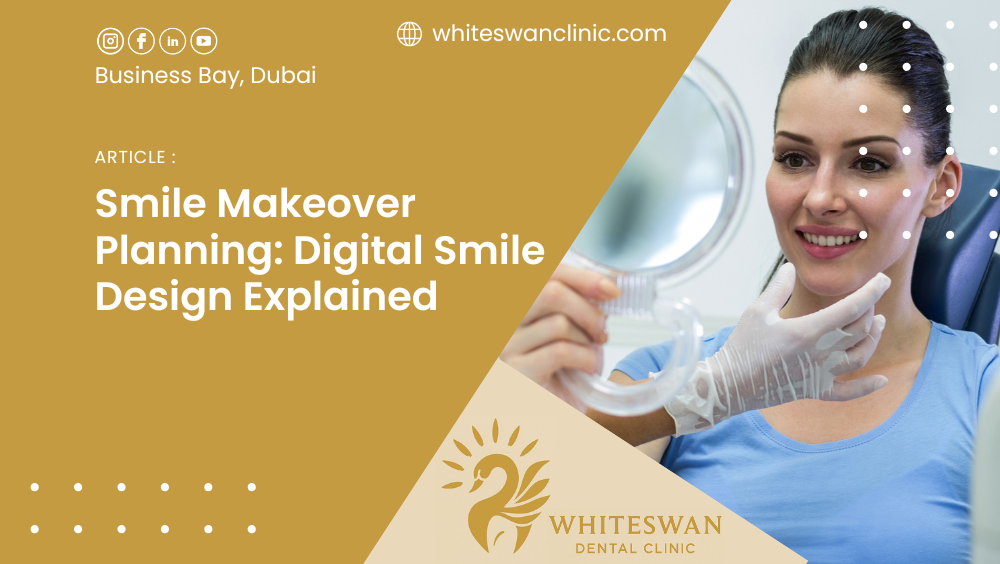
Smile Makeover Planning: Digital Smile Design Explained

Apparently, If you’ve ever wondered how celebrities get those perfectly balanced, photogenic smiles, here’s the secret: It’s just because of meticulous planning. Therefore At White Swan Dental Clinic, we use Digital Smile Design (DSD) to plan & preview a tailored smile makeover before a single tooth is treated. Consequently This modern, visual approach lets you move forward with confidence, give feedback, and see proposed changes,. So In this guide, you’ll learn how DSD works, what to expect during each step, and why it leads to beautiful, natural-looking results.

What Is Digital Smile Design?

Apparently, Digital Smile Design is a workflow that combines (often) short videos to create a precise digital model of your face & teeth, intraoral scans, and high-quality photos, . Moreover, Using that model, our clinicians design your ideal tooth shapes, sizes, and proportions while considering facial features like smile line, gums, and lips,. Since everything is visual, you can preview your new smile on-screen and, in many cases, try a 3D mock-up right in your mouth before treatment. Get details on  Dental Clinic in Business Bay.

Why Planning Matters More Than Ever:

A successful cosmetic dentistry result doesn’t happen by chance. With DSD:

  • We design with your face in focus—not just isolated teeth.
  • Moreover, We test function & aesthetics before committing to treatments like aligners, crowns, or. veneers,
  • We help ensure a result that looks natural and lasts, streamline appointments, and reduce surprises,.

Step by Step: How a DSD Smile Makeover Works

1) Discovery & Photography

To begin with , we learn about your goals. Do you want a whiter smile? Straighter edges? Less gum show? After that we capture standardized photographs and, where helpful, a brief video of your smile in motion. Since these images anchor the design, they must be consistent & crisp.

2) Digital Scans & Records

Next, we take intraoral scans (no goopy impressions) to map your teeth with remarkable accuracy. We record bite relationships and gum contours. These digital files feed the design software and allow precise tooth proportion and arch symmetry analysis.

3) Facial Analysis & Smile Blueprint

Using your photos as a frame, we align the planned tooth shapes with key facial references: midline, lip curve, and smile arc. Then we develop a smile blueprint—a visual plan that defines length, width, and contour of each tooth. You’ll see before-and-after simulations, so you can react in real time.

4) The 3D Try-In (Mock-Up)

With your approval, we 3D-print or mill a mock-up that fits over your existing teeth. You can test-drive the look, check speech and comfort, and even take photos. Usually This step helps answer, “Will I love this in real life?” Therefore, if you want tweaks, we re-mock as needed and adjust the design digitally .

5) Final Treatment Plan

After the design is locked, we outline your treatment path. Your plan might include teeth whitening, bonding, gum reshaping, ceramic, porcelain veneers,, or crownsclear aligners (like Invisalign®),. Since we built your plan from a visual blueprint, each procedure has a clear purpose and they work together seamlessly. Get details on Teeth Cleaning & Polishing.

What Problems Can DSD Solve?

  • Worn or chipped teeth: even edges and harmonious shapes
  • Crowding or gaps: coordinated orthodontics and veneers, when appropriate
  • Gummy smile: balanced tooth-to-gum display with precise gingival contouring
  • Discoloration: a whitening plan integrated with your final tooth materials
  • Asymmetry: improved midline and proportional balance across the arch

Benefits You’ll Notice

  • See it first: You preview your smile digitally—and often physically—before treatment.
  • Collaborative control: You can request changes early, not after placement.
  • Time efficiency: In addition With a clear roadmap, appointments become more predictable.
  • Natural aesthetics: moreover  Designs are crafted to your personality, lips, and, face, not a generic template.
  • Functional confidence: We plan for bite stability, not just surface beauty.

Techniques &,Materials : How We Bring the Design to Life:

  • Porcelain veneers: Usually ultra-thin restorations that transform minor alignment, shape, and color, while preserving tooth structure.
  • Ceramic crowns: usually full-coverage strength when teeth are heavily cracked or filled .
  • Composite bonding: small shape corrections & conservative edge refinements .
  • Clear aligners: staged tooth movement to set the foundation for lasting aesthetics.
  • Gum reshaping: laser-assisted refinement for symmetry and ideal tooth length.
  • Guided whitening: In addition calibrated shade improvement to match your final restorations.

Predictability, Safety,& Comfort

Although smile design sounds high-tech, it actually reduces uncertainty. Because you see the plan, you know the “why” behind each step. Moreover, we can phase care to suit your schedule and comfort level. For anxious patients, we offer gentle numbing, calming techniques, and breaks during longer sessions. Consequently, you stay in control from start to finish.

How Long Does a DSD Smile Makeover Take?

Timelines vary based on your plan:

  • Whitening + bonding: often a few visits
  • Veneers or crowns: typically 2–4 visits after mock-up approval
  • Aligners + veneers: several months, then final ceramic
  • Gum reshaping: often completed in one session, with a short healing period

Because DSD clarifies the destination, we schedule efficiently and reduce back-and-forth. Consequently You’ll know what each visit covers and how it moves you closer to your new smile.

Who Is a Good Candidate?

Apparently You may be a great fit if you:

  • If you really Want to correct uneven edges, discoloration,gaps, or chips,
  • Prefer a conservative approach with preview and input
  • Seek a result that respects your facial harmony and natural look
  • Also if you are Are willing to attend routine checkups and maintain excellent oral hygiene

Additionally If you have concerns like extensive decay, or active gum disease we’ll address those first, then return to cosmetic planning. By That way, your smile stays healthy, and looks good. Looking for a General Dentistry in Business Bay

Cost Considerations

Every plan is custom. Therefore, costs depend on the number and type of procedures, materials selected, and whether orthodontic alignment is needed first. However At White Swan Dental Clinic, we provide a transparent estimate after the mock-up stage, so you can choose the combination that fits your goals and budget and compare options.

Longevity & Aftercare

Apparently Great results deserve great care. Moreover, follow whitening protocols as advised, maintain regular cleanings, and Wear prescribed night guards if you clench,. Besides this, Most importantly, treat your restorations and veneers like natural teeth: avoid using teeth as tools, floss gently, and brush twice daily,. Therefore With proper care, your smile makeover can stay brilliant for many years.

Related Articles:

» Post-Whitening Care and Maintenance

» Whitening Strips: Do They Work?

» Laser Teeth Whitening Pros and Cons

» Achieving Perfect Smiles: Orthodontic Treatments in Dubai

» Teeth Whitening at Home vs Dentist

Why Choose White Swan Dental Clinic?

Further Beyond advanced technology, you’ll also find a caring team focused on communication. Moreover, we deliver with meticulous attention to detail, we design with you, and We listen,. Since we invite your input at every phase and plan thoroughly, you can expect a smile camera-ready, more balanced, only brighter, and that feels like you.

Ready to See Your Future Smile?

However If you’re curious about a smile makeover but want certainty before you commit, Digital Smile Design is the smart first step. Therefore Book a consultation with White Swan Dental Clinic to co-create a smile that fits your life predictably & beautifully, preview your results, and explore your options.

FAQs: Smile Makeover Planning

1) Distinguish  between traditional cosmetic dentistry & Digital Smile Design?

Digital Smile Design places your face at the center of planning. Instead of guessing, we test function & aesthetics  digitally and, usually , with a 3D mock-up. Consequently , decisions are data-driven,collaborative, and visual.

2) Will my teeth be recontoured  for veneers?

We aim for minimal-prep veneers whenever possible. The design stage shows whether conservative reshaping will achieve your goals. Moreover  If more structure is needed, we’ll explain why and discuss alternatives like bonding or orthodontics.

3) How original and natural will my smile appear to be?

Because we match tooth shape and shade to your facial analysis, results look refined yet authentic. We avoid a “one-size-fits-all” look and design to your age, lip dynamics, and personality.

4) Can I preview the results before treatment starts?

Yes. Usually  You’ll see digital before-and-after simulations, and many patients try a mock-up in the mouth to evaluate appearance, comfort, and speech, in real settings.

5) How do I maintain my smile makeover?

You can keep impeccable oral hygiene, attend routine visits, avoid biting hard objects, and use a night guard if recommended,. Consequently,Ask us about safe whitening touch-ups to keep your shade consistent over time.
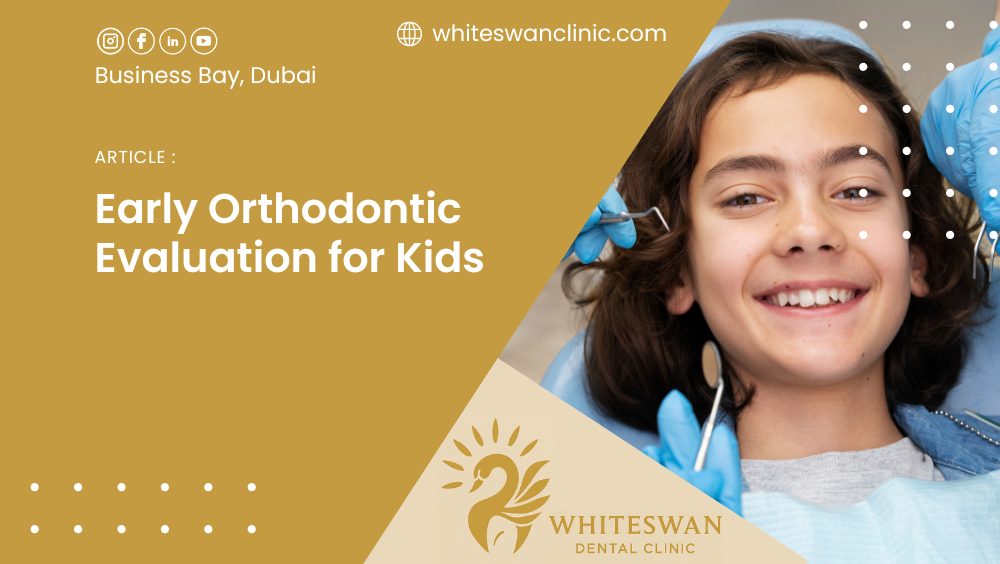
Early Orthodontic Evaluation for Kids

Parents want the best for their children’s smiles. At White Swan Dental Clinic, we do too. Since growth and development move quickly in the early years, an early orthodontic evaluation gives you a powerful head start. Actually , the American Association of Orthodontists advises a first orthodontic screening at age 7. Usually At this stage, small corrections can prevent bigger issues later,jawbones remain adaptable, and permanent teeth and baby teeth overlap,. As a result , your child can grow with confidence while you avoid complicated treatment and avoidable costs down the road.

Why age 7 matters

Usually By age seven, most kids have erupted the first permanent incisors and molars . Because of which , we can assess how the bite comes together and whether guidance is needed. During this short window, we evaluate:

  • Dental crowding & spacing
  • overbite,underbite, or Crossbite, patterns
  • Jaw growth and development symmetry
  • Habits such as mouth breathing & thumb nibbling
  • The relationship between bite,airway development, and tongue posture,

Because the jaws are still growing, early insights allow gentle redirection. As a result, we often keep treatment simple, comfortable, and efficient.Get details on Dental Clinic in Business Bay

What “early evaluation” really involves

At White Swan Dental Clinic, your child’s first orthodontic visit is friendly and low-pressure. First, we review medical and dental history. Next, we take child-sized digital x-rays and photos only when beneficial. Then, the dentist performs a comprehensive bite analysis and growth assessment. To sum up , we explain our findings in plain language. Moreover When treatment isn’t needed, we also recommend periodic orthodontic screening to ensure everything stays on track. Anyhow, when timing is right, we outline a personalized plan that fits your child’s lifestyle.

The power of interceptive orthodontics:

Usually Interceptive orthodontics focuses on guiding growth before problems worsen. Just so the jaws and face are developing, small appliances can create big benefits:

  • Palatal expanders widen a narrow upper jaw, which can improve nasal airflow and reduce crowding .
  • Space maintainers hold room for permanent teeth after early tooth loss.
  • Functional appliances can encourage forward lower-jaw growth in mild underbite cases.
  • Habit correctors help stop thumb sucking and retrain oral posture.

Importantly, interceptive care aims to avoid extraction of healthy permanent teeth, shorten time in children’s braces, and deliver a healthier bite. Get details on General Dentistry in Business Bay

Signs your child may need an early check

Parents usually notice little clues at home. Since you see your child every day, you’re the first to spot changes. Watch for:

  • Crowded or overlapping front teeth
  • Early or late loss of baby teeth
  • Jaw shifting or “clicking” during chewing
  • restless sleep,mouth breathing, or Snoring,
  • Chipped front teeth from a deep overbite
  • Difficulty pronouncing certain sounds
  • A smile that looks “narrow” or crooked

Additionally If any of these sound familiar, schedule an early orthodontic evaluation so we can guide you with clarity.

Airway, posture, and the smile connection

Orthodontics isn’t only about straight teeth. Since, tongue posture and airway development influence facial growth, we look beyond the smile. For example, chronic mouth breathing may narrow the upper jaw over time, which increases crossbite and dental crowding risk. In the same way , low tongue posture can affect arch width and speech . Because of which , we collaborate with pediatricians and, when appropriate,myofunctional therapists or ENT specialists to support healthy growth, and breathing . Eventually, better breathing often leads to a more balanced smile,improved focus, and better sleep,.

Braces later vs. guidance now

Many parents ask, “Can’t we just wait for braces?” Sometimes we can. However, early guidance can prevent problems that braces alone cannot fix later. Consider a narrow upper jaw that causes a crossbite. Expansion works best while the mid-palatal suture remains flexible, typically between ages 7–10. After that, expansion becomes slower or more complex. At the same time , thumb sucking can push front teeth forward and open the bite; stopping the habit early helps the bite normalize naturally. As a result , simplify any future children’s braces phase or early steps can shorten.

What treatment could look like

Apparently,every child is different, so no two plans look identical. Nonetheless, a common roadmap may include:

  1. Observation phase
    We monitor growth every 6–12 months. Meanwhile, we track eruption patterns and jaw changes.
  2. Interceptive phase
    When indicated, we use expanders, limited braces, or habit appliances for 6–12 months. Because children adapt quickly, most adjust within days.
  3. Resting phase
    After interceptive care, we pause to let remaining permanent teeth erupt. During this time, we give simple retainers or guidance as needed.
  4. Comprehensive phase (if needed)
    Later, brief braces or clear aligners line up the final details. Usually the early steps help which make , this phase often more predictable & shorter. Get details on Preventive Dentistry in Dubai.

Cost,convenience, & Comfort,:

Parents worry about comfort and time. We understand. That’s why our child-centered approach uses gentle forces and fun, kid-friendly visits. Moreover, early guidance usually spreads treatment over natural growth stages. As a result, appointments feel shorter and less intense. Commercially, interceptive care can reduce the need for complex procedures later. On top of that , our team explains, helps you maximize benefits,offers flexible options, and all fees upfront,.

Prevention you can practice at home

Usually,between visits, daily habits make a difference. Therefore,Encourage:

  • Consistent flossing and brushing (yes, even around simple appliances)
  • Be consistent in following A balanced, tooth-friendly diet low in sticky sweets
  • Maintain good posture and practice Nose breathing during screen time and homework
  • Plenty of sleep to support immunity & growth
  • Remember to have Regular dental checkups every six months

Because prevention compounds, these small steps safeguard your child’s progress.

Why choose White Swan Dental Clinic

Apparently,Families choose us for three reasons: transparency,empathy, and expertise,. To begin with , our dentists stay current with the latest orthodontic and pediatric research. Next , we explain choices clearly so you can decide with confidence. Finally, our calm environment helps kids relax. Besides this, we respect your time, we welcome questions, and we celebrate every milestone small or big . Eventually, we want your child to love their dental home and their smile. Looking for a Pediatric Dentist in Business Bay?

Common myths—busted

  • Myth: “Baby teeth don’t matter.”
    Reality: Baby teeth hold space and guide the bite. Therefore, they matter a lot.
  • Myth: “All kids need braces.”
    Reality: Many children only need monitoring or short interceptive care.
  • Myth: “Early treatment always means longer treatment.”
    Reality: Early care often reduces the length and intensity of later phases.
  • Myth: “We should wait until all adult teeth erupt.”
    Reality: Some problems are easier—and safer—to guide earlier.

Your next step

If your child is near age seven—or showing signs earlier—book an early orthodontic evaluation at White Swan Dental Clinic. Because timing shapes outcomes, a simple visit today can spare your child complex treatment tomorrow. Moreover, you’ll leave with a clear plan and genuine peace of mind.

Related Articles:

» Causes of Toothache and Quick Relief

» Post-Whitening Care and Maintenance

» How to Remove Dental Stains Safely?

» Whitening for Sensitive Teeth: Safe Protocols That Work

» How Often Should You See a Dentist?

Final Word

To conclude,At White Swan Dental Clinic, we believe healthy smiles last a lifetime,grow steadily, and start early,. Therefore, if you’re curious—or if your child shows any warning signs—contact us today. Because when you act early, you not only protect their bite, you also protect their confidence.

FAQs: Early Orthodontic Evaluation for Kids

1) What happens at the first visit?

We review health history, take kid-friendly images if needed, and examine how the teeth and jaws fit. Then we discuss findings and options. Because every child is unique, we tailor next steps and decide together.

2) Is age 7 mandatory?

Not mandatory—just wise. Moreover, The orthodontic screening at age 7 lets us catch growth issues early,dental crowding, and crossbite. Anyhow, if you notice concerns sooner, schedule a visit earlier.

3) Will my child definitely need braces later?

Not always. Sometimes interceptive orthodontics solves the underlying problem, which shortens or eliminates later children’s braces. Nevertheless, if we recommend a second phase, it’s usually simpler and faster.

4) Do expanders or appliances hurt?

Most kids feel pressure for a day or two, not sharp pain. Because the forces are gentle and the body adapts rapidly, discomfort fades quickly. We also teach easy ways to manage tenderness.

5) How much does early treatment cost?

Costs vary with each plan. That being said, early, targeted care can reduce the need for complex procedures in the future. Therefore At White Swan Dental Clinic, we provide benefit guidance,flexible payments, and transparent fees.

Post-Whitening Care: What to Eat and Avoid for 48 Hours

Apparently,You’ve just brightened your smile at White Swan Dental Clinic, and naturally you want those results to stay forever . Subsequently,The first 48 hours after teeth whitening matter more than most patients realize. Apparently, During this short window, your enamel becomes slightly more porous, which means pigments from foods and drinks can sneak in and dull your new shade. Luckily, with a few smart choices, help your smile stay luminous,keep sensitivity in check, and you can protect your investment,.

Consequently,Below you’ll find a clear, practical guide on how to build an easy routine that guards your glow,how to manage sensitivity,what to avoid, and what to eat after teeth whitening.

Why the First 48 Hours Are Critical

Apparently,Right after whitening, your enamel temporarily opens up at a microscopic level. Therefore , it’s more receptive not only to stains but also to temperature extremes. So , the choices you make,especially what you drink and eat ,directly influence how bright your teeth look by day three and beyond. On top of that , these habits reduce the chance of post-treatment tenderness. Get details on Dental Clinic in Business Bay.

The “White Diet”: Safe Foods to Enjoy

Usually For two days, choose light-colored foods with minimal pigment. In other words, think gentle pale, and neutral,.

  • Lean proteins:you can enjoy egg whites,white fish,turkey, tofu, or Plain chicken,.
  • Dairy & alternatives: you can have skim or white milk, unsweetened soy milk, and low-fat cheese,cottage cheese Plain yogurt,,,.
  • Grains & starches: it is advisable to have lightly salted crackers/rice cakes,,cream of wheat,mashed potatoes,pasta, oatmeal,, and plain White rice,.
  • Vegetables (pale/white):also you can eat Cauliflower, peeled cucumbers, white mushrooms, peeled zucchini, cabbage.
  • Fruits (non-staining): additionally,you can have white melon,pears peeled apples or Bananas, (go easy and rinse afterward),.
  • Soups: you can have Cream-based or clear broth avoiding tomato, curry, or beetroot.
  • Desserts: you can still enjoy desserts in the form of angel food cake,tapioca,.rice pudding, Plain vanilla pudding,

Pro tip: Even after this If you’re unsure about a food, imagine spilling it on a white shirt. If it stains the shirt, it can likely stain your teeth right now. Looking for a Teeth Whitening near Business Bay?

What to Avoid: Sensitivity Triggers &,Stain Culprits

Usually During this 48-hour window, skip anything extremely hot/cold,acidic, or dark,. As These are the biggest offenders:

  • Dark beverages: avoid drinks like colored sports drinks,dark sodas,cola,red wine,tea, and coffee,.
  • Highly pigmented foods: do away with dark berries like blueberries, blackberries, pomegranate,beetroot,balsamic vinegar,,tomato sauce, soy sauce,
  • Acidic items: Avoid vinegar-heavy dressings,pickles,juices and Citrus fruits ,.
  • Colored sweets: Curb down the craving for popsicles with artificial colors,brightly dyed candies,.Chocolate,
  • Tobacco: strictly stay away from vaping liquids with colorants,cigars, and Cigarettes,.

Just so the enamel pores are more open, these pigments can lodge in quickly. Moreover , acids can roughen enamel surfaces and increase sensitivity , making new stains more likely.

Hydration Rules: What to Drink Instead

Apparently you don’t have to feel deprived. Instead, choose:

  • Still water (your best friend right now)
  • Sparkling water without citrus flavoring
  • White or skim milk
  • Caffeine alternative: If you need a pick-me-up, You can consider clear, non-staining electrolyte drinks without dyes.

If you are so into having coffee or tea, drink it through a straw, choose it lukewarm, add milk to lighten it, and rinse with water immediately after having it . Anyhow, for best results, hold off completely until the 48-hour mark. Get details on General Dentistry in Business Bay.

Technique,Timing, & Temperature: How to Eat Smart?

Even safe foods can cause temporary zing if they’re too hot or too cold. Consequently, aim for room-temperature meals. In addition:

  1. First Rinse, after that brush gently after having meals.
  2. Use a non-abrasive toothpaste and soft-bristled brush .
  3. to prevent enamel micro-wear,Wait for 30 minutes,before brushing, after the intake of acidic foods.
  4. avoid biting directly and Chew slowly into very firm foods for the first day.

Managing Sensitivity Like a Pro

Some patients feel brief tingles or cold sensitivity after whitening. Luckily , a few tweaks bring quick relief:

  • Switch to a desensitizing toothpaste with arginine or potassium nitrate .
  • Brush before bed and avoid icy or steaming foods overnight.
  • Mainly to strengthen enamel Use a fluoride rinse once in a day.
  • Apparently,If you received custom trays from White Swan Dental Clinic, you can also ask about a desensitizing gel for short-term use.
  • You can take an over-the-counter pain reliever if needed and also as advised by your dentist .

A Simple 48-Hour Meal Plan (Sample)

Day 1

  • Breakfast: During the breakfast you can have a banana,plain yogurt, and Scrambled egg whites,.
  • Snack: you can snack on a rice cake or Cottage cheese.
  • Lunch: for lunch you can have ,steamed cauliflower,mashed potatoes Grilled chicken breast,,.
  • Snack: Snack on Plain hummus & crackers (light-colored/plain).
  • Dinner: at night for supper have Baked white fish with peeled zucchini; also vanilla pudding for dessert.
  • Drinks: you can quench your thirst by drinking Water throughout the day; also white milk with dinner.

Day 2

    • Breakfast: you can have Oatmeal with a touch of honey; also peeled pear .
    • Snack: snack on Plain Greek yogurt.
    • Lunch: sautéed mushrooms,white rice, Turkey slices,
    • Snack: you can enjoy snacking on Plain rice pudding.
    • Drinks: also you are allowed to drink still or sparkling water; also unsweetened soy milk if preferred.
    • Dinner: For supper you can have ,Pasta with a light cream sauce; side of cabbage.

Oral Hygiene Checklist for the First Two Days

  • Brush twice daily in a gentle with low-abrasive paste and a soft brush .
  • You must floss gently once a day to prevent plaque from trapping pigments.
  • Rinse with water after every snack and drink.
  • you must Keep a reusable straw handy if you bend the rules with tea or coffee.
  • during this period ,Skip whitening strips or harsh mouthwashes (especially alcohol-heavy or dyed formulas). Looking for a Preventive Dentistry in Business Bay?

After 48 Hours: Reintroducing Color,Gradually

At the two-day mark, enamel returns closer to its normal state. Even then, proceed thoughtfully:

  • Add back lighter-colored fruits first, then moderate sauces.
  • keep a straw habit and Reintroduce tea or coffee with milk .
  • You can Maintain a nightly fluoride rinse & twice a day brushing habit .
  • You can immediately Book a quick check-in at White Swan Dental Clinic if you notice uneven color or persistent sensitivity.

Quick Reference: Yes/No Foods for 48 Hours

Yes:cauliflower,.Chicken, turkey, white fish, egg whites, plain yogurt, cottage cheese, clear or cream soups, vanilla pudding, water, white milk, pasta, oatmeal, mashed potatoes,white rice,peeled cucumbers, mushrooms, bananas, peeled apples, 

No: chocolate, colored candies, dyed popsicles, tobacco balsamic vinegar, beetroot, blueberries, pomegranate, citrus juices, pickles,Coffee, black tea, red wine, dark sodas, tomato sauce, soy sauce, curry.

Related Articles:

» Post-Whitening Care and Maintenance

» Whitening for Sensitive Teeth: Safe Protocols That Work

» Laser Teeth Whitening Pros and Cons

» Whitening Strips: Do They Work?

» Teeth Whitening at Home vs Dentist

Final Thoughts from White Swan Dental Clinic

To conclude,The first two days after whitening set the tone for your results. By practicing gentle, consistent hygiene,choosing non-staining drinks, and following a simple white diet, you protect your smile when it’s most vulnerable. After that , once 48 hours pass, add color back mindfully. Consequently your photos and your future self will thank you.

In short,If you have ongoing sensitivity or specific dietary needs , the team at White Swan Dental Clinic can customize a personal post-whitening plan to keep your smile brilliantly bright and your enamel comfortable.

Frequently Asked Questions:

1)  Am I allowed to drink coffee after teeth whitening?

Apparently) It’s best to avoid coffee for 48 hours. If you find it difficult to avoid coffee,  you can drink a small, lightened coffee by adding  milk, use a straw, keep it lukewarm, and rinse with water immediately after having it.

2) what is the reason behind tooth sensitivity after whitening and how long will it last?

Usually Whitening lifts stains from within enamel which can lead to the brief opening of enamel tubules and increased  sensitivity. However Sensitivity usually fades within 24–72 hours. In the meantime,  a fluoride rinse and desensitizing toothpaste help a lot.

3) Is sparkling water safe during the first two days?

Yes,you can choose plain sparkling water without citrus flavor. Even though it is mildly acidic, it’s far less risky  than juices or dark sodas. Also you can ,Rinse with still water if you’re concerned.

4) When can I have curry or tomato sauce again?

You must Wait at least 48 hours. After that reintroduce colored sauces gradually, rinse or brush after meals to prevent new stains and maintain great oral hygiene.

5) How can I keep my smile bright long-term?

Sip dark drinks with a straw, limit highly pigmented foods, Stick to daily flossing and brushing , and schedule periodic touch-ups as advised by White Swan Dental Clinic. Therefore,Regular polishing cleanings also prevent surface stains from building up.

Whitening for Sensitive Teeth: Safe Protocols That Work

Apparently,If your teeth twinge when you breathe in cold air, or sip iced coffee then you aren’t alone. Normally,Tooth sensitivity affects millions, and for many people it gets worse after whitening. Anyhow you don’t have to choose between a bright smile and everyday comfort. Because of which ,At White Swan Dental Clinic, we follow whitening protocols for sensitive teeth that lift stains gently,protect enamel, and, calm irritated nerves, so you can whiten with confidence.

Why Sensitive Teeth React to Whitening? 

Normally Sensitivity starts in the dentin, the layer beneath enamel. Apparently, when gums recede or When enamel thins, and expose root surfaces, microscopic tubules carry temperature changes straight to the tooth’s nerve. On top of that ,Typical whitening gels use carbamide peroxide or hydrogen peroxide to break apart stain molecules. However, long contact times,acidic formulas, or high concentrations, can temporarily increase fluid movement in those tubules, which triggers the familiar zing.

Therefore , we never treat sensitivity as an afterthought. But , we design a sensitivity-smart whitening plan that reduces triggers before, during, and after treatment. Get details on Dental Clinic in Business Bay.

The White Swan Sensitive-Safe Whitening Blueprint

We combine several protective steps. Together, they brighten smiles while keeping comfort front and center.

1) Pre-whitening desensitizing phase

First, we stabilize your comfort. For 7–14 days before whitening, we recommend:

  •  to calm,& strengthen enamel & nerve transmission use a potassium nitrate and fluoride toothpaste.
  • Nano-hydroxyapatite serum or paste to plug open tubules and rebuild mineral density.
  • If needed, a short course of fluoride varnish or CPP-ACP (casein phosphopeptide–amorphous calcium phosphate) in clinic to supercharge remineralization.

This “primer” often reduces sensitivity by 40–60% even before we whiten.

2) Careful case selection and shade mapping

Not every stain behaves the same. Therefore, we evaluate erosion, cracks, gum recession, white spot lesions, and existing restorations. We also record your baseline shade and set realistic goals. Because transparency builds trust, we explain what whitening can and cannot change (for example, crowns and fillings won’t lighten).

3) Low-and-slow gel selection

Instead of chasing speed, we choose pH-balanced, neutral-pH whitening gels with 5–10% hydrogen peroxide or 10–16% carbamide peroxide for at-home use, or a short-contact in-office gel in the 15–25% range when appropriate. Lower acidity and buffered formulas reduce irritation without sacrificing results.

4) Custom trays that fit like a glove

Ill-fitting trays leak gel onto gums, which stings and wastes product. Our precision-made custom trays hold thin, even layers of gel and keep it where it belongs. As a result, you use less gel, whiten more evenly, and stay more comfortable.

5) Pulsed, brief in-office sessions

For in-office whitening, we prefer short, pulsed applications with careful monitoring rather than marathon sessions. We may pair whitening with cool-light LED activation to optimize performance at lower gel strengths. Between passes, we apply remineralizing pastes that re-seal tubules.

6) Built-in desensitizers during whitening

We integrate potassium nitrate, arginine, fluoride, or nano-hydroxyapatite throughout treatment—either mixed into the gel, applied between sessions, or worn in trays on “rest days.” Consequently, sensitivity stays low while shade steadily improves.

7) Post-whitening recovery window

For 48 hours after each session, we promote enamel repair:

  • Avoid very cold or hot foods.
  • Skip highly pigmented drinks like black tea & red wine .
  • Also Rinse with neutral fluoride mouthwash.
  • Continue using desensitizing toothpaste twice a day .

This recovery window locks in results and keeps teeth calm. Get details on  Teeth Whitening Treatment in Business Bay?

In-Office vs At-Home :

Which is Better for Sensitive Teeth?

Normally Both paths can work beautifully; the best choice depends on your budget,timing, and. sensitivity profile, 

  • At-home whitening with custom trays: Apparently,You should wear low-concentration gel for 60–90 minutes per day or overnight with an even gentler formula. Because the process runs “low and slow,” sensitivity is easier to manage. Moreover, you can pause any day you feel tender.
  • In-office whitening: You’ll see faster shade jumps in a single visit. Nevertheless, we still run short, controlled cycles and layer desensitizers between passes. Many patients finish the appointment brighter with little to no next-day discomfort.

Often, the sweet spot is a hybrid: a conservative in-office boost, followed by at-home maintenance with mild gel.

Ingredients That Actually Help Sensitive Smiles:

Apparently for keeping your routine effective and simple , you can look for these evidence-backed ingredients:

  • Potassium nitrate: good at Soothing nerve signals.
  • Fluoride (especially sodium fluoride or stannous ):this usually helps to strengthen enamel and also minimizes tubule flow.
  • Nano-hydroxyapatite: Apparently Good at reducing roughness that grabs stains and Rebuilding mineral lattice.
  • Arginine and calcium carbonate: Work together to block tubules.
  • CPP-ACP: Delivers bioavailable phosphate and calcium for remineralization.

Consequently,When these ingredients appear before, during, and after whitening, sensitivity typically drops dramatically.

The Role of pH and Why It Matters:

Highly acidic gels open tubules and can roughen enamel, which invites more staining later. Thus, we insist on buffered, neutral-pH gels. They whiten at a controlled rate, protect the surface, and keep post-op sensitivity low. Add our cool-light protocol and you get the best of both worlds: efficiency with comfort. Get details on Root Canal Treatment in Business Bay.

Seven Smart Habits That Protect Your Bright Smile:

Clearly,A whiter smile lasts longer and feels better when you build these habits:

  1. You can Sip, don’t swish when you consume colored or acidic beverages; use a straw when possible.
  2. You can Rinse with water after drinking citrus, tea, or coffee,.
  3. Moreover, Wait 30 minutes to brush after drinking acidic foods so you don’t scrub away the softened enamel.
  4. You can Choose gentle technique and a soft brush to prevent gum recession.
  5. as your new normal,You can Use desensitizing toothpaste daily .
  6. Schedule professional cleanings; normally polished enamel resists stains.
  7. You can Top-up whitening usually with mild gel for one to two nights every few months rather than doing an aggressive overhaul once a year.

Who Should Avoid or Delay Whitening?

While most people can whiten safely, some situations deserve caution. Apparently, If you have significant recession, cracks, severe enamel erosion, active gum disease, or, untreated cavities, whitening should wait until we stabilize your oral health. Besides this nursing or Pregnant patients should postpone elective whitening. Moreover, if your teeth hurt even without sweet or cold stimuli, we’ll diagnose the root cause first.

What Results Can You Expect?

Because we personalize every plan, outcomes vary. Even so , patients with sensitivity commonly see two to six shades of improvement across two to four weeks with minimal discomfort. More significantly, your smile looks naturally bright, not chalky or over-bleached . And just so we build in maintenance from the start, you keep those gains without flare-ups. Looking for a Teeth Cleaning & Polishing

Why Choose White Swan Dental Clinic

You deserve a whitening plan that respects comfort as much as color. At White Swan Dental Clinic, our team:

  • Uses measured, dentist-dispensed gels only—never mystery kits.
  • Custom-fits trays for even contact and cleaner margins.
  • Integrates desensitizers at every stage.
  • Monitors progress with shade guides and photographs, then fine-tunes exposure times.
  • Teaches you a simple aftercare routine that actually fits your life.

Since we track each variable, we can replicate success season after season with fewer surprises.

Related Articles:

» Laser Teeth Whitening Pros and Cons

» Post-Whitening Care and Maintenance: Keep Your Bright Smile Longer

» Whitening Strips: Do They Work?

» Achieving Perfect Smiles: Orthodontic Treatments in Dubai

» Teeth Whitening at Home vs Dentist

Key Takeaways:

  • Apparently Sensitive teeth can whiten safely with short, pulsed sessions,custom trays,neutral-pH gels, and.
    pre-desensitizing, 
  • Moreover Ingredients like CPP-ACP,nano-hydroxyapatite,fluoride, and potassium nitrate, protect enamel and reduce sensitivity.
  • A hybrid approach which will me like a brief in-office whitening plus gentle at-home maintenance, usually delivers steady shade gains with minimal flare-ups.
  • Also Consistent top-ups & aftercare preserve brightness without stress.

Are you Ready to brighten your smile without the sting? 

Then you must immediately Contact White Swan Dental Clinic to schedule a sensitivity-smart whitening consultation. Subsequently We’ll guide you to a radiant result you can enjoy every day,customize your gel and tray protocol, and map your unique triggers,.

FAQs: Whitening for Sensitive Teeth

1) Will whitening make my sensitivity worse?

Not with the right plan. We pre-treat with potassium nitrate, fluoride, or nano-hydroxyapatite, use neutral-pH gels, and limit contact time. As a result, most patients report equal or less sensitivity than before they began.

2) What’s the safest whitening option if my teeth already zing?

A custom-tray, low-concentration program is the gentlest starting point. You control frequency, and we can alternate whitening nights with remineralizing gel until sensitivity settles.

3) How long does the whitening last ?

Normally, 6–12 months, based on home care & diet . However , quick top-up sessions (1–2 nights every 8–12 weeks) also keep color stable without triggering sensitivity.

4) if I have sensitive teeth can I use whitening strips?

You can, but normally   strips overlap onto gums and also deliver a one-size-fits-all dose. Custom trays are more precise, use less gel, and allow desensitizer days between sessions, so they’re usually more comfortable and effective.

5) What to do if I feel a sharp zing mid-treatment?

usually  apply a fluoride gel or, desensitizing serum gently rinse with lukewarm water, and,Remove the tray, . After that give your teeth 24–48 hours of recovery before resuming at a shorter wear time. Because of which If discomfort persists, contact White Swan Dental Clinic so we can adjust your plan.

Treating Open Bite & Tongue Thrust: Modern Options

Apparently,If you or your child struggles to bring the front teeth together, you’re not alone. usually An open bite pairs with a tongue thrust swallow, which pushes the tongue forward against the teeth. And Together, they can affect confidence,breathing,chewing, and speech,. Therefore The good news: modern dentistry gives you precise diagnostics and proven treatments—from gentle training exercises to clear aligners and advanced orthodontics. Consequently At White Swan Dental Clinic, we combine coaching,technology, and science, to help you bite,speak, and smile, with ease and grace. Get details on Dental Clinic in Business Bay

What Are Open Bite and Tongue Thrust?

An open bite means the upper and lower front teeth don’t meet when you close your mouth. You may notice a gap between the incisors while the back teeth touch. Normally A tongue thrust is a swallowing pattern where the tongue presses forward against or between the teeth. By the course of time , it can even reopen a bite after braces if left unaddressed and that pressure can prevent the front teeth from closing,.

Common signs include:

  • Space between the front teeth when you bite down
  • Lisping or speech issues with “s,” “z,” or “ch” sounds
  • Mouth breathing or difficulty sealing the lips
  • It can be because of  past pacifier use or Thumb sucking
  • Jaw fatigue, usually chewing difficulty or TMD-type symptoms,

Why Early Diagnosis Matters

Usually,Without treatment, an open bite can impact airway health,facial balance, and jaw growth,. Moreover It can also make orthodontic relapse more likely after treatment. Therefore, we always recommend a timely evaluation. At White Swan Dental Clinic, we start with:

  • 3D scans and photos to map tooth positions
  • Digital bite analysis to measure contact points
  • Airway screening for sleep-disordered breathing
  • Moreover,Functional checks for orofacial myofunctional disorders (OMDs)

Honestly,This baseline helps us distinguish skeletal open bite (bone-related) from dental open bite (habits & tooth position ), which guides the plan.

Modern, Evidence-Based Treatment Options:

Because every smile is different, we design custom plans. Anyhow, most solutions fall into several advanced categories:

1) Orofacial Myofunctional Therapy (OMT)

Usually Orofacial myofunctional therapy retrains the cheeks,lips, and tongue,. Apparently,With at-home practice and weekly coaching , you learn to swallow without pushing on the teeth,seal the lips, and. rest the tongue on the palate, Hence , OMT supports long-term stability and reduces forward pressure .

Ideal for: adults,teens, and children, with low tongue posture,mouth breathing, or. tongue thrust,
Often combined with: retainers,braces, or.clear aligners, Get details on Teeth Cleaning & Polishing

2) Clear Aligners (e.g., Invisalign®)

Today’s clear aligners do more than straighten. With precision attachments, bite ramps, and elastics, aligners can close an anterior open bite while staying almost invisible. Moreover, digital planning lets us preview progress and ensure controlled, efficient tooth movement.

Ideal for: image-conscious adults and teens;mild to moderate dental open bite; .
Benefits: excellent comfort,easy hygiene, and removable for meals,.

3) Advanced Braces with Elastics and TADs

For tougher cases, braces still shine. We often use:

  • Vertical elastics to seat the bite
  • Posterior intrusion to rotate the jaw favorably
  • Temporary anchorage devices (mini-implants/TADs) mainly to move teeth with pinpoint control

Because TADs anchor movement from the bone, they help close open bites that once required surgery.

Ideal for: moderate to complex open bites, especially when aligners alone won’t deliver.

4) Habit Appliances and Tongue Cribs (Selective Use)

When habits drive the problem, a small device called a tongue crib or habit appliance can block forward pressure while OMT retrains the swallow. Usually For young children transitioning from thumb sucking to pacifier use, this step can be transformative.

Ideal for: pediatric patients with persistent oral habits.

5) Palatal Expansion and Airway-First Care

If a narrow palate limits tongue space and nasal airflow, palatal expansion widens the arch and creates room for a stable tongue posture. As breathing improves, the tongue can rest up and back, not forward against the teeth. Consequently, expansion often boosts the success of OMT and orthodontics.

Ideal for:  growing patients with airway concerns,crowding, or crossbite,

6) Jaw (Orthognathic) Surgery for Skeletal Open Bite:-

In severe skeletal open bite, jaw surgery may create the most balanced, durable result. UsuallyWe pair surgery with braces or aligners for finishing detail,coordinate with oral surgeons, and plan these cases with 3D imaging,.

Ideal for: adults with severe skeletal discrepancies or failed prior correction. Get details on Preventive Dentistry in Dubai.

What About Breathing & Speech ?

Since tongue thrust normally involves airway dysfunction,sound, and speech errors we collaborate with speech-language pathologists and, when appropriate, sleep physicians. At the same time , we coach proper tongue rest position,lip seal, and nasal breathing, to support lasting change. Therefore This integrated approach improves overall wellness and reduces relapse not just tooth alignment.

How Long Does Treatment Take?

usually Timelines vary, yet clear patterns emerge:

  • OMT: 10–20 weeks of weekly/biweekly sessions plus daily home practice
  • Clear aligners: 8–18 months for many mild to moderate cases
  • Braces with TADs: 12–24 months for moderate to complex cases
  • Expansion: active phase ~3–6 months, followed by stabilization
  • Surgery cases: multidisciplinary timeline, usually 18–24 months total

Because we pair tooth movement with habit correction, results tend to hold better. Additionally, retainers with tongue-posture cues can help protect your investment.

Will the Open Bite Come Back?

Relapse risk drops when we treat the cause, not just the crowding. Hence our plans address:

  • Swallow pattern and tongue posture (OMT)
  • Airway and nasal breathing
  • Growth guidance in children
  • Precise retention for adults

We also schedule follow-ups and give you a simple home routine—because small, consistent habits keep the bite closed.

What to Expect at White Swan Dental Clinic

From your first visit, you’ll notice our step-by-step process:

  1. Comprehensive exam with 3D imaging and airway screening
  2. usually Functional assessment for orofacial myofunctional disorders
  3. Personalized plan that outlines OMT,braces,aligners,, or combined care
  4. Transparent timeline and fees with flexible payments
  5. Coaching and check-ins to keep progress steady

Additionally,You get a team that celebrates your wins,explains options clearly, and listens. Looking for a General Dentistry in Business Bay?

Who Is a Good Candidate?

You may benefit from treatment if you have:

  • A visible gap when biting your teeth together
  • Difficulty pronouncing “s” and “z” sounds
  • A history of thumb sucking, pacifier use, or mouth breathing
  • Prior orthodontic treatment with bite opening again
  • Trouble chewing certain foods or tired jaw muscles

Children and adults both qualify. However, we choose different tools at different ages to take advantage of growth or to minimize invasiveness.

At-Home Habits That Help

Although professional treatment matters, daily habits accelerate success:

  • Rest the tongue on the palate (“tip up, back flat”)
  • Keep lips sealed and breathe through the nose
  • Chew foods evenly on both sides
  • Practice your OMT exercises as prescribed
  • Avoid finger or thumb habits; clearly consider positive reinforcement

Consequently,Small actions, repeated daily activities, change the trajectory of your bite.

Related Articles:

» Causes of Toothache and Quick Relief

» How Often Should You See a Dentist?

» Bleeding Gums: When to See a Dentist in Dubai?

» How to Remove Dental Stains Safely?

» Cavity Symptoms and Early Treatment

Ready to Close the Gap For Good?

It is apparent that Whether you’re exploring myofunctional therapy, TADs, or Invisalign open bite, our team at White Swan Dental Clinic will guide you. On top of that ,We’ll coach you through every step, customize your plan, and pinpoint the cause, . Hence ,Book your comprehensive evaluation today, and let’s help your smile, speech, and bite, work together beautifully and gracefully.

FAQs

1) Can clear aligners really fix an open bite?

Yes—especially for dental open bite caused by tooth position and habits. With attachments, bite ramps, and elastics, aligners guide vertical changes effectively. However, complex skeletal cases may still need TADs or surgery. We’ll show you a digital simulation before you commit.

2) Is it compulsory to do myofunctional therapy if I’m getting braces or aligners?

Usually, yes. OMT trains a healthy swallow and tongue posture, which reduces forward pressure on the front teeth. Therefore, it improves results and lowers relapse risk. Think of it as “physical therapy” for your bite.

3) How do you discern  if my open bite is dental or skeletal?

Apparently  we use bite analysis,facial photos, and 3D imaging, to evaluate growth patterns,tooth eruption, and jaw position,. Therefore If bone structure drives the issue, we discuss TAD-assisted orthodontics or orthognathic surgery . And also If we find that habits and teeth  lead the problem, OMT,braces, and aligners, often suffice.

4) Will I need a tongue crib?

Not always. A tongue crib helps when habits are strong or when a child needs extra support. Nevertheless, we prefer to pair any appliance with OMT, so skills replace the habit for lasting change.

5) How long do results last?

With corrected habits, nasal breathing, and a tailored retainer plan, results can last for years. We schedule periodic reviews and give you maintenance tips so your bite stays where it belongs—closed and comfortable.

Adult Braces: Discreet Options for Working Professionals

Usually A busy career with video calls client lunches, and,endless meetings, can make the idea of adult braces feel a little intimidating. However You might worry about whether they will fit into your lifestyle,how they will feel, and how they will look,. Moreover, modern orthodontics gives you far more choice than the metal braces you remember from school.

Therefore,At White Swan Dental Clinic, we see more adults every year who want a straighter smile without drawing attention at work. Luckily, there are several discreet braces options for working professionals that combine into daily life while still delivering powerful results.

Consequently In this guide, you’ll discover what to expect on your treatment journey,the main types of adult braces,and how they fit into a professional routine. Get details on Dental Clinic in Business Bay.

Why More Adults Are Choosing Braces Now

Apparently Today’s workplace is more visual than ever. You appear on Zoom calls, present in boardrooms, and network at events. Because of this, your smile has become a big part of your professional “brand.”

On top of that , many adults never had orthodontic treatment as teenagers, or their teeth shifted back over time. Subsequently, they now seek adult orthodontic treatment to:

  • Improve confidence when speaking and smiling
  • Correct crowding or gaps
  • Relieve jaw strain and bite problems
  • Protect teeth from uneven wear

At the same time, they want treatments that are:

  • Discreet in person and on camera
  • Comfortable enough for long working days
  • Flexible around travel and changing schedules

Thankfully, modern braces for adults are designed with exactly these needs in mind.

What Working Professionals Need From Adult Braces

If you’re a professional, you don’t just want straight teeth. You also want minimal disruption. Because of which , when we discuss orthodontic options for adults, we focus on:

  • Appearance: How visible are the aligners,wires, or brackets, ?
  • Speech: Is it possible to speak clearly in meetings and calls?
  • Convenience: How often must you visit the clinic for adjustments?
  • Lifestyle: Is it possible to enjoy travel, client dinners, and coffee, ?

Apparently every job is different, White Swan Dental Clinic creates personalized plans. Moreover, For example, a teacher who speaks all day may prefer one option, whereas a consultant who travels usually may choose another. Get details on Teeth Cleaning & Polishing in Business Bay.

Discreet Orthodontic Options for Adults:-

Apparently,Modern orthodontics offers several low-visibility braces styles. In addition, each comes with its own benefits, and your dentist will help you choose the right one for your schedule,budget, and teeth,.

1. Clear Aligners (Invisible Trays)

Normally Clear aligners are one of the most popular adult braces options. Besides this they use a series of custom-made, transparent trays that fit snugly over your teeth.

Why working professionals love them:

  • They are almost invisible in face-to-face conversations and photos.
  • You remove them for important events, coffee, and meals,.
  • They usually require fewer in-clinic appointments.

Moreover, clear aligners are removable, they demand good discipline. You usually wear them 20–22 hours per day. Anyhow, the flexibility makes them perfect for social events,speaking engagements, and business lunches.

2. Ceramic Braces (Tooth-Coloured Brackets)

Apparently If your case requires more control than aligners can offer , ceramic braces which provide a strong yet subtle option. Besides this,these braces work like traditional metal braces but use clear brackets or tooth-coloured and often a light-colored wire.

Benefits for professionals:

  • They merge with your natural tooth shade, so they appear less noticeable.
  • Also They stay fixed, so you don’t have to worry about forgetting to wear them.
  •  Usually they can handle a wide range of orthodontic cases, from mild to complex.

As , ceramic braces stay on your teeth, they are always quietly working in the background, even when you are busy leading meetings or answering emails .

3. Lingual Braces (Hidden Behind the Teeth)

Usually,For those who need maximum discretion, lingual braces sit behind the teeth instead of in front. Because of which , they stay hidden when you laugh,speak, or smile,.

Why they suit working professionals:

  • They are completely invisible from the front.
  • They provide the full control of traditional braces.
  • Apparently They are ideal if you frequently appear in photos or public events.

Anyhow , lingual braces may affect speech slightly at first, and they can take a bit of time to get used to. Nevertheless , most adults adapt quickly with a bit of practice.

4. Clear Wires and Minimal Metal Options

Apparently Sometimes, the best solution is a personalized combination. Moreover For example, your dentist might suggest:

  • Slim metal brackets with clear wires
  • Ceramic brackets on upper front teeth and metal on lower back teeth
  • A short phase of conventional braces followed by clear aligners

Because every mouth is unique, White Swan Dental Clinic designs individual treatment plans. Because of which ,the goal is simple: balance effectiveness,comfort, and appearance, while respecting your professional life. Get details on Dental Checkup in Business Bay

Living With Adult Braces in a Professional Environment

Starting adult orthodontic treatment doesn’t mean putting your career on hold. Moreover,With a few smart habits, you can stay confident at work and protect your braces.

Handling Presentations & Meetings

Apparently,most people around you will notice your confidence more than your braces. But Still, you can:

  •  In case you feel self-conscious you can practise speaking out loud for a few days.
  • Keep a small dental kit consisting of travel mouthwash,floss, brush, at the office.
  • Sip water regularly to keep your mouth comfortable and fresh .

On top of that , if you choose clear aligners, you can remove them briefly for key presentations, as long as you keep your overall wear time on track.

Eating and Social Events

Business lunches and coffee breaks still fit into your life with braces. You simply:

  • Avoid very hard or sticky foods with fixed braces.
  • rinse or Brush after meals to keep aligners and brackets clean.
  • Remember to Store aligners in their case during meals instead of pockets or napkins.

Since you stay prepared, you can enjoy professional and social events without worrying about your smile.

Your Treatment Journey at White Swan Dental Clinic:-

Usually,At White Swan Dental Clinic, we guide you step by step, so that you will never feel rushed or lost.

  1. Comprehensive Consultation
    First, we listen. Apparently,We discuss your goals,your work routine, and your concerns, . After that we examine your overall oral health, jaw movement,bite, and teeth, .
  2. Photos and Digital Scans
    Instead of messy impressions, we usually take digital scans and photographs. This helps us show you how your teeth look now and how they could move.
  3. Personalised Treatment Plan
    In addition , we design a plan that fits your lifestyle. Besides this we explain whether lingual braces,ceramic braces, or clear aligners suit you best, and also we talk through costs and timeframes in simple language.
  4. Fitting and First Days
    Therefore  Once you decide, we give you your first set of aligners or we place your braces . Subsequently We teach you how to manage mild discomfort,what to avoid, and how to clean them,.
  5. Review Visits and Progress
    Moreover  Regular check-ups allow us to make small adjustments and monitor progress . Since we know you have a busy schedule, we always aim for on-time,efficient, appointments.
  6. Retention and Long-Term Results
    Apparently  after treatment, you move to retainers to keep your new smile in place. On top of that , we show you how to care for them and how often you wear them, so that your investment lasts.

Besides this ,throughout your journey, our focus stays on discreet, professional-friendly orthodontic care that respects your time and your career. Looking for a General Dentistry in Business Bay?

Common Myths About Adult Braces:-

Clearly, even today, many adults hesitate because of outdated myths.

  • “I’m really so old for braces.”
    The important factor to consider is As long as your gums are healthy, age is never a barrier. Honestly, many of our patients are in their 30s, 40s, and beyond.
  • “Braces are so painful.”
    Usually  tenderness or some pressure is normal in the first days after adjustments, but modern braces are designed for your comfort. Therefore,wax for brackets,soft foods, and simple pain relief, usually help.
  • “Treatment takes forever.”
    While complex cases take longer, many adult treatments now finish between 12–24 months, and some mild cases with clear aligners can be even shorter, based on your situation.

Since these myths persist, we always encourage an honest conversation. Besides this, once you have the facts, the decision feels much easier.

Related Articles:

» Cavity Symptoms and Early Treatment

» Causes of Toothache and Quick Relief

» How to Remove Dental Stains Safely?

» Can Cavities Heal Without Fillings?

» Achieving Perfect Smiles: Orthodontic Treatments in Dubai

Ready for a Subtle, Confident Smile?

Apparently,your smile should support your career, not hold it back. With adult braces for working professionals, you don’t have to choose between a polished appearance now and a healthier, straighter smile later. Finally,you can have both.

In addition If you’re curious which discreet braces option suits you best, the first step is a professional assessment. Therefore, At White Swan Dental Clinic, we’ll listen, examine, and after that build a plan that respects your goals,your work, and your time, 

FAQs: Adult Braces for Working Professionals

1. Is it possible for adult braces to be visible on camera and in meetings ?

Not necessarily. Moreover  Options like clear aligners,ceramic braces, and lingual braces, are designed to be discreet. In addition, Lingual braces sit behind your teeth,ceramic brackets blend with your teeth, and clear aligners are almost invisible, therefore  colleagues often don’t notice them unless you mention it.

2. Is it possible to remove my braces for important events or during presentations?

Apparently,If you choose clear aligners, you can remove them briefly for key moments, such as a photo session or an important presentation . Anyhow , you are still required  to reach your daily wear time, which usually comes between 20–22 hours, to keep treatment on track. Therefore ,fixed options like ceramic or lingual braces  stay on, but they are low-visibility and suitable for most professional situations.

3. What is the time span required for  visiting  the clinic during the treatment?

Usually most adults visit  between every 4–8 weeks, depending on how their teeth respond and the type of orthodontic treatment .Sometimes, Clear aligner patients blend  in-person visits with remote check-ins. Therefore  At White Swan Dental Clinic, we schedule reviews efficiently to minimise disruption to your workday.

4. Are having braces affect the way I speak during presentations & on calls?

Apparently, some treatments, particularly lingual braces and the first few days with aligners, may slightly affect speech. Anyhow, this usually improves quickly as your tongue adapts. Therefore,staying hydrated,practicing key phrases, and reading aloud at home, help you regain clear speech fast.

5. Are adult braces worth it if my teeth are only slightly crooked?

Usually, even mild crowding can make cleaning harder and affect your confidence . Therefore Adult braces can refine your smile,align your bite, and improve long-term oral health, moreover, For minor issues, short-term orthodontic plans or clear aligners typically  work very well. As a result ,Many professionals say that gaining a confident, relaxed smile was one of the best investments they made in themselves.

How to Clean Aligners Properly in Dubai’s Heat

Apparently,If you wear clear aligners in Dubai, you already know the city’s warm climate can speed up bacteria growth and cause stains faster than you’d like. Luckily, with a smart routine, you can keep your Invisalign or other clear aligners practically invisible,odor-free, and fresh, despite the Dubai heat. Therefore Below is a practical, dentist-approved guide from White Swan Dental Clinic that you can follow every day. It’s written for the Gulf’s climate, but it works anywhere humid and hot.

Why Dubai’s Heat Changes Your Aligner Care

Usually, frequent outdoor time,humidity, and heat, create a perfect environment for bacterial buildup. On top of that , dehydration reduces saliva, your mouth’s natural cleaner. Consequently , discoloration,odor, and plaque, can appear more quickly on retainers and aligners. Since saliva thins out in the heat, food particles cling to trays longer. Because of which , the cleaning steps you choose and when you do them matter even more here. Get details on Dental Clinic in Business Bay.

Your Daily Cleaning Routine (Morning & Night)

Apparently,follow this simple ritual twice a day. It’s gentle on your trays effective, and quick .

  1. Wash your hands
    Initially, scrub for 20 seconds. Clean hands protect aligners from unwanted contaminants.
  2. Rinse aligners with cool water
    Always you can use lukewarm or cool water. Since Hot water can warp the plastic.
  3. Brush aligners with a soft brush
    Use a dedicated, soft-bristled toothbrush and a drop of clear, unscented liquid soap. Brush inside and outside for 30–45 seconds per tray. Then, rinse thoroughly.
    Pro tip: A separate brush prevents toothpaste abrasives from scratching the trays.
  4. Brush and floss your teeth
    Clean teeth before the trays go back in. Otherwise, plaque gets trapped under the aligner resulting in bacteria formation.
  5. Air-dry for a minute
    You can Quickly air-dry trays before reinserting. Even a short dry time helps discourage odor.

Since consistency beats intensity, keep the steps repeatable and short. Moreover, stash a travel kit in your bag so you never skip a clean when you’re out.

After Every Meal or Karak Break

Dubai’s food scene tempts you all day. Meanwhile , a tiny habit stops stains before they start:

  • Carefully,Rinse your mouth with water right after drinking or eating anything besides water.
  • Remember to Rinse aligners before you reinsert them.
  • Wait on colored drinks (like karak, saffron milk, coffee, or cola) until you remove your trays.
  • Never sip hot liquids with aligners in. Heat can warp aligners and lock in stains.

Weekly Deep-Clean for Crystal-Clear Trays

Apparently,Once or twice a week, give your aligners a spa day:

  • Aligner cleaning tablets or crystals : Dissolve effervescent dental tablets or aligner cleaning crystals in cool water. And Soak for 10–15 minutes, after that brush lightly and rinse.
  • Ultrasonic cleaner (optional): usually A small ultrasonic cleaner adds a deeper clean without abrasives. Therefore Use cool water; follow device instructions.
  • Vinegar rinse (DIY fallback): moreover,If you’re out of tablets, you can mix one part white vinegar to three parts water. Also soak for 10 minutes, after that brush gently, and rinse very well.
  • Avoid harsh chemicals: you can usually Skip alcohol-based mouthwash,boiling water, and bleach,. Consequently They can cause surface clouding and damage plastic.

Because trays contact your gums and tongue for 20+ hours a day, you want them clean yet biocompatible. Gentle methods win, especially in the Dubai heat. Get details on Preventive Dentistry in Dubai.

Products to Use—and What to Avoid

Use:

  • Clear, unscented liquid soap
  • Aligner cleaning crystals or effervescent tablets
  • Soft-bristled toothbrush for trays
  • Ultrasonic cleaner (cool water)

Avoid:

  • Hot water (warping risk)
  • Abrasive toothpaste (scratches cause haze and attract plaque)
  • Colored soaps (can tint trays)
  • strong peroxide or Bleach can weaken plastic
  • Mouthwash with alcohol usually can crack and dry plastic over time

Beating Stains and Odor in a Hot Climate

Heat accelerates stain chemistry. However, you can beat it with timing and technique:

  • Rinse first, brush second: Dried residue scratches more. Rinse as soon as trays come out, then brush.
  • Handle spice and turmeric carefully: usually Popular dishes can stain trays fast. Be careful to remove aligners while eating, after that rinse both mouth and trays before reinserting.
  • Hydrate constantly: Apparently,More water means more saliva, which organically washes away smell-causing compounds.
  • Rotate travel brushes: Additionally,Replace small travel brushes monthly. Worn bristles smear residue and trap odors .

Storage & Case Hygiene (Don’t Skip This!)

Because your aligner case travels everywhere—from the office to the majlis to the desert—it picks up dust and microbes quickly.

  • You should remember to clean the case daily with water and liquid soap .
  • You can Air-dry with the lid open to prevent musty odors.
  • You can disinfect weekly with a 5-minute soak in a tablet soak or diluted white vinegar (1:3) . Rinse thoroughly.
  • Never wrap aligners in tissue: They dry out, collect lint, and often get thrown away by accident.

Outdoor & Travel Tips for Dubai Residents

  • Carry a mini kit: Pack a few cleaning tablets,foldable cup,compact brush,and a travel-size liquid soap.
  • Use insulated bottles: Keep cool water handy for rinsing when you grab street snacks or break fast.
  • Watch for sand and dust: If sand gets on trays, rinse before brushing to avoid micro-scratches.
  • Shade your aligners: Never leave trays or the case in a hot car. Heat can deform plastic even if you’re inside the mall for “just a minute.” Looking for a General Dentistry in Business Bay?

Mistakes That Ruin Aligners (Avoid These)

  • Brushing with whitening toothpaste
  • Soaking in mouthwash containing alcohol
  • Using hot or boiling water
  • Eating with aligners in
  • Skipping flossing (traps plaque under trays)
  • Storing in tissue or napkins
  • Leaving trays in a hot car or direct sun

Since these habits cause odors,warping, and cloudiness, skipping them preserves both aesthetics and comfort .

When to Call White Swan Dental Clinic

Reach out if you notice:

  • Persistent odor despite cleaning
  • White spots or rough patches on the trays
  • Warping (trays feel loose or suddenly tight)
  • sore spots or Gum irritation that don’t settle
  • chips or Cracks in the plastic

Our team can check your fit, refresh your routine, and, if needed, issue replacement trays.

Quick 60-Second Aligner Clean (For Busy Days)

As life gets hectic, use this rapid routine when time is tight:

  1. Rinse with cool water (10 seconds).
  2. Brush each tray with liquid soap (20 seconds)each.
  3. Rinse thoroughly (10 seconds)
  4. You can Air-dry briefly and reinsert.

While it’s not a deep clean, this fast loop keeps bacteria and odors in check until you can soak.

Related Articles:

» How to Remove Dental Stains Safely?

» Cavity Symptoms and Early Treatment

» Achieving Perfect Smiles: Orthodontic Treatments in Dubai

» Wisdom Tooth Removal: What to Expect

» When Should I Have Root Canal Retreatment?

The White Swan Takeaway

In short, Dubai’s climate doesn’t have to dull your smile. However, With vigilant case hygiene, weekly aligner cleaning crystals, gentle soap brushing, and cool-water rinses, you’ll keep trays clear and outsmart heat-accelerated bacteria. On top of that , by cleaning and hydrating right after meals, you’ll protect both your enamel and your aligners. Consequently, If trouble spots persist, White Swan Dental Clinic is here to help you keep your treatment on track, cleanly and comfortably and fine-tune your routine .

FAQs: How to Clean Aligners Properly in Dubai’s Heat

1) Can I use toothpaste to clean my aligners?

Not the gritty kind.usually many regular pastes and Whitening toothpaste contain abrasives that invite plaque and scratch plastic . Therefore, use aligner cleaning crystals, clear liquid soap, or a quick vinegar soak when needed.

2) How often should I deep-clean with tablets?

Once or twice a week works well. However, if you drink lots of coffee or karak, add one extra soak midweek to control stains and odor.

3) Is an ultrasonic cleaner worth it?

Yes—if you want “like-new” clarity with less scrubbing. Nevertheless, use cool water and follow instructions. It complements, not replaces, daily brushing with liquid soap.

4) What if my aligners smell after a day outside?

First, check your case hygiene. After that , do a tablet soak and brush the trays afterward. Besides this , make sure you floss and brush  before reinserting trays and increase water intake.

5) Can I drink iced coffee with aligners in?

It’s better to remove them. Even iced drinks can stain and trap sugars against enamel. If you sip occasionally, rinse with cool water right away and deep-clean that evening.

Jaw Pain & Crowding: Can Orthodontics Help?

If your jaw aches after meals, your teeth feel cramped, or your smile looks “busy” in photos, you’re not imagining it. Jaw pain and dental crowding often travel together, and good—news orthodontic treatment can address both. At White Swan Dental Clinic, we see every week how guided tooth movement reduces muscle—strain, balances the bite and eases day to day discomfort. In the guide below, you’ll learn what’s going on, why it hurts and how braces or clear aligners can help you breathe, chew and smile with confidence.

What’s really causing the pain?

Teeth that are too close together aren’t just a cosmetic—problem. When your teeth overlap or twist, your jaws have to work harder to find a place where they can meet. Because of this, the temporomandibular joints (TMJs),which are the hinges in front of your ears, have to work—harder. In the meantime, your chewing—muscles, especially the masseters and temporalis, make up for it, which can cause tension head—aches, sore faces or full ears. Get details on Dental Clinic in Business Bay.

Common culprits of crowding and jaw pain include:

  • Genetics: Narrow arches or large teeth in a small jaw create teeth crowding.
  • Early tooth loss: When baby teeth vanish too soon, neighboring teeth drift and block eruption paths.
  • Habits & posture: Mouth breathing, thumb sucking, or low tongue posture can narrow the dental arches.
  • Clenching & grinding (bruxism): Constant micro-trauma inflames the TMJs and wears down enamel.
  • Malocclusion: Overbite, underbite, crossbite, or open bite shifts forces onto the joints and muscles.

Because these factors interact, pain rarely improves on its own. Instead, it lingers—until the bite is balanced.

How crowding strains your bite

Crowding disrupts the natural “cog-wheel” fit of upper and lower teeth. Therefore, you may chew on one side, slide your jaw forward or thrust the lower jaw to find contact. Over time, this compensating movement overloads the TMJs and surrounding muscles. Furthermore, misaligned incisors can make you tear food awkwardly;back teeth then grind more than they should, creating a cycle of fatigue and soreness.

Watch for these signs:

  • Morning jaw stiffness or pain after long calls or meetings
  • Clicking or popping when you open wide
  • Flat, chipped, or notched edges on front teeth
  • Gum recession on one or two overloaded teeth
  • Frequent tension headaches or neck tightness
  • Teeth that look rotated, overlapped or “stacked”

If several items sound familiar, orthodontic correction is worth exploring.

Can orthodontics actually relieve jaw pain?

Yes—when planned carefully. By aligning teeth and correcting the bite, orthodontics spreads chewing forces evenly. As the bite stabilizes, the TMJs stop “searching” for a comfortable position, and muscles don’t have to overwork. Moreover, straighter teeth are easier to clean, which reduces inflammation that can amplify pain.

Key orthodontic options:

  • Braces (metal or ceramic):Time tested precision for moderate to severe malocclusion and crowding.
  • Clear aligners(e.g.,Invisalign type systems): Removable, discreet and effective for mild to moderate crowding and many bite issues.
  • Auxiliaries: Elastics, bite turbos or temporary anchorage devices fine tune jaw relationships.
  • Arch development: In younger patients, expansion can widen narrow arches, improve nasal airflow, and make room for proper alignment.

Our orthodontic evaluations include TMJ screening, muscle palpation, bite analysis, and 3D imaging when needed because every jaw is different.

What results can you expect?

Most patients report two improvements—function and comfort:

  1. Functional gains: Chewing feels easier, speech can sound clearer, and teeth contact simultaneously.
  2. Comfort gains: Less jaw fatigue, fewer headaches, and reduced clicking. Additionally, many people sleep better once they stop clenching as hard.

Orthodontics is not a universal remedy for all TMJ disorders;however, bite alignment frequently eliminates the mechanical triggers that perpetuate pain.

Braces vs. clear aligners: which is better for jaw pain?

Both can work beautifully. The best choice depends on your crowding pattern, your bite and your lifestyle.

  • If your rotations are very bad, you need a lot of root level control or you want the strongest mechanics, choose braces.
  • If you want to be able to take your aligners out for meals and hygiene or if you want a discreet way to get your bite aligned, choose clear aligners.

Either way, the treatment plan matters more than the appliance. At White Swan Dental Clinic, we build plans that sequence tooth movements to protect your joints while we unlock crowding—no shortcuts, no guesswork. Get details on Teeth Cleaning & Polishing.

When orthodontics needs a teammate

Sometimes the jaw joints are inflamed or the muscles are in spasm. In these cases, we may begin with supportive care before or alongside tooth movement:

  • Custom nightguard or deprogrammer to calm overactive muscles
  • Targeted bite adjustments for obvious high spots
  • Physiotherapy exercises, heat or gentle stretching for jaw mobility
  • Habit coaching to reduce daytime clenching and improve tongue posture
  • Airway evaluation if mouth breathing or snoring is present

Because the jaw system is integrated, this blended approach often accelerates relief.

The step-by-step process at White Swan Dental Clinic

  1. Comprehensive exam: We assess jaw pain, TMJ function and teeth crowding with photos, scans and bite records.
  2. Diagnosis & goals: We map the bite, spot overload zones and set success targets you can feel and see.
  3. Appliance selection: Braces or aligners—plus any auxiliaries—are chosen to match your needs and timeline.
  4. Active alignment: Teeth move in small, comfortable steps. Meanwhile, we monitor joint comfort at each visit.
  5. Bite finishing: We fine-tune contacts so your teeth “land” together without sliding.
  6. Retention: A tailored retainer plan locks in your new balance and protects your investment.

Throughout, we prioritize comfort, clear communication, and predictable progress.

How long does it take?

Timelines vary with severity, biology, and appliance type. Nevertheless, many cases finish within 6–18 months. Mild crowding with aligners may resolve sooner; complex bite corrections with braces may require a bit longer. Importantly, symptom relief often starts early—once forces begin to balance.

Will it hurt?

Modern orthodontics uses light, biologically friendly forces. You may feel pressure for a day or two after each adjustment or aligner change. However, most patients describe manageable tenderness rather than pain—and they notice that jaw soreness from clenching eases as the bite settles.

Practical benefits beyond pain relief

  • Easier cleaning & fresher breath: Straighter teeth reduce plaque traps.
  • Healthier gums: Even forces prevent localized recession and inflammation.
  • Less wear: Balanced bites reduce chipping and grinding facets.
  • Confident smile: The cosmetic win is a bonus you’ll see in every photo.

Who is a good candidate?

You’re likely a candidate if you have:

  • Crowded or overlapped front teeth
  • Recurrent jaw tightness, clicking, or morning soreness
  • A known bite discrepancy(overbite,underbite,crossbite,Open bite)
  • Chipping on a few teeth,uneven wear or gum recession in a specific area
  • Previous orthodontic relapse with new teeth crowding

If you have significant joint degeneration or systemic conditions, we’ll coordinate care with your physician or a TMJ specialist to ensure safety. Looking for a Preventive Dentistry in Business Bay?

At-home habits that help—starting today

  • Adopt the “lips together, teeth apart” rule to reduce clenching.
  • Practice nasal breathing and good tongue posture (gently on the palate).
  • Use a warm compress for 10 minutes when the jaw feels tight.
  • Limit chewy, very hard foods during flare-ups.
  • Stretch gently: Slow opening and side-to-side movements can ease stiffness.

Small habits often make a big difference while your bite improves.

Related Articles:

» Cavity Symptoms and Early Treatment

» How to Remove Dental Stains Safely?

» Achieving Perfect Smiles: Orthodontic Treatments in Dubai

» Bleeding Gums: When to See a Dentist in Dubai?

» When Should I Have Root Canal Retreatment?

Why choose White Swan Dental Clinic?

Because you deserve a plan that treats the whole system not just the smile. Our team blends orthodontics, TMJ-aware planning, and patient-friendly technology to deliver predictable results. Moreover, we’ll explain every step, share before and after simulations and support you with clear home-care guidelines and check-ins that respect your schedule.

Can Orthodontics Relieve Jaw Pain and Address Crowding?

You don’t have to deal with a tight jaw, stress headaches, or a smile that is too full. Make an appointment for an orthodontic consultation at White Swan Dental Clinic  We’ll work together to find the problem, make a plan that works for you and help your bite get back to normal so that eating, talking and smiling feel natural again.

FAQs

1) Can orthodontics fix jaw pain without surgery?

Often, yes. By correcting malocclusion and spreading forces evenly, orthodontics reduces joint overload and muscle strain. Therefore, many patients experience less pain without any surgery. Complex skeletal discrepancies may still benefit from surgical orthodontics, but that’s uncommon.

2) Are clear aligners as effective as braces for crowding-related pain?

For mild to moderate teeth crowding and many bite issues, clear aligners work very well. However, severe rotations or large jaw discrepancies still respond best to braces. We’ll recommend the option that protects your joints and reaches your goals efficiently.

3) Will I need a nightguard after treatment?

Sometimes. If you clench during stressful periods, a retainer-nightguard hybrid can protect your new bite while maintaining alignment. We’ll personalize this after we evaluate your muscles and wear patterns.

4) How quickly will my jaw start to feel better?

Many patients notice reduced morning tightness within a few weeks as the bite stops sliding. Nevertheless, full relief may track with your alignment timeline because muscles and joints need time to adapt.

5) What if I had braces before and my crowding came back?

Relapse happens when retainers aren’t worn or when growth and habits change the bite. Fortunately, clear aligners shine in retreatment. We can recapture alignment, refine contacts, and then set up a retainer plan that fits your lifestyle.

Fixed Retainers vs Nightly Clear Retainers,Which Is Better?

Apparently,keeping your new smile straight after clear aligner or braces treatment is just as important as getting it there. Therefore, At White Swan Dental Clinic, patients often ask whether a fixed retainer or a nightly clear retainer (like a clear, removable tray) is the smarter choice. ,The honest answer: both work,yet they suit different goals,teeth, and lifestyles, . Consequently,This guide breaks down how each option performs in real life so you can choose with confidence.

What Is a Retainer—and Why It Matters

Usually,after orthodontic treatment, teeth naturally try to drift back. Moreover, Soft tissues and bones need time to stabilize. Because of which , you need retention to hold the position you worked so hard to achieve. In addition Without a retainer, even tiny shifts can change your smile line and bite . Consequently That’s the reason why orthodontists recommend either a fixed,bonded retainer or a clear removable retainer worn nightly. Get details on Dental Clinic in Business Bay.

How Fixed Retainers Work

A fixed retainer is a slim wire bonded behind the front teeth—usually canine to canine—on the lower arch, upper arch, or both. It stays in place 24/7.

Pros of fixed retainers

  • Always on duty: Because you don’t remove it, it protects alignment around the clock.
  • Zero routine effort: No nightly habit to remember.
  • Great for relapse-prone cases: Rotations, crowding, and lower incisors benefit especially.

Cons of fixed retainers

  • Flossing takes technique: You’ll thread floss under the wire (we’ll teach you).
  • Possible buildup: Tartar can collect around the bond if you rush brushing.
  • Breakage risk: Apparently The wire can debond if you dislike nightly routines, grind heavily or bite something hard .

Best for: usually for Patients who want maximum protection with minimal daily decision-making those who dislike nightly routines, and with a history of crowding, l.

How Nightly Clear Retainers Work

Apparently,a clear retainer is a custom, transparent tray that fits snugly over your teeth. You wear it at night (and sometimes for short daytime stints right after treatment).

Pros of clear retainers

  • Easy cleaning: brush gently, Rinse, and you’re done.
  • low-profile & Comfortable: Most people adapt within days.
  • Double duty: You can use it as a night guard with special material choices.

Cons of clear retainers

  • Consistency matters: Skipping nights invites relapse.
  • Replacement over time: Chances are there for Trays to wear, warp, or get lost.
  • Dry-mouth sleepers: If you breathe through your mouth,you may notice morning dryness.

Best for: Usually for Patients who can reliably stick to a nightly habit,prefer the backs of their teeth wire-free, and like a clean feel.

Head-to-Head: Which Holds Better?

Both hold well—when used correctly. A fixed retainer holds the front teeth constantly, so it’s incredibly reliable for the lower arch where teeth love to crowd. At the same time , a clear retainer stabilizes all teeth while it’s in, which is excellent if you wear it every night.

In short:

  • If you worry about nightly compliance, fixed wins.
  • If you value a removable option and follow routines well, clear is terrific.

Comfort, Speech, and Daily Life

  • Fixed: You’ll feel the wire with your tongue at first, but speech rarely changes. Eating remains normal.
  • Clear: You only wear it during sleep; therefore, your day stays unchanged. If by any chance Early on , you might notice faint pressure when you put it in, this usually fades within a week.

Cleaning & Maintenance

Fixed retainers:

  • Brush along the gumline carefully.
  • Use a water flosser or floss threaders to clean under the wire.
  • You can Schedule professional cleanings;also convey the hygienist you have a bonded retainer.

Clear retainers:

  • Most importantly Rinse after removal, after that brush gently with a soft brush remember not to use abrasive toothpaste.
  • Soak occasionally in retainer cleaning crystals or a mild, non-whitening solution.
  • Remember to Store dry, safely kept in a vented case far away from pets and heat.

Durability and Repairs

  • Fixed retainers can last many years. However, bonding points may pop off if you bite hard objects or grind. If you feel a rough edge or a lifted spot, contact us quickly; small repairs are straightforward.
  • Clear retainers typically last 1–3 years depending on material, grinding, and care.Subsequently If you grind, we can make a more durable,thicker, tray.

Cost Considerations

Usually expenses vary with materials and whether you require upper, lower, or both arches. Generally , fixed retainers have a higher initial fee but fewer replacements, while clear retainers may be cheaper up front yet replaced periodically. Consequently, At White Swan Dental Clinic, we’ll outline all-inclusive options so you understand the lifetime value not just the first invoice. Looking for a General Dentistry in Business Bay?

Lifestyle Fit: Which One Matches You?

Choose a fixed retainer if you:

  • Don’t want one more habit to remember.
  • Had significant crowding or rotations before treatment.
  • Prefer set-and-forget compliance.

Choose a nightly clear retainer if you:

  • Love the feeling of a freshly cleaned, wire-free mouth.
  • Already wear a night guard or can be consistent with routines.
  • Want the option to refresh or replace trays periodically.

Hybrid approach: Many patients wear a fixed retainer on the lower teeth and a clear retainer for the upper. Usually this strategy blends constant lower protection with flexible upper retention and also works beautifully for people who want the best of both.

Common Myths—Debunked

  • “Fixed retainers trap food, so they’re bad.”
    With proper hygiene and routine cleanings, fixed retainers are safe and clean. We’ll show you the exact technique.
  • “If I wear a clear retainer for six months, I’m done.”
    Teeth can shift slowly over years. Nightly wear is a long-term habit—simple and powerful.
  • “Only teenagers need retainers.”
    Adults experience tooth movement too, especially with grinding, gum changes, or extractions. Retainers protect every smile, at any age.

What We Recommend at White Swan Dental Clinic

We start with your history (crowding, spacing, rotations), bite stability, and habits (nighttime grinding, mouth-breathing, or clenching). Then we tailor a plan:

  1. Relapse-prone cases: Lower fixed retainer plus an upper clear retainer.
  2. Great compliance, mild relapse risk: Nightly clear retainers upper and lower.
  3. Severe pre-treatment crowding or high relapse risk: Fixed retainers on both arches with periodic checks, plus a backup clear retainer kept at home.

We also suggest backup trays for travelers and busy professionals. On top of that,If you crack or lose a retainer on a trip, your backup saves the day.

Practical Tips for Long-Term Success:-

  • Set a nightly trigger:- you can keep your clear retainer by your toothbrush so that you never forget.
  • Book regular checks: usually We monitor your bonded wire and also polish around it when required.
  • Act fast on changes: If a fixed retainer feels loose or a clear retainer fits tighter than usual, call us. Early action prevents shifting.

So…Which Is Better?

If you love effortless reliability, a fixed retainer shines. If you thrive on routine and want wire-free teeth, a nightly clear retainer wins. Since both options maintain alignment beautifully when used as directed, the “best” choice is the one you’ll actually use every day (or every night). At White Swan Dental Clinic, we’ll help you choose—and we’ll be here to maintain, repair, or refresh your retainers so your smile stays camera-ready.

Related Articles:

» How to Remove Dental Stains Safely?

» Cavity Symptoms and Early Treatment

» When Should I Have Root Canal Retreatment?

» Wisdom Tooth Removal: What to Expect

» Causes of Toothache and Quick Relief

Call +971 56 316 5587 – Dental Clinic in Dubai

Either you choose fixed retainers or nightly clear retainers, the goal is the same: confident smile and stable teeth for life. Therefore Book a retention consult at White Swan Dental Clinic. Consequently We’ll design a personalized retention plan,discuss your routine, and examine your bite, that fits your lifestyle today and ten years from now.

FAQs

1) Do fixed retainers protect all my teeth?

A fixed retainer usually stabilizes the front six teeth. That’s where crowding returns first. If you need full-arch stabilization, we may pair it with a clear retainer.

2) Will a clear retainer change my bite over time?

No—when properly designed and worn at night, it maintains your bite. However, skipping nights can allow subtle shifts. Consistent wear keeps everything in line.

3) Can I wear a clear retainer as a night guard for grinding?

Sometimes. We can fabricate a thicker, more durable tray if you grind. Standard thin retainers aren’t built to absorb heavy clenching, so tell us about any grinding habits.

4) What if my fixed retainer breaks?

Call us right away. Avoid moving the wire with your tongue. We’ll rebond or repair it promptly. Meanwhile, if you have a backup clear retainer, wear it nightly to hold alignment.

5) How often should I replace a clear retainer?

Usually   with good care, most trays last 1–3 years. And  clean with hot water ,chew on the tray, or If you grind, , it may wear sooner. In addition We’ll check fit at your cleanings and recommend replacements as needed.

Teen Aligners: What Parents Should Ask Before Starting

Choosing teen aligners can feel exciting and a little overwhelming.As a parent, you want a straight smile for your child,but you also want a plan that fits school, sports, and family life.At White Swan Dental Clinic,we guide families through every step so treatment feels clear,comfortable and predictable.Below, you’ll find the key questions to ask before your teen starts clear aligner treatment, plus practical tips that make a real difference from day one.

Why Aligner Treatment for Teens Works

Teenagers are still growing and that’s good news.With the right plan,clear aligners for teens can move teeth efficiently while blending into daily routines.Compared with brackets and wires,aligners are:

  • Nearly invisible, so teens feel less self conscious.
  • Removable for eating, brushing and sports.
  • Often paired with remote monitoring and shorter in office visits.

However, success depends on compliance. Because aligners come out, your teen must wear them 20–22 hours daily. That’s why the questions below matter so much. Get details on Dental Clinic in Business Bay.

How Aligners Move Teeth (In Plain English)

Each aligner is a precise, 3D-printed tray that nudges teeth in tiny steps. Teens switch to a new set every 1–2 weeks. Small tooth colored attachments (little “handles” bonded to teeth) help guide movement. Additionally, your orthodontist may add elastics to correct bites. With consistent wear, teeth follow the digital plan toward the desired alignment.

15 Smart Questions Every Parent Should Ask

1) Is my teen a good candidate for clear aligners?

Not every bite is the same. Ask whether your child’s crowding, spacing, overbite, underbite or crossbite fits aligners or whether braces would be faster or more predictable. Request a candid, case-specific explanation.

2) Who designs the treatment plan?

Confirm that a licensed orthodontist or aligner experienced dentist at White Swan Dental Clinic diagnoses the case, places attachments, plans each movement, and reviews progress. Expertise drives results.

3) What is the estimated treatment time?

You deserve a realistic timeline, not a guess. Ask for a range and what factors like cooperation, growth, or complex bite changes—might extend it.

4) How many hours per day must my teen wear aligners?

Most plans require 20–22 hours daily. Clarify how missed hours affect outcomes and whether the schedule allows for meals, sports, and instruments.

5) What happens if my teen forgets to wear them?

Life happens. Ask about protocols for setbacks: do you backtrack to the previous tray, extend wear by a few days, or schedule a check?

6) How often are check-ins?

Some teens thrive with monthly visits; others do well with remote monitoring plus fewer appointments. Pick the rhythm that keeps your teen accountable.

7) Will my teen need attachments or elastics?

Attachments are common; elastics help with bite alignment. Learn how long your teen might wear them and whether these will be noticeable.

8) What about oral hygiene?

Aligners trap plaque if you skip brushing. Confirm a simple routine: brush after meals, rinse trays with cool water, and use aligner cleaning crystals or liquid recommended by the clinic. Good hygiene reduces stains and cavities.

9) Can my teen play sports and instruments?

Yes—with planning. Aligners are removable; however, for contact sports, a custom mouthguard is essential. For wind instruments, some teens remove trays during practice, then compensate by wearing them longer at other times.

10) How do meals and snacks work?

Aligners come out for eating and hot drinks. Water is fine while trays are in. Ask for strategies to avoid lost aligners—like keeping a ventilated case in every bag.

11) What if an aligner breaks or goes missing?

Get the clinic’s same-day instructions. Usually, you either move ahead to the next set or revert to the previous one. A spare aligner case and a “travel kit” help prevent mishaps.

12) How many refinements are included?

A refinement is an extra set of trays near the end to perfect details.Clarify how many rounds and appointments are included so there are no billing surprises.

13) What is the total cost, and what does it cover?

Request a written estimate that includes diagnostics, aligners, attachments, emergency visits, refinements, and retainers. Additionally, ask about insurance coordination and interest free financing.

14) What happens after treatment?

Teeth can shift. A clear retainer at night keeps the smile stable. Confirm how long retainers last, the replacement cost, and whether bonded retainers are an option.

15) How does the clinic measure progress?

Progress should align with the digital plan. Ask if the team uses photo check-ins, 3D scans, or bite tracking to catch issues early. Looking for a General Dentistry in Business Bay?

Setting Your Teen Up for Success

  • Aligner routine: Create fixed “in/out” times—after meals and bedtime brushing—so wear hours stay consistent.
  • Habit anchors: Keep a labeled aligner case in the backpack,sports bag and bedside drawer.
  • Motivation: Celebrate milestones,like finishing a tray series or hitting a wear time streak.
  • Comfort plan: Mild pressure on day one of a new tray is normal. Over the counter pain—relief and switching to new trays at night can help.
  • School-friendly kit: Include a soft brush, mini tooth—paste, flossers, travel size mouthwash and aligner case. Because preparation beats panic,this kit saves the day.

What to Expect at White Swan Dental Clinic

First, we complete a comprehensive exam with digital scansand photos. Then, we present your teen’s treatment plan, estimated timeline, and cost options.Next, we place attachments (if needed) and deliver the first aligner sets with clear wear instructions. Moreover, we schedule regular progress checks—in person or remote—to keep everything on track. Finally, we end with retention guidance and a simple plan for long-term smile stability.

Cost, Insurance, and Financing—Made Simple

Transparent fees matter. Therefore, your written quote should list:

  • Diagnostics: exams, photos, 3D scans and x-rays.
  • Active treatment: all aligners, attachments, planned visits, and remote monitoring.
  • Refinements: how many are included, if needed.
  • Retention: at least one set of retainers and fitting.

We help you maximize dental insurance benefits and offer flexible financing. Additionally, you can use HSA/FSA funds where applicable. Because every family’s budget is different, we keep options open and stress low.

Life With Aligners: Everyday Tips That Actually Help

  • Keep trays clean:Rinse after removal;brush gently with a soft brush.Avoid hot water it can warp aligners.
  • Mind your beverages: Water is safe. Coffee, tea, or soda can stain trays and teeth; remove aligners first.
  • Stick to the plan: Wear 20–22 hours daily. If a party or game interrupts, add hours the next day.
  • Track changes: Many families like a simple habit app or calendar to log tray changes and wear time.
  • Speak clearly: A day or two of minor lisping can happen; reading aloud helps speech adapt quickly.

Retention: Protect the Smile You Earned

When active treatment ends, retainers keep teeth aligned while gums and bone stabilize. Typically, teens wear retainers nightly. Over time, your provider may taper to a few nights per week. Even so, long term retainer use is the best insurance for that confident smile. Store retainers in a ventilated case, keep them away from heat and replace them if cracked or loose.

Common Myths—Busted

  • “Aligners are only for simple cases.” Not true. With the right plan and attachments, many moderate cases do beautifully.
  • “You can wear aligners only at night.” Unfortunately, no. Night-only wear rarely delivers planned tooth movement for teens.
  • “They hurt a lot.” Most teens report mild, short-term pressure—usually manageable with at-home comfort steps.
  • “Sports are off-limits.” Actually, aligners pair well with custom mouthguards.
  • “Results are automatic.” Consistent compliance and check-ins drive success.

When to Start

If your teen feels motivated, can keep a routine, and wants a low profile option, teen aligners are a strong choice. However, if your child frequently misplaces items or resists daily habits, braces may be simpler. Either way, a thorough consultation at White Swan Dental Clinic will clarify the path.

Related Articles:

» How to Remove Dental Stains Safely?

» Cavity Symptoms and Early Treatment

» When Should I Have Root Canal Retreatment?

» Wisdom Tooth Removal: What to Expect

» Causes of Toothache and Quick Relief

Call +971 56 316 5587 – Dental Clinic in Dubai

A confident smile changes how teens show up at school, on the field and in photos. If you’re considering teen aligners and want a plan that fits real life, schedule a consultation with White Swan Dental Clinic. We’ll answer every question, outline costs clearly and design a timeline your family can trust.

FAQs

1) Are teen aligners safe for growing mouths?

Yes. With proper diagnosis and planning by an orthodontist, aligners guide teeth safely while respecting growth. We adjust the plan as your teen develops.

2) How long does treatment usually take?

Most teen cases run 6–18 months, depending on complexity and wear time. Consistent 20–22 hours daily often shortens the timeline.

3) What if my teen loses a tray?

Contact us right away. We may advise wearing the previous tray, advancing to the next, or ordering a replacement. Meanwhile, keep that backup case handy to prevent losses.

4) Will aligners affect sports or band practice?

Not much. For contact sports, use a custom mouthguard. For wind instruments, some students remove trays during practice and make up the hours later.

5) Do results last forever?

With retainers, yes—long term. Teeth naturally want to shift, so nighttime wear is your best defense. We’ll guide you on a personalized retention schedule.