
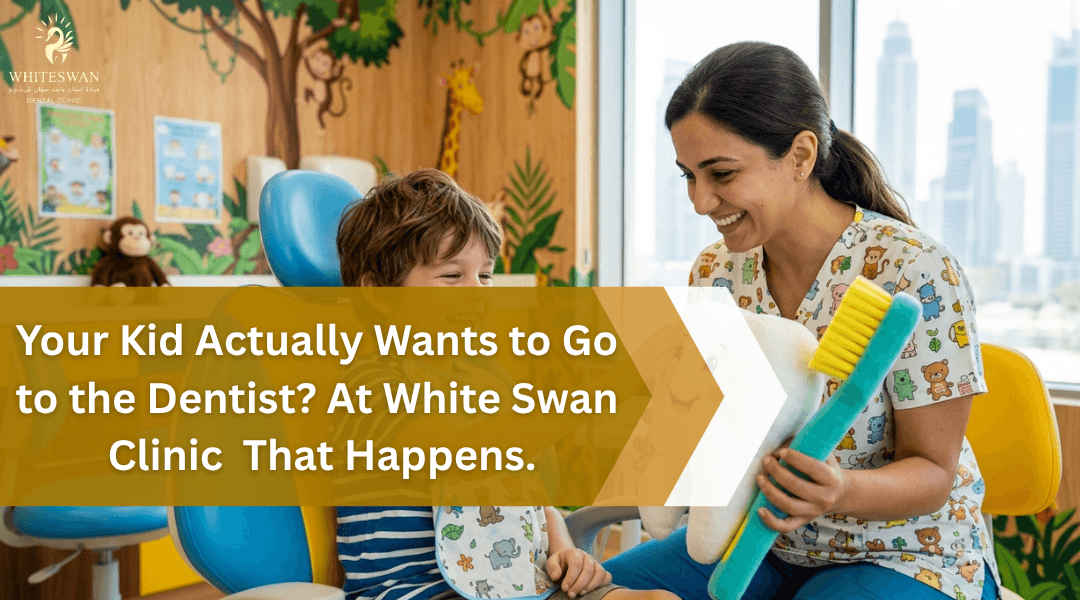
Let me be honest with you. Most kids hear the word “dentist” and immediately tighten up. Some cry. Some bargain. Some pretend to be asleep.
And as a parent, you feel it too, that low-grade dread before every appointment, hoping it goes smoothly, hoping your child does not have a complete meltdown in the waiting room.
That is exactly why we do things differently at White Swan Dental Clinic. We are based in Business Bay, Dubai, and we have spent years figuring out what actually makes children comfortable, not just tolerate a dental visit, but genuinely feel okay about it.
This blog is about that. About what a child-friendly dental environment looks like in real life, why it matters more than most people realise, and a little bit about the work we have been doing in the community to help children in Dubai build healthy habits early.
First Things First — What Does “Child-Friendly” Actually Mean?
It is a term that gets thrown around a lot. Clinics put it on their websites, on their brochures, sometimes without much behind it.
For us, it means a few specific things:
• Our team talks to kids like kids, not in that slightly patronising way, but genuinely at their level. We explain what we are doing before we do it. No surprises.
• We do not rush. A nervous five-year-old cannot be hurried. We know that.
• Parents stay in the room. Always. We never ask a child to handle this alone.
• The instruments we use are sized for small mouths. Everything is gentler, smaller, quieter where possible.
• We celebrate them afterwards. Even just a sticker. But it matters.
None of this is complicated. But it requires the team to actually care, and ours does.
We Took a Trip to Learning Tree Nursery, Here Is What Happened
A few weeks ago, our team packed up and headed over to Learning Tree Nursery for a Dental Camp for Children. No dental chairs, no clinical setting, just us, the kids, and a lot of oversized toothbrushes.
We spent the day going through some basics with the little ones. What teeth actually do. Why we brush them. How to hold a toothbrush properly (most adults do not even do this right, by the way). What happens when we eat too much sugar. Simple stuff, explained in a way that stuck.
The kids were brilliant. Curious, noisy, full of questions. One child asked us if teeth can feel sad. Another wanted to know if sharks brush their teeth. We answered every single question.
We did some hands-on activities, letting them practise brushing on a big model mouth, colouring sheets, a bit of fun alongside the learning. By the end, they were genuinely excited about brushing their teeth that evening. We know because a few parents messaged us later to say their kids reminded them to brush before bed. That is the whole point.
Thank you to Learning Tree Nursery for having us. These kinds of visits matter far more than a single dental appointment ever could. Getting to children before problems start, before the fear sets in, before the cavities arrive — that is where the real impact happens.
Why Does Any of This Matter? A Few Honest Numbers
Tooth decay is the most common chronic disease in children worldwide. In the UAE, studies have shown that a significant number of children between the ages of three and five already have some form of dental decay when they first visit a dentist.
That is not because parents do not care. It is usually because:
• The first dental visit often happens too late, only when there is already pain
• Brushing habits are not established early enough
• Sugary snacks and juices are part of the daily routine without parents realising the impact
• Children avoid dental visits because they are scared so problems build quietly
Early visits fix most of this. Not because we find problems, but because we prevent them.
The general advice from most dental bodies is to bring your child in around the time their first tooth appears — roughly six months to a year old. That first visit is not even really a check-up in the traditional sense. It is just a gentle hello, a quick look, and a conversation with you about what to expect over the coming years.
What We See Most Often in Children and What We Do About It
Here is a straightforward look at the most common things we deal with in our younger patients:
Cavities
Still the number one issue. Usually linked to diet and brushing habits at home. We handle these with the gentlest technique possible and always make sure the child understands what is happening, so there is no fear.
Sensitive or Bleeding Gums
Often just plaque buildup or teething-related. A good clean and some guidance on home care usually sorts it. We also check for anything that needs more attention.
Thumb Sucking and Dummy Use
This is more common than people admit. When it continues past a certain age, it can affect how teeth come in. We monitor it and advise at the right time, no pressure, no alarm.
Teeth Grinding
Plenty of children grind at night. Sometimes it is stress, sometimes just a phase, sometimes it points to misalignment. We assess it properly and give honest advice.
Teeth Coming In Late or Crooked
Genetics plays a big role. We keep an eye on development over time and step in with X-rays or guidance when needed. No over-treating, no unnecessary interventions.
A Few Practical Tips If You Are Getting Your Child Ready for a Visit
Over the years, the families that have the smoothest first visits tend to do a few specific things beforehand:
• They talk about the dentist casually at home, weeks before not as a big event, just a normal thing people do
• They avoid words like “hurt”, “needle”, or “shot” — even if they are trying to prepare their child, it plants the wrong seeds
• They read a book about dental visits. There are great children’s books on this that make it feel completely ordinary
• They book a morning slot children are fresher, less tired, and more cooperative before lunch
• They bring a comfort item a favourite toy or teddy, sitting in the chair alongside them genuinely helps
• They keep their own nerves quiet children pick up on parental anxiety immediately
And after the visit, whatever goes well celebrate it. Even the smallest cooperation deserves acknowledgement.
Why Families in Business Bay Come to White Swan
Business Bay is one of those neighbourhoods that has grown incredibly fast. What started as a business district is now a proper community — families, schools, nurseries, people who live and work here and need reliable, quality services nearby.
We built White Swan Dental Clinic here because we wanted to be part of that community — not just a service people use when something goes wrong, but a place families trust over the long term.
A few things we hear from parents who visit us regularly:
• They appreciate that we are honest, we do not recommend treatments that are not needed
• They value the fact that their children actually ask to come back, which apparently never happened at their previous clinic
• They like that the whole family can be seen in one place — no separate children’s clinic, no referrals back and forth
• They mention the location, Business Bay is central, easy to get to whether you are coming from Downtown, DIFC, or further out
We also have a multilingual team, which matters in a city as diverse as Dubai. Wherever you are from, we want you to feel at home.
FAQs — Questions We Get From Parents All the Time
1. How old should my child be for their first dental visit?
Around six months after the first tooth appears, or by their first birthday. The earlier the better — it is mainly about getting them comfortable and giving you guidance.
2. My child had a bad experience at another clinic. Can you still help?
Yes, and this is actually something we do quite a lot. We take more time with children who have had difficult experiences before. There is no rush, and we never push past what a child is comfortable with.
3. How often do children need to come in?
Every six months is standard. It keeps things consistent and means we catch anything small before it becomes something bigger.
4. Do you offer fluoride treatments for kids?
We do. It is quick, painless, and genuinely effective at protecting developing teeth. We will always explain what we are recommending and why before we do anything.
5. What if my child will not open their mouth or cooperate?
Completely normal. We are patient. We use a tell-show-do approach explain, demonstrate, then gently do. We have never met a child we could not eventually win over.
6. Where exactly are you in Business Bay?
Full details, directions and appointment booking are on our website at whiteswanclinic.com.
To Wrap Up
Getting children comfortable with dental care early is one of the most genuinely useful things a parent can do. Not because teeth are everything but because the habits formed in childhood follow people for life. A child who grows up without fear of the dentist, who brushes properly, who understands why it matters that child becomes an adult with far fewer dental problems.
That is what drives the work we do at White Swan Dental Clinic, from the appointments in our Business Bay clinic to the community camps we run at nurseries like Learning Tree.
If you have been putting off booking your child’s first visit — or if a previous experience put you off — come and say hello. We think you will notice the difference.Book online at whiteswanclinic.com— White Swan Dental Clinic, Business Bay, Dubai.