
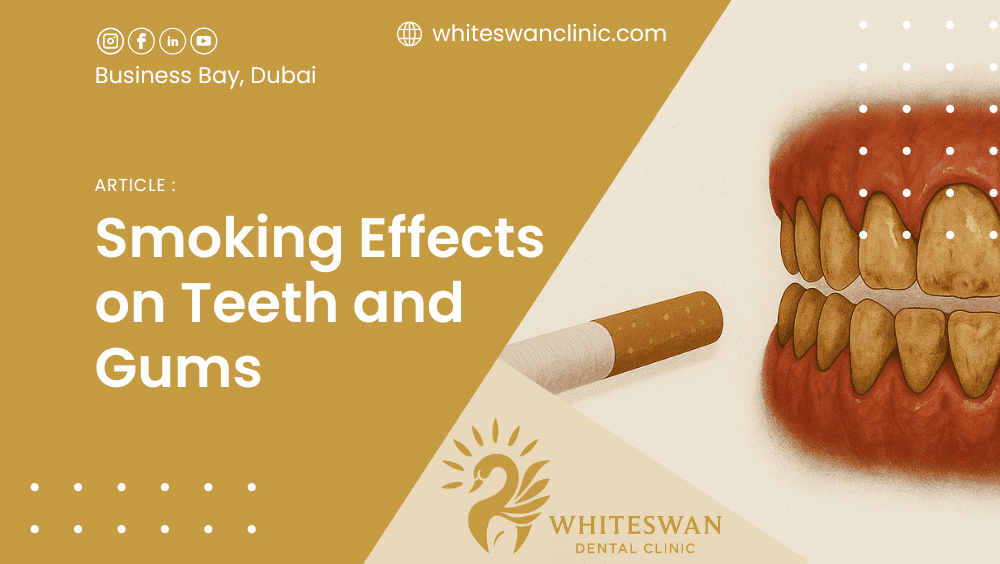
Lighting up does more than stain your fingers. Moreover,It feeds the bacteria that trigger gum disease and decay,dries the tissues, and rewires your mouth’s defence system. Since, the mouth heals more slowly under smoke exposure, small problems snowball into bigger ones—implant failures,receding gums,persistent bad breath, and loose teeth,. So In this in-depth guide, we explain exactly how vape aerosols and tobacco affect your smile, what signs to watch for, and which treatments can help you recover oral health while you work on quitting.
What smoking actually does in your mouth
Although smoke feels localised to your throat and lungs, it bathes your teeth and gums in a chemical cocktail. Consequently, several things happen at once:
- Blood flow drops. Nicotine constricts vessels. Therefore, gums receive fewer nutrients and less oxygen.
- Immune cells underperform. Your body fights plaque less effectively, so bacteria flourish.
- Saliva thickens. A drier mouth can’t buffer acids or wash away food as well.
- Plaque hardens faster. Minerals in saliva turn sticky film into calculus (tartar), especially behind the lower front teeth.
- Surface staining accelerates. Usually,pigments and tar embed into rough tartar and enamel causing deep tooth staining.
Since these changes happen together, the risk of periodontitis (advanced gum infection) rises sharply. Get details on Dental Clinic in Business Bay.
The visible signs: more than yellow teeth
You’ll notice:
- grooves and brown edges on front teeth, especially near the gumline.
- classic bad breath from volatile sulphur compounds;Persistent odour even after brushing.
- Black triangles between teeth as inflamed gum tissue shrinks away
- Gum recession,exposes sensitive root surfaces and usually makes teeth look longer .
- Chalky enamel patches and tiny cracks that catch stain.
- Frequent ulcers that hang around, since healing slows.
Importantly, bleeding can be less obvious in smokers because vessels stay constricted. So your gums may look “quiet” while disease progresses underneath. That’s one reason regular exams matter.
Gum disease and bone loss: why smokers lose teeth faster
Plaque sits like a biofilm fortress around the teeth. In non-smokers, the immune system and gums usually mount a visible response—swelling and bleeding—so people seek help early. In smokers, however, the inflammatory signals hide. At the same time , bacteria keep damaging the ligament fibres that hold teeth in place. Over the course of time , teeth loosen,pockets deepen, and the jaw bone withdraw.
If Left unchecked, periodontitis leads to:
- Mobility (wiggly teeth)
- Spacing changes as teeth drift
- Bite collapse and difficulty chewing
- Eventual tooth loss
Because the body heals slowly under nicotine, every missed clean becomes costlier. Therefore, consistent maintenance is everything. Looking for a Teeth Whitening near Business Bay?
Dental implants and extractions: higher risks you should know
Many smokers ask about implants after losing teeth. Therefore,Implants can work, yet the risks rise:
- Dry socket after extraction: delayed healing,causing intense pain and clots dislodge more easily.
- Early failure: due to this ,the bone may not fuse to the titanium (osseointegration).
- Peri-implantitis: It is a severe gum infection around the implant that mirrors periodontitis
We won’t lecture you. However, we will level with you: even cutting down improves outcomes. Preferably, stop four weeks after and two weeks before surgery; your tissues will thank you.
Vaping, shisha, and “social” smoking: are they safer?
- Vaping: No tar, but nicotine still constricts blood flow. On top of that , heat can irritate soft tissue and sweetened e-liquids can fuel cavity-causing bacteria
- Shisha/waterpipe: Different flavour, same problem—high heat and long sessions deliver significant toxins and heavy staining.
- Occasional smoking: Frequency helps, yet the mouth doesn’t get a reset button. Inflammation lingers between sessions.
So yes, alternatives may change the risk profile, but they don’t erase it. Your gums still need extra care.
Whitening vs. cleaning: what helps stained smokers’ teeth?
People often ask for teeth whitening first.Moreover, Whitening lifts extrinsic stains within enamel, but it can’t mask deep grooves or bleach tartar. Because of which, the correct order is:
- Professional polish and scale to remove calculus and plaque.
- Air-polishing (if suitable) to lift stubborn surface pigments.
- Whitening (take-home or in-chair trays ) once surfaces are stable and clean .
Since smoking can re-stain quickly, we’ll help you plan realistic maintenance, perhaps more frequent cleans and shorter whitening touch-ups. Get details on Teeth Cleaning & Polishing.
The deep clean that slows gum disease
When pockets form, regular polishing can’t reach the root surfaces. That’s where scaling and root planing (a deep clean) helps. Usually,We numb the area gently, then smooth the roots so bacteria have fewer places to hide. As a result, bleeding reduces,pockets shrink, and gums tighten, . Even though,smoking slows healing, most patients still feel firmer and cleaner within weeks,especially when they follow a focused home routine.
Home care upgrades that make a real difference:-
- Sonic toothbrush morning and night
- Interdental brushes (size matched to each space)
- Dry mouth support: Use xylitol mints to stimulate saliva,have sugar-free gum, and stay hydrated,
- Mouthwash as directed (give fluoride time to work; make sure that you avoid swishing straight after brushing;)
Oral cancer risk: the screening you shouldn’t skip
Tobacco and heavy alcohol together multiply oral cancer risk. Because of which , we perform oral cancer screening at every comprehensive exam. In addition,We examine the floor of the mouth for colour changes, ulcers, or patches,palate,edges,tongue and cheeks, ,. Therefore,Early detection changes everything. If we find a suspicious lesion, we fast-track you for specialist assessment.
What to do right now (whether or not you’re ready to quit)
- you about Book a periodontal assessment. We’ll map pocket depths, record bleeding points, and photograph stain patterns.
- Commit to a 3–4 month hygiene interval. Smokers accumulate calculus faster; shorter gaps keep disease at bay.
- Upgrade your toolkit. Sonic brush + sized interdental brushes + fluoride paste make the biggest dent.
- Treat dryness. use saliva-friendly products,limit coffee/energy drinks, and Sip water
- Plan a stain-management cycle. Clean → air-polish → whitening; then maintain.
Even without quitting, these steps protect your smile and wallet.
Ready to quit (or at least cut down)? We’ll back you
We’re a dental clinic, not a stop-smoking centre, yet we coordinate care that works:
- Brief motivational support during your appointment—no judgment, just options.
- Nicotine replacement advice you can discuss with your GP or pharmacist.
- Trigger mapping: pair cleaning times with difficult smoking windows to reinforce new habits.
- “Quit-for-surgery” plans if you’re preparing for implants or extractions.
Small reductions still improve gum blood flow. Therefore, even “half as many” yields better healing.
Myths we hear every week (((and the truth)))
- “ Usually My gums don’t bleed, so they’re healthy.”
- Not really. Usually,In smokers, reduced blood flow can hide inflammation while bone loss continues.
- “Whitening will fix everything.” Whitening lifts colour; it doesn’t treat infection or replace lost gum tissue.
- “I brush hard, so I’m safe.” Over-brushing can recede gums faster, especially on already fragile tissue. Technique beats force.
- “Vaping is harmless for teeth.” It’s different, not harmless; dehydration and bacteria shifts still hurt gums.
Your 90-day action plan
Day 1–7: a personalised home-care kit,photos,hygiene visit,oral cancer screening, ,and Comprehensive exam,
Week 2–4: Scaling and root planing if required; stain management. Start hydration and interdental habits.
Week 5–8: Re-check pockets; begin whitening if gums are stable. Trial nicotine reduction strategies if you’re ready.
Week 9–12: Maintenance polish; update photos; reinforce the routine. Discuss implant or restorative plans if you need them.
Because progress motivates, we’ll show you before/after stain maps and pocket charts at each visit.
Why choose White Swan Dental Clinic
You’ll get empathetic clinicians, modern hygiene technology, and evidence-based plans that match your pace. Apparently,We don’t shame smokers; we protect smiles. Because of which ,Whether you want pre-implant planning,deep gum therapy, or cosmetic brightening, our team will assist you step by step and aid your long-term oral health.
Related Articles:
» Teeth Whitening at Home vs Dentist
» Whitening Strips: Do They Work?
» How to Remove Dental Stains Safely?
» Post-Whitening Care and Maintenance: Bright Smile Longer
» Whitening for Sensitive Teeth Safely
The Lasting Impact of Smoking on Teeth and Gums
You deserve a mouth that feels fresh, looks bright, and stays strong for decades. Smoking makes that harder—but not impossible. With supportive smoking cessation steps,smart home care, and targeted cleaning, you can turn the tide. MoreoverIf you’re ready for a practical, judgment-free plan, White Swan Dental Clinic will meet you where you are and help your gums heal, one visit at a time.
FAQs
Probably, but don’t assume. Nicotine can mask inflammation and, narrows blood vessels . Therefore x-rays and A periodontal chart reveal the real picture.
Yes, but stains return faster. Clean first, then whiten, and plan for regular maintenance. Cutting down extends your results.
It removes tar, yet nicotine still reduces blood flow and dehydration persists. Gums remain at higher risk than in non-users.
Usually yes, with careful planning. Anyhow, the risks of dental implants failure and peri-implantitis are higher. Therefore, Stopping two weeks before and four weeks after surgery improves success rates.
Immediately book a hygiene visit and start interdental cleaning nightly. Apparently,that combo slows gum disease, and reduces the bacterial load immediately even if you’re not ready to quit.