
When you lose a tooth your smile will not change. But it can affect the way you chew,speak and the confidence of posing photos and attending meeting.The good thing is today we can replace a missing tooth without more complications.You can get a dental implant or a dental bridge to replace your teeth.We need to choose the proper one based on what we require.
At White Swan Dental Clinic, many patients have a confusion about choosing the suitable one. Two options work perfectly. But the best option depending on your preferences, your mouth, your timeline, your budget.
We can keep it simple and practical.
First, What’s the Difference?
Dental Implant
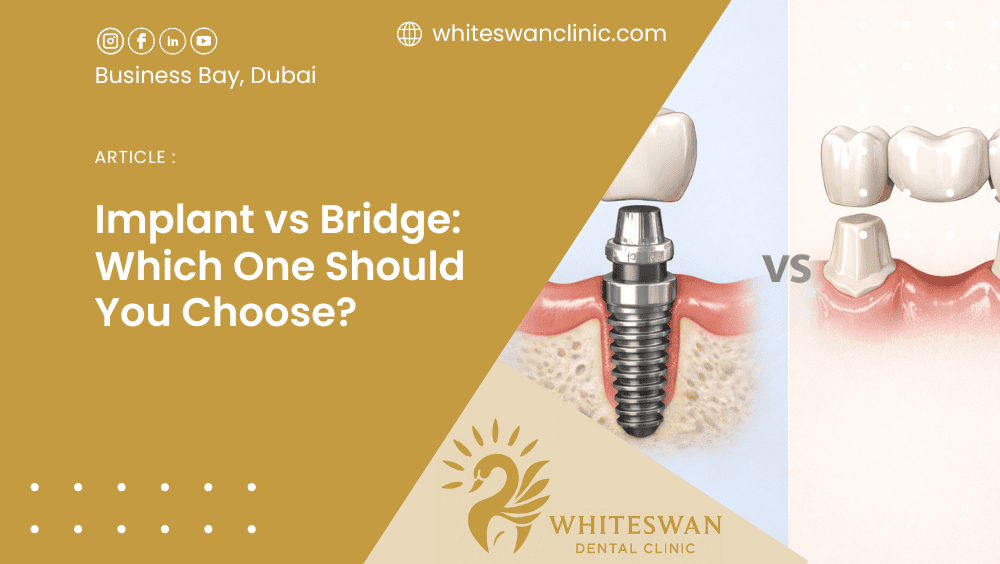
A dental implant is a replacement “root” for the missing tooth.. A small titanium post is put into the jawbone. After it heals and joins with the bone then a crown is put on top.
In simple teerms, an implant is a new root and a new tooth that stands on its own.
Dental Bridge
A dental bridge replaces the space by using the teeth next to the tooth that is lost as support. The teeth next to the false tooth are shaped, crowns are put on them, and the false tooth is attached in the middle.
In simple terms, a bridge is a new tooth that is held up by teeth that are close by.
Both can look natural. Both can restore function. But they work it in different methods. Looking for a Dental Clinic in Business Bay?
Why This Choice Matters More Than You Think
Over time, nearby teeth can tilt into the space of missing teeth. So your bite may change,and jawbender the missing tooth will shrink slowlly.So you have to decide as soon as possible.
But,you should not make a decision based only on what is fast and cheap. You can think like this,
- Bridges are often faster.
- Implant is often more independent and long-term focused.
Now let’s compare properly.
Implant vs Bridge: Real-Life Comparison
1) Effect on Nearby Teeth
This is one of the huge differences.
- Implant:it will not depend on neighbouring teeth. Your nearby teeth stay untouched.
- Bridge: it needs nearby teeth to be trimmed and crowned to hold the bridge.
If your nearby teeth are already crowned or heavily filled, a bridge will be a sensible option. But, if those teeth are perfectly healthy, many people do not like to shave them.
2) Jawbone Health
When you lose a tooth, the jawbone beneath it may slowly lose its volume.
- Implant: Helps keep the bone active because the implant works like a root.
- Bridge: This does not stimulate the bone beneath the area where the tooth is missing.
So, for long-term bone preservation, implants have the edge.
3) Treatment Timeline
If you’re replacing a front tooth, you may want a solution quickly for confidence reasons.
- Bridge: Often completed in a few weeks (depending on your case).
- Implant: Usually takes longer because the implant needs healing time.
That said, many implant plans include a temporary tooth, so you don’t have to walk around with a gap.
4) Strength and Bite Feel
- Implant: It feels just like a natural tooth and handles chewing forces well.
- Bridge: Strong too, but the support teeth carry the load.
For back teeth , chewing pressure is higher. Because of that, many patients prefer implant crowns in the back.
5) Cleaning and Daily Maintenance
Most of the people don’t think about the cleaning and maintainace.
- Implant: You should brush and floss them like a natural tooth. Moreover clean the gums carefully.
- Bridge: You should clean under the bridge using floss threaders or special brushes.
If bridge cleaning is ignored, food can trap and the support teeth can develop decay or gum issues. So, bridges need cleaning and maintainance.
6) Longevity
Both will last for many years, but which one will fail first will vary.
- Implant: The implant will last long; the crown may need replacement after wear.
- Bridge: Can last well too, but it depends on the health of the support teeth.
So, a bridge is only as strong as the teeth holding it. Get details on Dental Bridges in Business Bay.
Cost: Why the “Cheaper” Option Isn’t Always Cheaper
People often assume:
Bridge = cheaper and Implant = expensive.
Upfront, that can be true. However, your real cost depends on what you need and what happens later.
Implant cost factors
- Bone grafting (if needed)
- Type of crown material
- Surgical complexity
- Number of implants
Bridge cost factors
- Number of units (3-unit vs longer bridge)
- Crown material choice
- Condition of support teeth (sometimes extra treatment is needed)
If the nearby teeth are healthy some patients choose implants because they see them as a long-term investment. Looking for a General Dentistry in Business Bay?
Who Should Consider a Dental Implant?
You will be a good candidate for dental implants if:
- You want a long-term replacement that feels natural
- Your neighbouring teeth are healthy and you want to keep them untouched
- Your jawbone is sufficient (or you’re open to grafting if required)
- You’re okay with a longer timeline for healing
- You want better support for bone and bite stability
Who Should Consider a Dental Bridge?
A dental bridge can be a smart option if:
- You want a quicker result
- You prefer a non-surgical approach
- Your adjacent teeth already have crowns or large fillings
- Bone level is low and you prefer not to do grafting
- You want a predictable plan in a shorter period
Front Tooth vs Back Tooth: Does Location Change the Choice?
Yes, it often does.
- Front teeth: Looks matter a lot, and gum shape matters too. Both options can look excellent when planned well.
- Back teeth: Strength matters more. Implants are often preferred for molars because they take better chewing pressure over time.
Related Articles:
» How to Care for Implants: A Cleaning Routine That Actually Works?
» Dental Implants in Dubai: Step-by-Step Process
» Implant-Supported Dentures Benefits
» Loose Crown or Bridge: What To Do Immediately?
» What to Expect at a Dental Exam?
So… Which One Should You Choose?
Here’s an easy way to choose:
- If you want a replacement that stands alone, protects neighbouring teeth, and supports bone health then you can choose a dental implant
- If you want a quicker, non-surgical option and the supporting teeth are suitable then you can choose a dental bridge.
At White Swan Dental Clinic, we don’t push a “one-size-fits-all” answer. We look at your bite, your gum health, your bone level, and the condition of nearby teeth—then we recommend what makes sense long-term.
FAQs on “Implant vs Bridge”
In many cases, implants last longer because they don’t depend on neighbouring teeth, but both can last well with proper care.
Most patients thought it was easier than expected. It is done under anaesthesia, and post-treatment discomfort is manageable only.
Often a few months because the implant needs to integrate with bone. However, temporary teeth may be used during healing.
Many bridges can be completed in a few visits across a few weeks, depending on your case.
A bridge requires shaping the support teeth. That’s why the condition of those teeth matters a lot.
Yes,depending on the situation bone grafting or other techniques may help.
Both can look natural. Implants often feel more like a “real tooth” because they emerge from the gum like a natural tooth.
Bridges can be cheaper upfront. Implants may offer stronger long-term value for many patients.
Yes, bridges can replace multiple teeth, but longer bridges place more load on support teeth.
Yes. Multiple implants can support crowns or implant-supported bridges for bigger gaps.
Usually yes, because you must clean under the bridge. Special floss or brushes are needed.
A proper dental evaluation is the best way. Bite forces, gum health, bone level, and nearby teeth condition all guide the decision.