
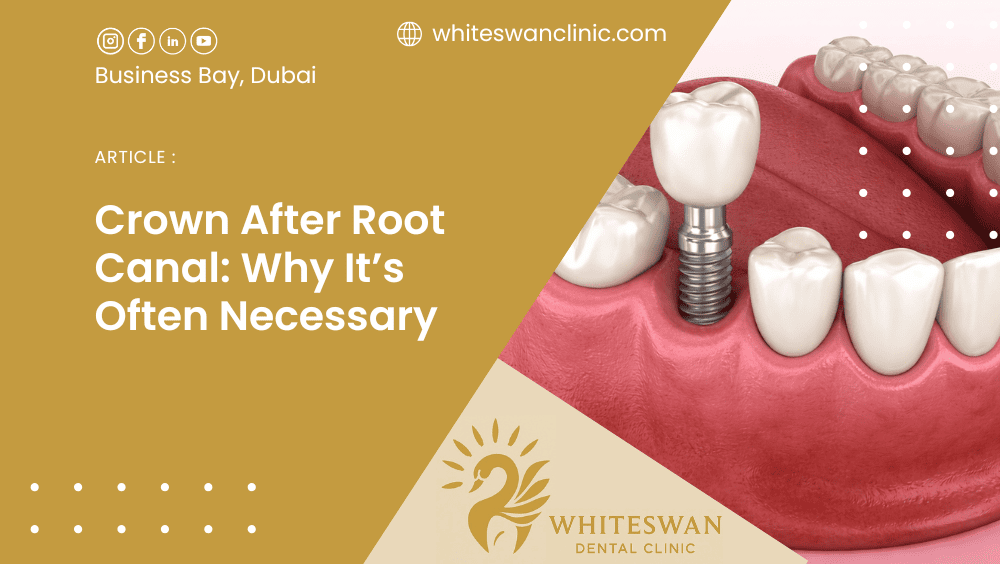
A root canal is a difficult process for painful teeth.The nerve is cleaned out after the infection is gone, and the tooth finally stops hurting.
A lot of clients at White Swan Dental Clinic inquire, “If the pain is gone, why do I still need a crown?”
A crown after a root canal is not an extratreatment.It secures your treated tooth against the wear and tear of everyday chewing, changes in temperature, and long-term use. If it doesn’t have that protection the tooth will break, leak, or crack beyond repair. From this below information you can know why dentists suggest a crown, how to know if you need it, and what happens if you delay.
What Happens to a Tooth After a Root Canal?
A root canal treatment removes infected pulp from inside the tooth. Nerves and blood vessels are in that pulp. After removed that the tooth become
- Less hydrated over time
- If there was a big hole, an old filling, or degradation then the structure was weaker.
- More vulnerable to cracks because the tooth no longer has the same internal support
Many root canals are also done on teeth that are already in bad shape.
The dental crown protects the tooth and reduces the risk of crack. Looking for a Dental Clinic in Business Bay?
The Main Reason: Root-Canal Teeth Crack More Easily
The truth is that teeth, especially back teeth, are prone to crack after getting a root treatment. Cracks can also be sneaky.You might not feel it right away, but over time you can see:
- Sharp pain when chewing
- Sensitivity that comes and goes
- A piece of the tooth breaking off
- Gum swelling near the tooth again
A properly fitted crown after the root canal spreads biting forces more evenly. In this way, it helps secure a small crack from becoming a big crack.
Front Tooth vs Back Tooth: Does Everyone Need a Crown?
No.The need depends heavily on which tooth has the root canal and how much tooth structure is left.
Back teeth (molars and premolars)
These teeth have more chewing pressure. Because of that, dentists almost always recommend a crown for molar root canal cases. Molars grind food thousands of times a day. So the chance of cracking is fast.
Front teeth (incisors and canines)
The front teeth cut food .If there is a small tooth damage and there is sufficient enamel thickness, a simple dental filling is enough. But if the tooth is broken, cracked, or discolored you can fit the crown. Get details on Root Canal Treatment in Business Bay.
Key Signs You Likely Need a Crown After Root Canal
A crown is often advised if you have one or more of these:
- Large filling already present
- Tooth structure missing due to deep decay
- A tooth that has cracks or “craze lines”
- Root canal done on a molar or premolar
- Tooth has had multiple restorations before
- Bite pressure is high
In these situations, the crown isn’t just “nice to have.” It’s the difference between keeping the tooth for years vs losing it early.
What If You Skip the Crown?
Some people postpone the crown because the tooth feels healthy. That is reasonable.Still delaying is risky.
Without a crown, the tooth can:
- Fracture under chewing forces
- Develop micro-leakage around the temporary filling
- Get reinfected, needing retreatment
- Break below the gumline—then extraction may be the only option
And the difficult thing is a tooth can break suddenly while eating something normal such as nuts and even bread crust. So there is a chance for it to happen without any warning. Looking to a Best Clinic for Tooth Removal?
Why a Filling Alone Often Isn’t Enough
A regular filling restores the “hole,” but it doesn’t fully protect the tooth’s cusps especially in molars. Over time, those cusps can flex and crack.
After a root canal, a dental crown covers and supports the whole biting surface. It also secures the tooth better than large fillings which helps keep bacteria from leaking out.
Crown Types Commonly Used After Root Canal
At White Swan Dental Clinic, the type of crown you get depends on your bite, the position of your teeth,and budget. Common options include:
1) Zirconia crown
Strong and natural-looking. Moreover it is suitable for back teeth because it can handle a lot of pressure from biting.
2) Porcelain-fused-to-metal
It is a strong choice with a metal base and porcelain top. It can be long-lasting, although it may show a darker line near the gum in some cases.
3) E-max
Highly aesthetic, often used for front teeth. Strong, but usually selected where appearance is a top priority.
Your dentist will suggest the best fit based on function first—because a crown has to survive daily life, not just look good. Get details on Dental Checkup in Business Bay.
Do You Need a Post and Core Too?
Yes. If there is not enough tooth tissue to hold the crown in place, your dentist might recommand a post and core treatment.
- Post: placed into the root canal space to help retain the core
- Core: rebuilds the tooth foundation so the crown has proper support
However, posts are not automatically needed. In fact, if there are enough healthy teeth remaining, avoiding a post can be better. It depends on the case.
How Soon Should You Get the Crown After Root Canal?
After the root canal, within a few weeks you should get the crown. Temporary restorations are not last long; they are only protect the tooth for a short period of time.
If you delay, cracks and leakage increase.
So, if you have recently had root canal treatment in Dubai, it is better to plan for the crown placement immediately and avoid last-minute confusions.
What the Crown Process Usually Looks Like
Most crown procedures follow a simple sequence:
- Assessment & X-ray to confirm the root canal is healing well
- Tooth preparation
- Impressions or digital scan for accurate fit
- Temporary crown placed for protection
- Final crown cementation once ready
- Bite adjustment for comfort and proper chewing
After placing the root canal you will be able to eat normally, smile beautifully, and you can stop worrying about the tooth cracking.
Related Articles:
» Root Canal vs Extraction + Implant
» When Should I Have Root Canal Retreatment?
» The Importance of Periodontal Care in Dubai’s Dental Scene
» Whitening for Sensitive Teeth Safely
» Causes of Toothache and Quick Relief
Caring for a Crowned Root-Canal Tooth
A crown will secure the tooth, but we need to give basic care. So:
- With fluoride toothpaste you have to brush everyday.
- Floss everyday
- if you grind your teeth use a night guard
- Avoid biting ice and very hard foods
- Visit your dentist regularly for check-ups and cleaning
If you follow good habits,a crown can last many years.
FAQs on “Crown After Root Canal: Why It’s Often Necessary”
Not always. However, it’s often necessary for molars and teeth with large fillings or weak structure.
Yes, you can, but it increases the risk of cracking or leakage. So earlier is safe.
It depends on the crack. Some fractures can be restored, but deep cracks may require extraction.
Not always. If the tooth is strong and minimally restored, a filling may work. Still, crowns are common if damage is extensive.
This is because the nerve and blood supply are removed, and the internal structure of the tooth is often weakened by decay or old fillings.
No. The tooth has no nerve after the root canal, and local anaesthesia can be used for gum comfort.
For back teeth, zirconia is often preferred for strength. For front teeth, aesthetic porcelains may be ideal.
No. A post is only used when there isn’t enough tooth structure to hold the crown securely.
Yes, reinfection can occur due to leakage, new decay, or cracks.
Depending on bite forces, hygiene, and crown material it lasts 10-15 years.
Yes. Modern crowns look natural, especially for visible teeth
If the bite is high you feel mild discomfort. A quick adjustment resolves it.