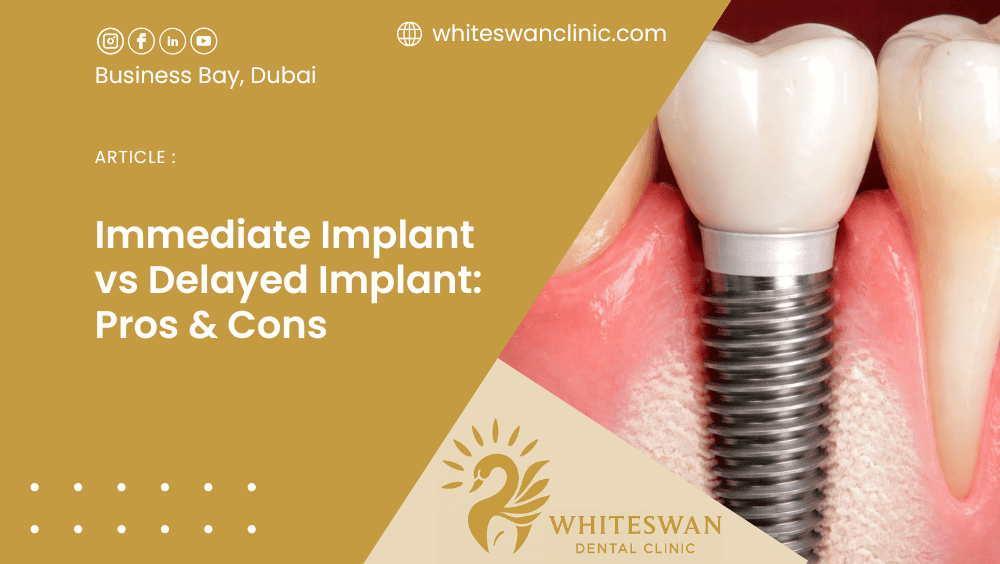
If you’ve lost a tooth — or if someone has said that one should come out — dental implants can seem like the “best of all worlds” option. They feel natural, they chew like a tooth and they can last for years with good care. But there is one constant question at White Swan Dental Clinic, Business Bay, Dubai:
Immediate implants (in this case an implant that is placed soon after the extraction) or delayed implants (an implant that is placed when the gum and bone are already healed)?
Both are proven methods. But they each have different mouths, different risks and different timelines.
What’s the Actual Difference?
Immediate Dental Implants
This type is placed immediately on the same day where your tooth is extracted (or within a very short period following). A temporary tooth can also be planned in selective cases — particularly if the bite is light and the implant is stable.
Delayed Dental Implants
After healing, a delayed implant is placed. That typically means spending about 8 to 16 weeks waiting after extraction. If infection control or bone graft healing is required. Looking for a Dental Clinic in Business Bay?
Why Timing Matters More Than Most People Think
If a tooth is extracted, the bone and gums do not “stay still.” They change. Bone can shrink, gums can settle and if there was an infection, the area can remain inflamed for a spell. Therefore, timing affects:
- the amount of bone available,
- the shape of the gum line,
- infection risk,
- how quickly you can get a final crown,
- and how predictable the result feels.
So yes, speed is part of it—but safety and stability matter even more.
Immediate Implants: The Pros
Here’s why many patients like the immediate route.
1) Faster overall treatment
Since extraction and implant placement are combined, you can shave months off the overall timeline. That matters a lot if you want to return to normal faster.
2) Fewer surgical visits
It can treat extraction and the implant surgery all in one sometimes instead of extracting and coming back later for a surgery. Consequently, it can feel more convenient most of the time.
3) Better chance to preserve the gum shape
The socket immediately surrounding the extraction site is still fresh and resembles the natural tooth root. Thus, immediate placement can preserve the native gum contour — particularly important with anterior teeth.
4) Possibility of a quicker temporary tooth
In selected cases, you may be able to get a temporary tooth planned earlier. Not always on the same day, but sometimes sooner than with delayed cases. Get details on Dental Checkup in Business Bay.
Immediate Implants: The Cons
Immediate implants are great when the conditions are right. But when they’re not, rushing can backfire.
1) Not ideal with active infection
If the tooth is taken out because of a serious infection or abscess, placing another immediately may increase complications. But waiting is usually the right play in that case.
2) Requires strong “initial grip” in the bone
Dentists call this “primary stability.” In simple terms: the implant needs to feel firm from day one. If the bone is soft or the socket is wide, stability can be lower. Consequently, delayed placement may be recommended.
3) Technique-sensitive
Immediate placement needs accurate planning and careful gum handling. It’s not just “put the implant in quickly.” It’s precision work.
4) You may still need bone grafting
Many patients assume immediate means “no graft.” In fact, small gaps can develop around the implant even when placed immediately. Thus, a graft can still be utilized to maintain future aesthetics and volume of the bone in the long-term. Looking to a Best clinic for Tooth Removal?
Delayed Implants: The Pros
Delayed implants are popular because they can be calm, controlled, and predictable.
1) Healing first can reduce risk
If the extraction site needs time to settle—especially after infection—delayed placement gives your body a clean starting point. As a result, many complex cases become easier.
2) Better option if infection was the main issue
If the tooth was removed due to infection, so that the tissue can heal. As a result, the implant can be inserted in a healthier environment.
3) Easier bone graft planning (when needed)
In the case of bone loss, grafting may be easier to do first with the implant placed at a later stage. That gradual approach frequently builds more sustained support.
4) More flexibility
With extra healing time, your dentist can refine the plan— particularly if you have bite problems, gum recession or more than one missing tooth. Get details on Broken Tooth Treatment in Business Bay.
Delayed Implants: The Cons
Of course, delayed implants have downsides too.
1) The whole process takes longer
This is the main reason some patients feel frustrated. Extraction happens first, healing happens next, then surgery, then healing again before the crown.
2) Bone shrinkage after extraction
Bone naturally resorbs after a tooth is removed. So, if the socket isn’t protected with preservation grafting, there may be less bone later. Consequently, you might need additional grafting.
3) More appointments
Because the steps are spread out, you may need extra visits. For busy schedules in Dubai, that can be a deciding factor.
Immediate vs Delayed Implants
|
Point |
Immediate Implant |
Delayed Implant |
|
Timing |
Same day as extraction |
After healing (8–16 weeks typical) |
|
Overall time |
Usually shorter |
Usually longer |
|
Infection tolerance |
Lower |
Higher |
|
Need strong early stability |
High |
Moderate |
|
Appointments |
Often fewer |
Often more |
|
Best for |
Healthy socket + good bone |
Infection, bone loss, complex cases |
Who Usually Fits Immediate Implant Placement?
Immediate implants often suit patients who have:
- healthy gums and good oral hygiene,
- no active infection at the site,
- solid bone that can hold the implant firmly,
- a controlled bite (not heavy grinding),
- realistic expectations about the healing stage.
Still, the final decision depends on a proper scan and exam, not just “I want it fast.” Looking for a General Dentistry in Business Bay?
Who Should Consider Delayed Dental Implants?
Delayed implants often suit patients who have:
- a tooth removed due to infection or abscess,
- a complicated extraction,
- bone loss or thin bone walls,
- gum disease that needs stabilising,
- medical / lifestyle risk factors such as smoking, uncontrolled diabetes, etc.
In many cases, delay is not “slow.” It is safe & well-planned.
A Common Confusion: Immediate Placement vs Immediate Loading
These two sound similar, but they are not the same.
- Immediate placement :implant is placed right after extraction.
- Immediate loading : a tooth is attached to the implant soon after placement.
Immediate loading needs for very strong stability and controlled, carefully managed bite. Otherwise, your doctor will keep the implant protected while it integrates.” Get details on Teeth Cleaning and Polishing.
Pain, Healing, and Daily Life After Surgery
Most patients describe discomfort from implants as something they can tolerate — a soreness rather than sharp pain. And the swelling is usually minor and resolves within 48 hours.
To heal smoothly:
- stick to soft foods for a while,
- Don’t smoke
- avoid chewing hard foods on that side,
- follow medication instructions,
- keep your mouth clean as advised,
- show up for your reviews (small issues are easier when caught early).
In Business Bay, we see many patients who return to work quickly. Still, it’s better to plan surgery when your schedule isn’t packed with meetings. Looking for a Teeth Whitening near Business Bay?
Cost Factors in Dubai
Implant costs are not only about the implant itself. Pricing can vary depending on:
- CBCT scan and diagnostics,
- extraction type (simple vs surgical),
- bone grafting and membranes,
- sinus lift needs (upper back teeth),
- implant brand and components,
- crown material (often zirconia/ceramic),
- sedation options (if required).
Immediate cases can reduce appointments, but they may include extra planning or grafting. Delayed cases can involve more steps, yet may be smoother in high-risk situations.
How We Choose the Best Option at White Swan Dental Clinic (Business Bay)
We look at:
- 3D CBCT scan findings,
- gum thickness and smile aesthetics,
- presence of infection,
- bone strength and shape,
- bite forces and grinding habit,
- medical history and lifestyle.
Then we recommend the plan that gives you the best chance of long-term success—because nobody wants to repeat implant treatment.
Related Articles:
» Crown After Root Canal: Why It’s Often Necessary?
» Veneers vs Bonding: Which Smile Makeover Suits You?
» Dental Cleanings: What Happens and Why It’s Not a Big Deal?
» Crowded Teeth: Treatment Options and Timeline
Immediate or Delayed Implant?
Immediate implants, if performed in a site with robust bone and health, can be great when it is functioning high! Delayed implants are the safer option for infection, bone loss, or complex extraction. Regardless of which way you choose to go, the end goal remains the same: a stable natural-looking tooth that lasts.
FAQs on “Immediate Implant vs Delayed Implant”
Yes, when the site is clean and stability is strong. Otherwise, delayed placement can be safer.
Sometimes, but usually delayed is recommended if the infection is active or severe.
Usually 3–6 months in total depending on the healing and grafting.
Yes, generally — but with a poor stability and the need for additional protection to the implant those timelines can still develop.
Not always. Many immediate cases still use small grafts to fill gaps and support the gum line.
Immediate can be excellent in the right case. Delayed can also be highly aesthetic with careful tissue shaping
Only if stability is high and bite forces can be controlled. It’s not suitable for everyone.
Yes. Smoking increases the risk of failure and slows down healing. Immediate implants can be less forgiving.
Pain levels are often similar. Immediate may feel simpler because it combines steps.
Soft foods only, and no chewing directly on the implant side until your dentist gives you the go-ahead.
Beside bone grafting or staged treatment can rebuild support.Delayed placement is commonly chosen in such cases.
A clinical exam and CBCT scan are the only reliable way. Your dentist will assess stability, infection risk, and aesthetics.