
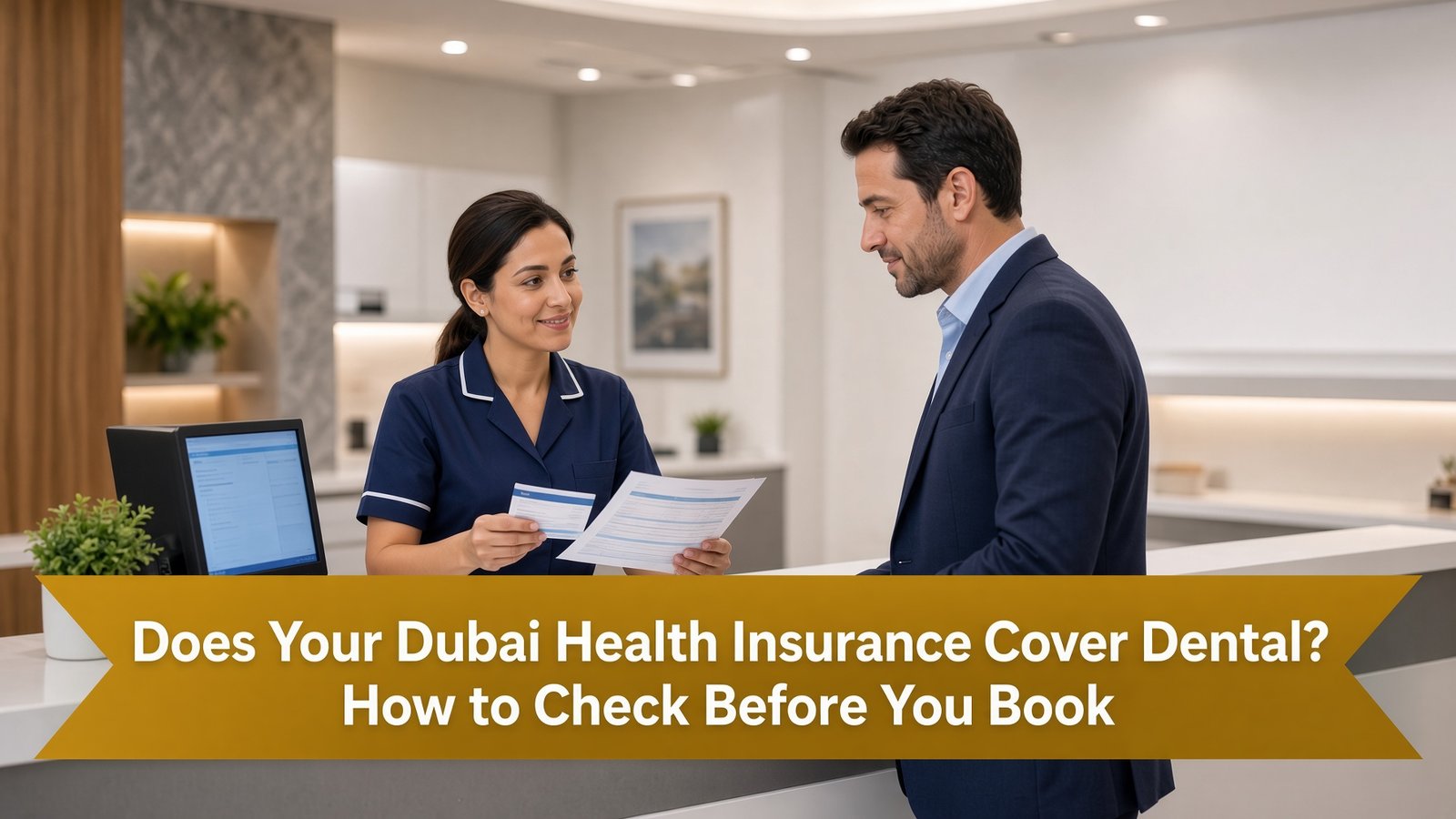
The most uncomfortable moment in any clinic is not the treatment. It is the conversation at reception afterwards, when you discover the policy you assumed covered everything covered rather less than that.
Health insurance is mandatory for every resident in Dubai. Dental cover is a separate question entirely, and the answer depends on which plan you happen to be on. Fifteen minutes of checking beforehand removes the surprise.
How dental sits inside Dubai health insurance
Dubai made health insurance compulsory under Law No. 11 of 2013. Employers must cover employees, and sponsors must cover dependants and domestic staff. The regulated minimum is the Essential Benefits Plan, designed for lower income workers, which carries an annual claims limit of AED 150,000.
Historically, routine dental sat outside that minimum. Since 1 January 2025, the Dubai Health Authority has required a minimum dental benefit, widely reported at AED 500 per year, within basic plans. That is a real improvement, but it is a small allowance intended for essentials rather than a meaningful budget for treatment.
Mid range and premium plans are where genuine dental cover lives. Annual dental sub limits on those plans commonly run somewhere between AED 2,000 and AED 10,000 depending on the tier. A dental rider added to an existing medical plan typically costs a few hundred to a couple of thousand dirhams a year and unlocks higher limits and a broader list of treatments.
The critical thing to understand is that a dental sub limit is separate from your overall medical limit. A policy advertising a million dirhams of cover can still cap dental at AED 1,500. Once dental is exhausted, you cannot draw on the medical pool for it.
What is usually covered, and what is usually not
Broadly, plans that include dental tend to cover examinations, imaging, cleaning, fillings and simple extractions, often with a share payable by you at each visit. Root canal treatment is frequently available on better tiers or through a rider.
Commonly excluded or heavily restricted:
- Cosmetic treatments including whitening, veneers and smile design. These are elective and almost always paid in full by the patient.
- Orthodontics such as braces and clear aligners, excluded on most plans, with a limited lifetime allowance on some premium products.
- Implants and prostheses, excluded from standard plans and often excluded even where a dental rider is in place.
Waiting periods also apply on many policies, so a plan you joined last month may not cover certain treatments yet.
The five checks to run before you book
1. Read the benefit table, not the brochure. Find the dental section of your policy schedule and note three numbers: the annual dental limit, the share you pay at each visit, and any per treatment caps.
2. Confirm the clinic is in your network. Insurers publish approved clinic lists. Inside the network you usually get direct billing and pay only your share on the day. Outside it, you generally pay in full and claim later, if your plan permits claims at all.
3. Check whether prior approval is needed. Treatments above roughly AED 1,000 commonly require approval from the insurer or their third party administrator before the appointment. Advisers often suggest submitting around ten days ahead of a planned visit. Turning up for a crown without approval is how patients end up paying for it themselves.
4. Check what you have already used. Your annual limit resets on the policy year, not the calendar year. A single root canal can consume most of a modest dental allowance, so it helps to know your remaining balance before planning further work.
5. Ask the clinic to verify eligibility. Clinics can confirm eligibility electronically through the Dubai system used for insurance claims. Call ahead with your card details and ask them to check coverage for the specific treatment code, not just whether they accept your insurer.
If you are a freelancer or your employer plan is basic
Employers in Dubai must insure their employees, but they are not required to insure dependants, and many companies buy at the lower end of the market. Freelancers and business owners arrange their own cover entirely.
If you fall into either group, you have three practical routes. Upgrade your medical plan at renewal to a tier that includes meaningful dental. Add a dental rider to your existing plan, which typically costs a few hundred to a couple of thousand dirhams a year and unlocks higher limits and treatments such as root canal work. Or buy a standalone dental product, which several UAE insurers and brokers offer separately.
Which of the three makes sense depends entirely on usage. For a single adult with healthy teeth and one checkup a year, upgrading an entire medical policy for dental alone rarely pays. For a family with children, or anyone who knows they have treatment coming, a rider or standalone plan usually does.
Practical ways to manage what is not covered
If your cover is thin, you have options beyond simply paying more.
Use your preventive benefit. Most plans that include dental fully cover a routine examination once a year. Catching a small cavity early costs a fraction of treating it later, and preserves your annual limit for things that matter.
Ask about clinic packages. Many Dubai clinics bundle common treatments at a set price for patients paying directly, which can beat the effective cost of a low tier claim.
Time larger work. If a treatment can safely wait until your new policy year begins, and your dentist agrees clinically, that resets your limit.
Consider a rider at renewal rather than an upgrade of the entire medical plan. For a family that uses dental services regularly, a rider is often better value than moving the whole policy up a tier.
Before your appointment, have these ready
Your insurance card, your Emirates ID, your policy number and the name of the specific plan. Know your dental limit and the share you pay. Ask the clinic for an itemised estimate showing what the insurer is expected to pay and what you will pay.
FAQ
Is dental cover mandatory in Dubai?
Health insurance is mandatory. Since January 2025, basic plans must include a minimum dental benefit, but it is small.
Are whitening and veneers covered?
Almost never. Cosmetic dentistry is treated as elective and is paid by the patient.
Why was my treatment rejected even though I have dental cover?
Common reasons include exhausted annual limits, missing prior approval, waiting periods or an excluded treatment type.
What does a dental sub limit mean?
It is the maximum your insurer pays for dental in a policy year, separate from your overall medical limit.
Can I use my Dubai policy in another emirate?
Sometimes, but networks differ by emirate, so check before travelling for treatment.
Want your cover checked before you sit in the chair?
White Swan Dental Clinic in Business Bay can verify what your plan covers and give you an itemised estimate before treatment starts, so there are no surprises at reception. Get in touch at https://whiteswanclinic.com/