
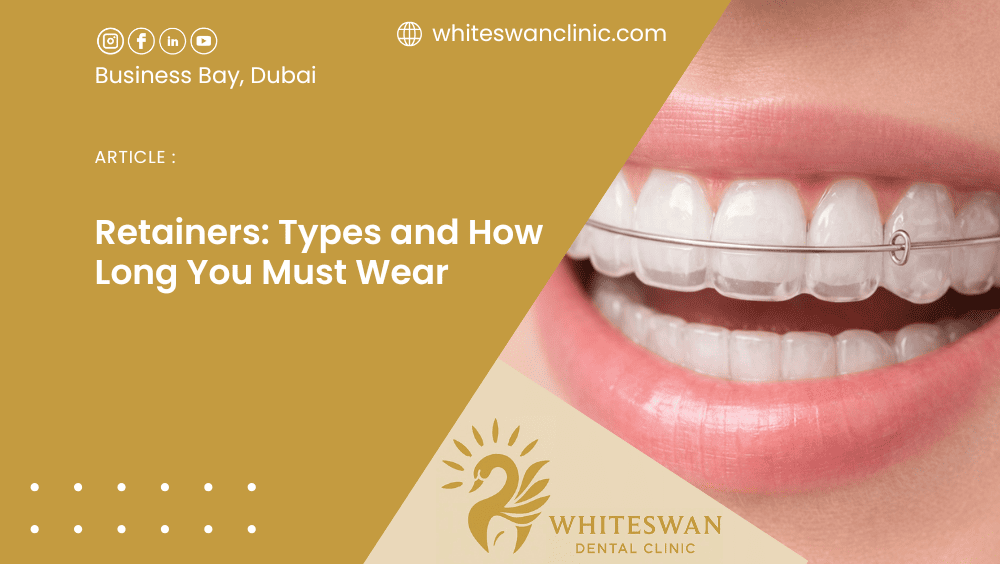
Taking off your braces or clear aligners is like crossing the finish line. You can see that your teeth are straighter and your bite feels better now that the days are past. The only way to keep everything you’ve worked for safe is to wear your retainer.
Teeth are not fixed like tiles in cement. They sit in living bone and soft tissue that keeps adapting. Because of that, teeth can slowly drift over time—even after a perfect orthodontic result. A retainer is the simple tool that holds your smile in place while your mouth settles into its new normal.
At White Swan Dental Clinic, we often say this: orthodontic treatment creates the result, but retainers keep it.
What Is a Retainer?
While wearing braces or aligners, a retainer holds your teeth.It prevents teeth from moving back.Even though most people are not expecting it to, this “shift back” happens more often than you might imagine
Why does relapse happen?
- The fibres around teeth try to pull them back.
- jaw and bite might shift for young adult
- Small habits such as grinding, nail-biting, or tongue thrusting are making pressure.
- Aging will change the tooth positions
So yes, retention matters. And the earlier you take it seriously, the easier your life becomes later. Looking for a Dental Clinic in Business Bay?
Types of Retainers: The Main Options
Several typical retainers have various feel, look, and maintenance styles. The best option depends on the situation and habit.
1) Clear Retainers (Essix-Style)
These are clear, removable trays that fit over your teeth—similar in appearance to aligners.
Why people like them
- They’re almost invisible.
- They’re lightweight and comfortable for most patients.
- They suit many post-aligner and post-braces cases.
Things to keep in mind
- They can crack if you grind your teeth.
- They can stain if you drink tea/coffee with them in.
- They must be removed for meals and hot drinks.
Clear retainers are easy to wear, uncomplicated, and not very noticeable.
2) Hawley Retainers
A Hawley retainer has an acrylic base (usually on the palate) and a thin metal wire across the front teeth. It’s the “classic” retainer many people remember.
Benefits
- Strong and long-lasting when cared for properly
- Can be adjusted if small movement happens
- Often easier to repair compared with clear trays
Downsides
- More visible than clear retainers
- Can feel bulky at first (you adapt, but it takes time)
- For a few days, speech may sound a little odd.
If you need durability and flexibility, a Hawley retainer would be a good fit.
3) Fixed Retainers (Bonded / Permanent Retainers)
A fixed retainer is a thin wire bonded behind your teeth—commonly on the lower front teeth.
Why it works well
- It supports your teeth all day, every day.
- It doesn’t depend on memory or routine
- It is not visible so nobody can see it.
What you need to manage
- Flossing takes more effort
- Plaque will develop if cleaning is rushed.
- The wire can loosen and needs monitoring.
A fixed retainer is recommended when the lower teeth are crowded before treatment, as that area is prone to shifting again. Get details on Best Dental Clinic for Teeth Filling.
How Long Must You Wear Retainers?
Most of the time you need to wear retainers for a long time. The schedule changes, but a need doesn’t go away on its own. If teeth aren’t supported, they can move slowly for years.
Here is how retention works:
Stage 1: Full-Time Wear (First 3–6 Months)
After braces or aligners, the mouth is still adapting.
- Usually 20–22 hours per day
- Remove only for eating and brushing
This stage is the most important because relapse risk is highest early on.
Stage 2: Night-Only Wear (Next 6–12 Months)
Once things stabilise:
- Wear your retainer every night
- Aim for 8–10 hours while sleeping
Night-only wear is realistic for most people and still it works extremely.
Stage 3: Long-Term Retention (Ongoing)
After the first year:
- Many patients wear retainers 3–5 nights per week
- Some should wear them every night, depending on their case
In simple words: after orthodontic treatment, you don’t “finish” retention—you simply reduce it. Looking to a Best Clinic for Tooth Removal?
Does the Retainer Type Change the Wearing Time?
Yes, the retainer type changes the wearing time.
- Clear retainers: This type of retainers need consistent wear because missing nights can make small shifts.
- Hawley retainers: Can sometimes be adjusted for tiny movements, which is useful.
- Fixed retainers : It gives you continual support, but you could still need a removable retainer for the higher arch or extra protection.
Many patients do best with a combined plan:
fixed retainer on the lower front teeth + night-time removable retainer for the upper teeth.
Signs Your Retainer Needs Attention
Your retainer should be tight but not painful.Don’t ignore it if something changes.
Watch for:
- Your retainer suddenly feels very tight
- It doesn’t seat properly or lifts at the back
- You notice a gap returning or crowding starting
- Your bonded wire feels loose or sharp
- You get gum irritation around the fixed retainer
Catching small problems early saves you from bigger correction later. Get details on Root Canal Treatment in Business Bay.
How to Clean Retainers Without Damaging Them
Retainers need to be clean . They can smell unpleasant, get dirty, and produce germs if you don’t.
For removable retainers
- Rinse after removing
- Brush gently with a soft toothbrush
- Use retainer cleaning tablets a few times a week
- Store in a proper case (not tissue!)
Avoid these mistakes
- Don’t use boiling or hot water
- Don’t scrub with abrasive toothpaste daily
- Don’t leave them in a hot car
- Don’t keep them dry and dirty in a pocket or bag
Clean retainers feel better, last longer, and protect your oral health.
Related Articles:
» When to Replace Old Fillings: Signs You Shouldn’t Ignore?
» Braces vs Clear Aligners: Comfort and Lifestyle
» Dental Implants in Dubai: Step-by-Step Process
» Sensitive Teeth: Causes and Fixes
» Dental Checkup in Dubai: What’s Included and How Often You Need It?
What If You Stop Wearing Your Retainer?
Skipping one night happens. But stopping fully for weeks or months often causes relapse.
If you haven’t worn it in a while:
- Try it gently at night
- If it fits but feels tight, wear consistently and monitor
- If it doesn’t fit at all, don’t force it—book an appointment
Often, the sooner you act, the easier it is to recover your alignment.
Retainer Reviews: How Often Should You Check In?
Even if everything feels fine, a quick check-up helps:
- 1–2 checks in the first year after treatment
- Then yearly, often alongside your regular cleaning visit
For fixed retainers, check-ups matter even more because loosening can be subtle at first.
FAQs on “Retainers: Types and How Long You Must Wear”
Most patients need 20–22 hours daily for the first few months.
Usually after a few months, depending on stability and your dentist’s advice.
Many people should wear them long-term, at least a few nights a week, to prevent shifting.
Not always. Clear retainers are discreet, while Hawley retainers are durable and adjustable.
Yes, especially for lower front teeth that previously had crowding.
No. You have to remove it to avoid damage and bacteria develop.
Tightness often means your teeth started moving slightly—usually from missed wear.
Often 6–24 months, depending on care and grinding habits.
Yes, and heat can warp them, so it’s safer to remove them for hot drinks.
Use floss threaders, super floss, or a water flosser for easier cleaning.
Book a repair soon. A loose wire can allow movement and trap plaque.
You should replace quickly because if you wait, the new one might move around and become harder to fit.