
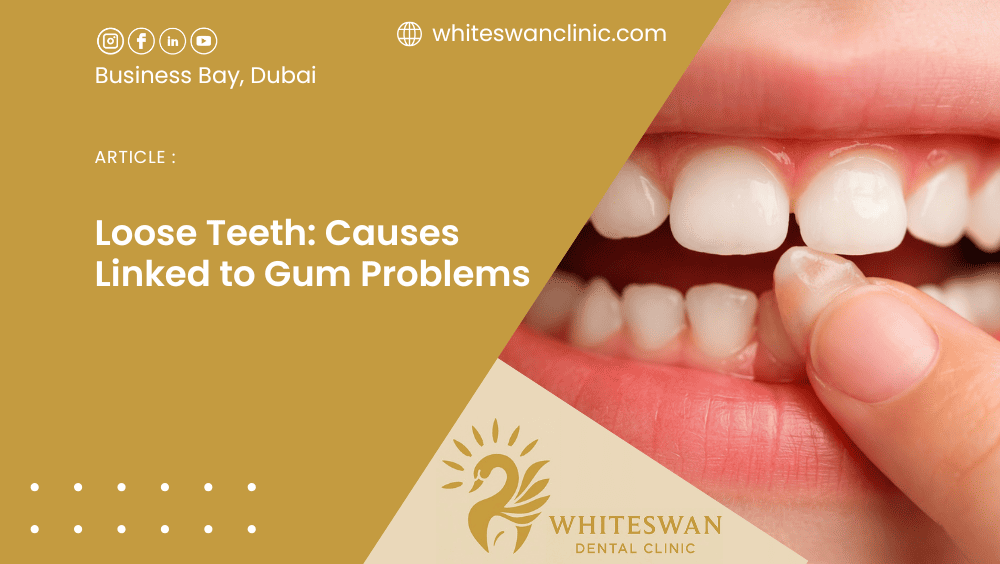
Feeling a tooth that is even slightly “wobbly” can rattle your confidence quickly. You chew on one side, you don’t eat crunchy stuff and you keep checking the mirror as though things will miraculously change. If you’re suffering through this, let me tell you: Loose teeth are not normal, very much the opposite of it, and especially so in adults. And most of the time, the actual reason is around the tooth — not in it. It’s the gums.
At White Swan Dental Clinic, we see many patients who come in saying, “Doctor, it’s just slightly moving.” In most of those cases, that “slight movement” is linked to gum problems, usually gum disease that has been quietly building for months or even years.
This article focuses on loose teeth associated with gum problems, including the primary causes of ‘tooth mobility,’ and what you can do to save the tooth from further damage.
How Gums Hold Teeth in Place
Your tooth is not just stuck into the jaw like a nail in wood. It’s supported by a full system:
- Gums wrap around the tooth and act like a seal
- A thin tissue called the periodontal ligament holds the tooth like a cushion
- The jawbone supports the root & keeps it stable
So when gingivitis starts, it is not only bleeding of the gums. It can over time harm the ligament and then may gradually eradicate its supporting bone. That’s when you start to notice that little bit of movement. Looking for a Dental Clinic in Business Bay?
The Most Common Gum-Related Causes of Loose Teeth
1) Gingivitis (Early Gum Infection)
The first stage of gum disease is gingivitis. It typically occurs when plaque simply sits on teeth and gum lines. At this point, the tooth may still be somewhat intact. But the gums provide early warning signs.
Signs you may notice:
- bleeding gums while brushing or flossing
- red, swollen gums
- mild bad breath
If treated early, gingivitis can return the gums to a healthy state. But if it is not paid attention to, it can enter into the next stage where looseness begins.
2) Periodontitis (Advanced Gum Disease)
This is one of the biggest reasons adults develop loose teeth. Periodontitis means infection has gone below the gum line. Bacteria create deep spaces called “pockets,” and these pockets allow more infection to settle in.
Over time, periodontitis can cause:
- gum recession
- deep pockets around teeth
- bone loss around roots
And once the bone support reduces, the tooth loses its grip and starts to move.
Common warning signs:
- gums pulling back and teeth looking longer
- bad breath that doesn’t go away
- pain while biting
- pus or swelling near the gums
- new gaps forming between teeth
3) Gum Recession (Gums Pulling Back)
Many people think gum recession is only “a look problem.” Actually, it’s much more. When gums pull back, the roots become exposed. Those root surfaces attract plaque easily and are harder to clean properly.
So recession can start small, and then slowly lead to gum inflammation, infection, and even bone loss. As a result, recession can increase the risk of loose teeth—especially around the front teeth.
4) Tartar Buildup (Hardened Plaque)
Plaques that stay too long become tartar. And tartar is rough, which means bacteria stick to it easily. Brushing alone cannot remove tartar once it forms.
So tartar keeps irritating the gums every single day. Over time, gum disease develops and the tooth support becomes weaker.
This is why professional scaling and polishing is not just a “cleaning.” It’s a protective treatment.
5) Aggressive Gum Disease (Fast Bone Loss)
Sometimes gum disease progresses faster than usual. It may happen in younger people as well, and it can be linked to genetics or a stronger inflammatory reaction in the body.
If you are young and a tooth feels loose, don’t wait thinking, “It’s probably nothing.” Fast gum disease needs fast treatment.
6) Teeth Grinding (Bruxism) + Gum Problems
Grinding puts heavy pressure on the supporting ligament around teeth. On its own, grinding may cause sensitivity or jaw pain. But when gum disease is already present, grinding can speed up tooth movement.
Clues you may be grinding:
- jaw tightness in the morning
- headaches near the temples
- worn-down tooth edges
- tooth feels loose mostly after waking up
A night guard can reduce pressure and protect your teeth while gums are being treated.
7) Poorly Fitting Crowns or Fillings
Older dental work that doesn’t fit well may trap food and plaque in the margins. Even if it appears OK, the surrounding gum could stay inflamed. If not addressed, this can cause infection to develop under the gum line.
So yes, a loose tooth sometimes can develop around a crown if it’s hard to clean.
8) Smoking and Vaping
If you smoke, blood circulation also gets reduced in the gums. As a result, gum disease can progress silently with fewer bleeding-like symptoms. Gums are fine, many smokers don’t see blood much.
Sadly, by the time a tooth feels loose, the disease may already be advanced.
9) Diabetes and Poor Healing
When blood sugars are not in good control, the body has a tough time fighting infections. That includes gum infections. So diabetes can contribute to gum disease, and speeding the loss of bone.
If you’re a diabetic and notice bleeding or smells from your mouth or gums, or movement in your teeth it’s worth getting yourself an early check up. Get details on Dental Checkup in Business Bay.
Early Symptoms People Usually Ignore (But Shouldn’t)
Loose teeth usually don’t start suddenly. The gums give warnings first. Watch out for:
- bleeding while brushing
- swelling or puffiness near the gum line
- persistent bad breath
- gums pulling back
- tooth sensitivity increasing
- food getting stuck more than before
- a change in bite or teeth shifting
If you see these signs, it’s better to get a gum check-up now than wait until the tooth becomes unstable.
How Dentists Check Loose Teeth
At White Swan Dental Clinic, we don’t just “tap the tooth and guess.” We usually check:
- gum pocket depth measurement
- X-rays to see bone support
- bite pressure evaluation
- signs of infection like pus or abscess
- gum recession and inflammation levels
This helps us find the real cause and choose the right treatment plan. Looking for a General Dentistry in Business Bay?
Treatment Options for Loose Teeth Caused by Gum Problems
1) Scaling and Root Planing (Deep Cleaning)
This is a deeper cleaning done under the gums. It removes tartar, bacteria, and infection from the root surfaces. After that, gums can heal and tighten.
Many patients feel a big difference in bleeding and swelling after deep cleaning.
2) Periodontal Maintenance
Gum disease can return if bacteria builds up again. That’s why regular maintenance visits are important, especially if you had periodontitis.
3) Splinting (Stabilising the Tooth)
If a tooth is loose, but still repairable, your dentist may splint it to neighboring teeth. This decreases movement while the healing process is taking place.
4) Night Guard for Grinding
If grinding is a major factor, a custom night guard protects teeth and reduces pressure on the ligament.
5) Advanced Gum Treatment
In cases of deep pockets or severe bone loss, additional therapy may be required. such as:
- local antibiotics inside pockets
- gum surgery for deeper cleaning
- bone grafting or regenerative treatment (when possible)
6) Tooth Removal and Replacement (Only if Needed)
Extraction (removing the tooth) may be advised to prevent the spread of infection if the tooth can’t be saved. From then onwards replacement options could be:
- implant (when gums and bone are stable)
- bridge
- partial denture
Related Articles:
» When to Replace Old Fillings: Signs You Shouldn’t Ignore?
» Dental Abscess: Warning Signs That Need Immediate Care
» Sensitive Teeth: Causes and Fixes
» Implant Maintenance: Hygiene Tips for Long-Term Success
» Root Canal vs Extraction + Implant
How to Prevent Loose Teeth from Gum Disease
Small habits matter a lot here:
- brush twice daily with a soft brush
- floss daily or use interdental brushes
- do professional cleaning regularly
- don’t ignore gum bleeding
- reduce or stop smoking/vaping
- manage diabetes and overall health
- wear a night guard if you grind
- book a check-up if you see gum recession
From Gums to Teeth: How Health Impacts Your Smile
The loose tooth is not something you “wait and see.” The cause, in many instances, is gum disease, and gum disease is insidious but inexorable. The sooner you treat it, the better your chance of saving your natural tooth.
FAQs on “Loose Teeth: Causes Linked to Gum Problems”
Yes. Periodontitis damages bone and ligament support, and that causes looseness.
Usually no. However, early gum treatment can often stabilize i
Not always. If caught early, teeth can tighten after gum care and bite control.
Bleeding typically indicates inflammation, which is often caused by plaque buildup or an infection in the gums.
It’s good for bacteria, but it doesn’t touch tartar or keep you from losing bone all on its own.
Yes. If tartar hardens for a long period of time it can cause infections in the gums, resulting in loss of bone.
Local anaesthesia is sufficient in most patients. Mild soreness can happen after.
Many people feel improvement within 1–2 weeks. Deeper healing may take longer.
Temporary looseness can occur during orthodontic movement. Gum disease is different and needs treatment.
If grinding is involved, yes. It reduces extra pressure on the tooth.
Often yes. Smoking cuts the blood supply to the gums, and disease can become advanced without symptoms.
As soon as you notice it. Early care improves the chance of saving the tooth.